Mehmet Hanifi Doğru , Murat Kalak , Burak Şahin , Eyüp Yeter , Kursad Gov
{"title":"A comparative experimental study on abrasive flow machining vs flow peening GOV processes on Inconel 718","authors":"Mehmet Hanifi Doğru , Murat Kalak , Burak Şahin , Eyüp Yeter , Kursad Gov","doi":"10.1016/j.surfin.2024.105243","DOIUrl":null,"url":null,"abstract":"<div><div>Inconel 718, a nickel-based super alloy, has a broad applications area from aerospace, medical and defence to traditional industries because of its high durability, corrosion resistance and elevated temperature performance. Unconventional surface treatment methods of abrasive flow machining (AFM) and shot peening (SP) are applied to improve the mechanical performance of Inconel 718. In this work, a new surface treatment process known as flow peening (GOV) already developed by combining the advantages of abrasive flow machining (AFM) and shot peening methods such as surface finishing and residual compressive stress generation respectively was applied experimentally for Inconel 718. The effects of process parameters for GOV and AFM processes on the surface quality of the specimens were experimentally investigated. White layer decrease, surface roughness decrease and material removal amount were discussed for both processes. The best surface quality with 0.56 μm R<sub>a</sub> surface roughness value and material removal amount of 7.2 mg were obtained by GOV process while similar level of surface roughness value of 0.52 μm was obtained by removing 6648.03 mg material for AFM. When the AFM process was continued, the best values of 0.24 μm R<sub>a</sub> was obtained removing excess material of 17,385.60 mg compared to the GOV process. Also, all these results were supported by SEM images.</div></div>","PeriodicalId":22081,"journal":{"name":"Surfaces and Interfaces","volume":"55 ","pages":"Article 105243"},"PeriodicalIF":6.3000,"publicationDate":"2024-12-01","publicationTypes":"Journal Article","fieldsOfStudy":null,"isOpenAccess":false,"openAccessPdf":"","citationCount":"0","resultStr":null,"platform":"Semanticscholar","paperid":null,"PeriodicalName":"Surfaces and Interfaces","FirstCategoryId":"88","ListUrlMain":"https://www.sciencedirect.com/science/article/pii/S2468023024013993","RegionNum":2,"RegionCategory":"材料科学","ArticlePicture":[],"TitleCN":null,"AbstractTextCN":null,"PMCID":null,"EPubDate":"2024/10/24 0:00:00","PubModel":"Epub","JCR":"Q2","JCRName":"CHEMISTRY, PHYSICAL","Score":null,"Total":0}
引用次数: 0
Abstract
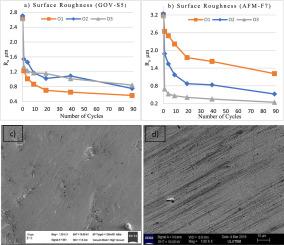
Inconel 718, a nickel-based super alloy, has a broad applications area from aerospace, medical and defence to traditional industries because of its high durability, corrosion resistance and elevated temperature performance. Unconventional surface treatment methods of abrasive flow machining (AFM) and shot peening (SP) are applied to improve the mechanical performance of Inconel 718. In this work, a new surface treatment process known as flow peening (GOV) already developed by combining the advantages of abrasive flow machining (AFM) and shot peening methods such as surface finishing and residual compressive stress generation respectively was applied experimentally for Inconel 718. The effects of process parameters for GOV and AFM processes on the surface quality of the specimens were experimentally investigated. White layer decrease, surface roughness decrease and material removal amount were discussed for both processes. The best surface quality with 0.56 μm Ra surface roughness value and material removal amount of 7.2 mg were obtained by GOV process while similar level of surface roughness value of 0.52 μm was obtained by removing 6648.03 mg material for AFM. When the AFM process was continued, the best values of 0.24 μm Ra was obtained removing excess material of 17,385.60 mg compared to the GOV process. Also, all these results were supported by SEM images.
期刊介绍:
The aim of the journal is to provide a respectful outlet for ''sound science'' papers in all research areas on surfaces and interfaces. We define sound science papers as papers that describe new and well-executed research, but that do not necessarily provide brand new insights or are merely a description of research results.
Surfaces and Interfaces publishes research papers in all fields of surface science which may not always find the right home on first submission to our Elsevier sister journals (Applied Surface, Surface and Coatings Technology, Thin Solid Films)




 京公网安备 11010802042870号
京ICP备2023020795号-1
京公网安备 11010802042870号
京ICP备2023020795号-1

 分享
分享
 求助内容:
求助内容: 应助结果提醒方式:
 扫码关注我们
