Dae Hwan Lee, Chanhyeok Kim, Giwon Shin, Geoneop Choi, Sang Shin Park, Taiho Park and Sung Yun Son
{"title":"Recent advances in the synergistic effects of organic conjugated materials and quantum dots on solar cells","authors":"Dae Hwan Lee, Chanhyeok Kim, Giwon Shin, Geoneop Choi, Sang Shin Park, Taiho Park and Sung Yun Son","doi":"10.1039/D4TA04233F","DOIUrl":null,"url":null,"abstract":"<p >Quantum dot solar cells (QDSCs) have been noted for their exceptional optoelectronic properties, including strong light absorption and a tunable bandgap, which are vital for photovoltaic applications. However, quantum dots (QDs) are limited by their electronic properties and stability owing to the insulating nature of hydrocarbon ligands. The integration of organic conjugated materials (OCMs) into QDSCs has emerged as a promising strategy for overcoming these challenges by exploiting their multiple roles in QDSCs. In this review, we discuss and categorize the synergistic effects between OCMs and QDs in QDSCs, which accentuate crucial performance factors such as charge extraction and interdot conductivity, as well as recent research strategies for incorporating OCMs. Furthermore, we outline the fundamental principles for the efficient design of OCMs in QDSCs and offer strategic guidance for the development of high-performance QDSCs. We believe that this review provides in-depth insights necessary for creating new avenues for the development of advanced QDSCs.</p>","PeriodicalId":82,"journal":{"name":"Journal of Materials Chemistry A","volume":" 46","pages":" 31740-31768"},"PeriodicalIF":9.5000,"publicationDate":"2024-11-05","publicationTypes":"Journal Article","fieldsOfStudy":null,"isOpenAccess":false,"openAccessPdf":"","citationCount":"0","resultStr":null,"platform":"Semanticscholar","paperid":null,"PeriodicalName":"Journal of Materials Chemistry A","FirstCategoryId":"88","ListUrlMain":"https://pubs.rsc.org/en/content/articlelanding/2024/ta/d4ta04233f","RegionNum":2,"RegionCategory":"材料科学","ArticlePicture":[],"TitleCN":null,"AbstractTextCN":null,"PMCID":null,"EPubDate":"","PubModel":"","JCR":"Q1","JCRName":"CHEMISTRY, PHYSICAL","Score":null,"Total":0}
引用次数: 0
Abstract
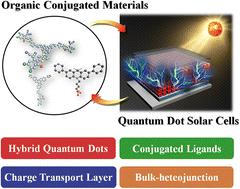
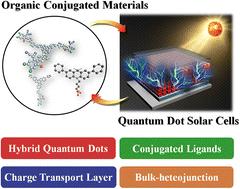
Quantum dot solar cells (QDSCs) have been noted for their exceptional optoelectronic properties, including strong light absorption and a tunable bandgap, which are vital for photovoltaic applications. However, quantum dots (QDs) are limited by their electronic properties and stability owing to the insulating nature of hydrocarbon ligands. The integration of organic conjugated materials (OCMs) into QDSCs has emerged as a promising strategy for overcoming these challenges by exploiting their multiple roles in QDSCs. In this review, we discuss and categorize the synergistic effects between OCMs and QDs in QDSCs, which accentuate crucial performance factors such as charge extraction and interdot conductivity, as well as recent research strategies for incorporating OCMs. Furthermore, we outline the fundamental principles for the efficient design of OCMs in QDSCs and offer strategic guidance for the development of high-performance QDSCs. We believe that this review provides in-depth insights necessary for creating new avenues for the development of advanced QDSCs.
期刊介绍:
The Journal of Materials Chemistry A, B & C covers a wide range of high-quality studies in the field of materials chemistry, with each section focusing on specific applications of the materials studied. Journal of Materials Chemistry A emphasizes applications in energy and sustainability, including topics such as artificial photosynthesis, batteries, and fuel cells. Journal of Materials Chemistry B focuses on applications in biology and medicine, while Journal of Materials Chemistry C covers applications in optical, magnetic, and electronic devices. Example topic areas within the scope of Journal of Materials Chemistry A include catalysis, green/sustainable materials, sensors, and water treatment, among others.



 京公网安备 11010802042870号
京ICP备2023020795号-1
京公网安备 11010802042870号
京ICP备2023020795号-1

 分享
分享
 求助内容:
求助内容: 应助结果提醒方式:
 扫码关注我们
