{"title":"Electron transfer mediated activation of periodate by contaminants to generate 1O2 by charge-confined single-atom catalyst","authors":"Qianqian Tang, Bangxiang Wu, Xiaowen Huang, Wei Ren, Lingling Liu, Lei Tian, Ying Chen, Long-Shuai Zhang, Qing Sun, Zhibing Kang, Tianyi Ma, Jian-Ping Zou","doi":"10.1038/s41467-024-53941-8","DOIUrl":null,"url":null,"abstract":"<p>The electron transfer process (ETP) is able to avoid the redox cycling of catalysts by capturing electrons from contaminants directly. However, the ETP usually leads to the formation of oligomers and the reduction of oxidants to anions. Herein, the charge-confined Fe single-atom catalyst (Fe/SCN) with Fe-N<sub>3</sub>S<sub>1</sub> configuration was designed to achieve ETP-mediated contaminant activation of the oxidant by limiting the number of electrons gained by the oxidant to generate <sup>1</sup>O<sub>2</sub>. The Fe/SCN-activate periodate (PI) system shows excellent contaminant degradation performance due to the combination of ETP and <sup>1</sup>O<sub>2</sub>. Experiments and DFT calculations show that the Fe/SCN-PI* complex with strong oxidizing ability triggers the ETP, while the charge-confined effect allows the single-electronic activation of PI to generate <sup>1</sup>O<sub>2</sub>. In the Fe/SCN + PI system, the 100% selectivity dechlorination of ETP and the ring-opening of <sup>1</sup>O<sub>2</sub> avoid the generation of oligomers and realize the transformation of large-molecule contaminants into small-molecule biodegradable products. Furthermore, the Fe/SCN + PI system shows excellent anti-interference ability and application potential. This work pioneers the generation of active species using ETP’s electron to activate oxidants, which provides a perspective on the design of single-atom catalysts via the charge-confined effect.</p>","PeriodicalId":19066,"journal":{"name":"Nature Communications","volume":"140 1","pages":""},"PeriodicalIF":15.7000,"publicationDate":"2024-11-05","publicationTypes":"Journal Article","fieldsOfStudy":null,"isOpenAccess":false,"openAccessPdf":"","citationCount":"0","resultStr":null,"platform":"Semanticscholar","paperid":null,"PeriodicalName":"Nature Communications","FirstCategoryId":"103","ListUrlMain":"https://doi.org/10.1038/s41467-024-53941-8","RegionNum":1,"RegionCategory":"综合性期刊","ArticlePicture":[],"TitleCN":null,"AbstractTextCN":null,"PMCID":null,"EPubDate":"","PubModel":"","JCR":"Q1","JCRName":"MULTIDISCIPLINARY SCIENCES","Score":null,"Total":0}
引用次数: 0
Abstract
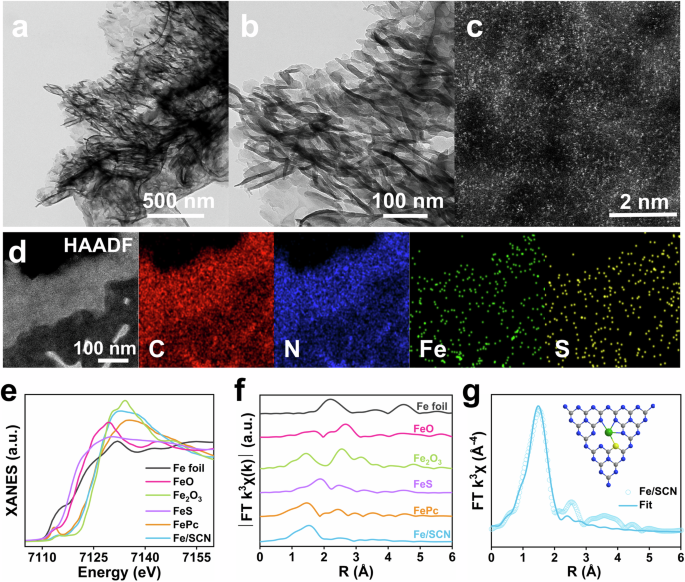
The electron transfer process (ETP) is able to avoid the redox cycling of catalysts by capturing electrons from contaminants directly. However, the ETP usually leads to the formation of oligomers and the reduction of oxidants to anions. Herein, the charge-confined Fe single-atom catalyst (Fe/SCN) with Fe-N3S1 configuration was designed to achieve ETP-mediated contaminant activation of the oxidant by limiting the number of electrons gained by the oxidant to generate 1O2. The Fe/SCN-activate periodate (PI) system shows excellent contaminant degradation performance due to the combination of ETP and 1O2. Experiments and DFT calculations show that the Fe/SCN-PI* complex with strong oxidizing ability triggers the ETP, while the charge-confined effect allows the single-electronic activation of PI to generate 1O2. In the Fe/SCN + PI system, the 100% selectivity dechlorination of ETP and the ring-opening of 1O2 avoid the generation of oligomers and realize the transformation of large-molecule contaminants into small-molecule biodegradable products. Furthermore, the Fe/SCN + PI system shows excellent anti-interference ability and application potential. This work pioneers the generation of active species using ETP’s electron to activate oxidants, which provides a perspective on the design of single-atom catalysts via the charge-confined effect.
期刊介绍:
Nature Communications, an open-access journal, publishes high-quality research spanning all areas of the natural sciences. Papers featured in the journal showcase significant advances relevant to specialists in each respective field. With a 2-year impact factor of 16.6 (2022) and a median time of 8 days from submission to the first editorial decision, Nature Communications is committed to rapid dissemination of research findings. As a multidisciplinary journal, it welcomes contributions from biological, health, physical, chemical, Earth, social, mathematical, applied, and engineering sciences, aiming to highlight important breakthroughs within each domain.



 京公网安备 11010802042870号
京ICP备2023020795号-1
京公网安备 11010802042870号
京ICP备2023020795号-1

 分享
分享
 求助内容:
求助内容: 应助结果提醒方式:
 扫码关注我们
