{"title":"In situ analysis of a boron-based catalytic electrode with trace platinum for efficient hydrogen evolution in a wide pH range†","authors":"Xunwei Ma, Yifan Zhang, Liugang Wu, Zijun Huang, Jiyuan Yang, Chunguang Chen, Shengwei Deng, Lincai Wang, Jian Chen and Weiju Hao","doi":"10.1039/D4TA05770H","DOIUrl":null,"url":null,"abstract":"<p >The development of highly active and cost-effective catalytic electrodes that function effectively across a wide range of pH values is one of the challenges to achieving efficient and stable hydrogen production <em>via</em> electrolytic water. This work constructs a self-supported catalytic electrode (Pt-NiB@NF) by growing boron-based catalytic materials <em>in situ</em> on nickel foam (NF) through mild electroless plating and then rapidly “decorating” trace amounts of platinum (Pt) on the precursor surface <em>via</em> electrodeposition. Decorating with trace amounts of Pt (0.58 wt%) achieves a 3.5-fold enhancement in the performance of NiB@NF. Pt-NiB@NF exhibits low hydrogen evolution reaction (HER) overpotentials of 70 mV and 12 mV at a current density of 100 mA cm<small><sup>−2</sup></small> in neutral high-salt media and alkaline environments, respectively. Meanwhile, Pt-NiB@NF demonstrates long-term stability at industrial-scale current densities, maintaining for 120 hours at 100 mA cm<small><sup>−2</sup></small> in neutral high-salt media and for 1200 hours at 500 mA cm<small><sup>−2</sup></small> in alkaline electrolyte. The strategy of mild electroless plating and rapid electroplating realizes large-area electrode preparation for assembling a proton exchange membrane electrolyzer, more promising for industry-grade hydrogen production <em>via</em> water splitting. This work provides an optimized solution for the commercialization and large-scale production of high-performance Pt-based electrodes through a simple preparation strategy.</p>","PeriodicalId":82,"journal":{"name":"Journal of Materials Chemistry A","volume":" 48","pages":" 33649-33660"},"PeriodicalIF":9.5000,"publicationDate":"2024-11-06","publicationTypes":"Journal Article","fieldsOfStudy":null,"isOpenAccess":false,"openAccessPdf":"","citationCount":"0","resultStr":null,"platform":"Semanticscholar","paperid":null,"PeriodicalName":"Journal of Materials Chemistry A","FirstCategoryId":"88","ListUrlMain":"https://pubs.rsc.org/en/content/articlelanding/2024/ta/d4ta05770h","RegionNum":2,"RegionCategory":"材料科学","ArticlePicture":[],"TitleCN":null,"AbstractTextCN":null,"PMCID":null,"EPubDate":"","PubModel":"","JCR":"Q1","JCRName":"CHEMISTRY, PHYSICAL","Score":null,"Total":0}
引用次数: 0
Abstract
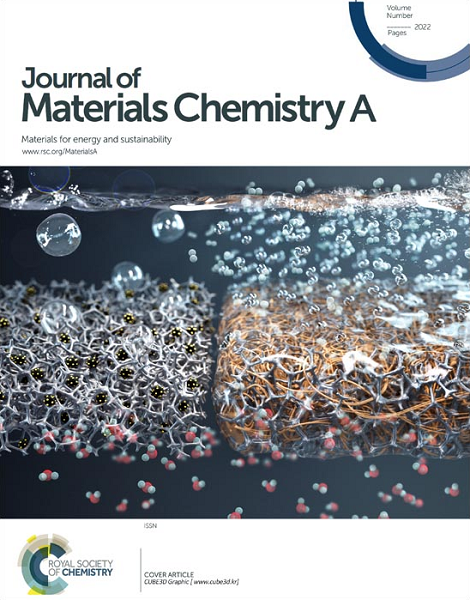
The development of highly active and cost-effective catalytic electrodes that function effectively across a wide range of pH values is one of the challenges to achieving efficient and stable hydrogen production via electrolytic water. This work constructs a self-supported catalytic electrode (Pt-NiB@NF) by growing boron-based catalytic materials in situ on nickel foam (NF) through mild electroless plating and then rapidly “decorating” trace amounts of platinum (Pt) on the precursor surface via electrodeposition. Decorating with trace amounts of Pt (0.58 wt%) achieves a 3.5-fold enhancement in the performance of NiB@NF. Pt-NiB@NF exhibits low hydrogen evolution reaction (HER) overpotentials of 70 mV and 12 mV at a current density of 100 mA cm−2 in neutral high-salt media and alkaline environments, respectively. Meanwhile, Pt-NiB@NF demonstrates long-term stability at industrial-scale current densities, maintaining for 120 hours at 100 mA cm−2 in neutral high-salt media and for 1200 hours at 500 mA cm−2 in alkaline electrolyte. The strategy of mild electroless plating and rapid electroplating realizes large-area electrode preparation for assembling a proton exchange membrane electrolyzer, more promising for industry-grade hydrogen production via water splitting. This work provides an optimized solution for the commercialization and large-scale production of high-performance Pt-based electrodes through a simple preparation strategy.
期刊介绍:
The Journal of Materials Chemistry A, B & C covers a wide range of high-quality studies in the field of materials chemistry, with each section focusing on specific applications of the materials studied. Journal of Materials Chemistry A emphasizes applications in energy and sustainability, including topics such as artificial photosynthesis, batteries, and fuel cells. Journal of Materials Chemistry B focuses on applications in biology and medicine, while Journal of Materials Chemistry C covers applications in optical, magnetic, and electronic devices. Example topic areas within the scope of Journal of Materials Chemistry A include catalysis, green/sustainable materials, sensors, and water treatment, among others.




 京公网安备 11010802042870号
京ICP备2023020795号-1
京公网安备 11010802042870号
京ICP备2023020795号-1

 分享
分享
 求助内容:
求助内容: 应助结果提醒方式:
 扫码关注我们
