Alexandra D. Easley, Cheng-Han Li, Shih-Guo Li, Tan P. Nguyen, Kai-Hua Mick Kuo, Karen L. Wooley, Daniel P. Tabor and Jodie L. Lutkenhaus
{"title":"Electron transport kinetics for viologen-containing polypeptides with varying side group linker spacing†","authors":"Alexandra D. Easley, Cheng-Han Li, Shih-Guo Li, Tan P. Nguyen, Kai-Hua Mick Kuo, Karen L. Wooley, Daniel P. Tabor and Jodie L. Lutkenhaus","doi":"10.1039/D4TA06766E","DOIUrl":null,"url":null,"abstract":"<p >Studies investigating the influence of the length of linkers between redox-active moieties and peptide-based polymer backbones were conducted to advance fundamental knowledge toward the design and development of sustainably-sourced, recyclable, and degradable materials for energy applications. In this work, precursor polypeptides were synthesized through the ring-opening polymerizations of <em>N</em>-carboxyanhydrides decorated with varying lengths of alkylchloride side chain groups, followed by post-polymerization installation of the viologen moieties. Electrochemical interrogation of the viologen-based polypeptides provided estimates of the electron transfer rate constants, both heterogeneous (<em>k</em><small><sup>0</sup></small>) and electron self-exchange (<em>k</em><small><sub>ex</sub></small>), the apparent diffusion coefficient (<em>D</em><small><sub>ap</sub></small>), and their device-based energy storage performance. For the first redox couple (viologen dication state to viologen radical-cation state), it was found that the rate of electron transfer among the pendant groups in all viologen-based polypeptides, <em>k</em><small><sub>ex</sub></small>, was not significantly impacted by linker length. In contrast, for the second redox couple (viologen radical-cation state to the neutral viologen), <em>k</em><small><sub>ex</sub></small> varied with linker length and was fastest during reduction from the viologen radical-cation state to the neutral viologen. Most interestingly, a linear relationship was identified between log(<em>k</em><small><sup>0</sup></small>) and log(<em>k</em><small><sub>ex</sub></small>) with a slope of 1.85, indicating that electron transport in the viologen-based polypeptides followed most closely to Marcus–Hush theory with diffusion limitations or Laviron–Andrieux–Savéant (LAS) theory. Finally, the polypeptides were studied in lithium metal half cells to determine the relationship between <em>k</em><small><sub>ex</sub></small> and energy storage performance. The viologen-based polypeptide with the moderate length linker exhibited the highest capacity and lowest degree of swelling, but only moderate <em>k</em><small><sub>ex</sub></small>, demonstrating that the device performance was primarily influenced electrode swelling. Taken together, the viologen-polypeptide backbone dictated the mechanism of electron transfer, whereas the linker length could be used to alter the rate of electron transfer (<em>k</em><small><sub>ex</sub></small>). Balancing the rate of electron transfer (<em>k</em><small><sub>ex</sub></small>) and degree of swelling will be a major challenge to identify polymers for high performance energy storage devices.</p>","PeriodicalId":82,"journal":{"name":"Journal of Materials Chemistry A","volume":" 46","pages":" 31871-31882"},"PeriodicalIF":9.5000,"publicationDate":"2024-11-06","publicationTypes":"Journal Article","fieldsOfStudy":null,"isOpenAccess":false,"openAccessPdf":"https://pubs.rsc.org/en/content/articlepdf/2024/ta/d4ta06766e?page=search","citationCount":"0","resultStr":null,"platform":"Semanticscholar","paperid":null,"PeriodicalName":"Journal of Materials Chemistry A","FirstCategoryId":"88","ListUrlMain":"https://pubs.rsc.org/en/content/articlelanding/2024/ta/d4ta06766e","RegionNum":2,"RegionCategory":"材料科学","ArticlePicture":[],"TitleCN":null,"AbstractTextCN":null,"PMCID":null,"EPubDate":"","PubModel":"","JCR":"Q1","JCRName":"CHEMISTRY, PHYSICAL","Score":null,"Total":0}
引用次数: 0
Abstract
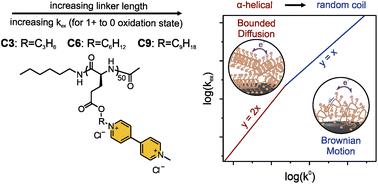
Studies investigating the influence of the length of linkers between redox-active moieties and peptide-based polymer backbones were conducted to advance fundamental knowledge toward the design and development of sustainably-sourced, recyclable, and degradable materials for energy applications. In this work, precursor polypeptides were synthesized through the ring-opening polymerizations of N-carboxyanhydrides decorated with varying lengths of alkylchloride side chain groups, followed by post-polymerization installation of the viologen moieties. Electrochemical interrogation of the viologen-based polypeptides provided estimates of the electron transfer rate constants, both heterogeneous (k0) and electron self-exchange (kex), the apparent diffusion coefficient (Dap), and their device-based energy storage performance. For the first redox couple (viologen dication state to viologen radical-cation state), it was found that the rate of electron transfer among the pendant groups in all viologen-based polypeptides, kex, was not significantly impacted by linker length. In contrast, for the second redox couple (viologen radical-cation state to the neutral viologen), kex varied with linker length and was fastest during reduction from the viologen radical-cation state to the neutral viologen. Most interestingly, a linear relationship was identified between log(k0) and log(kex) with a slope of 1.85, indicating that electron transport in the viologen-based polypeptides followed most closely to Marcus–Hush theory with diffusion limitations or Laviron–Andrieux–Savéant (LAS) theory. Finally, the polypeptides were studied in lithium metal half cells to determine the relationship between kex and energy storage performance. The viologen-based polypeptide with the moderate length linker exhibited the highest capacity and lowest degree of swelling, but only moderate kex, demonstrating that the device performance was primarily influenced electrode swelling. Taken together, the viologen-polypeptide backbone dictated the mechanism of electron transfer, whereas the linker length could be used to alter the rate of electron transfer (kex). Balancing the rate of electron transfer (kex) and degree of swelling will be a major challenge to identify polymers for high performance energy storage devices.
期刊介绍:
The Journal of Materials Chemistry A, B & C covers a wide range of high-quality studies in the field of materials chemistry, with each section focusing on specific applications of the materials studied. Journal of Materials Chemistry A emphasizes applications in energy and sustainability, including topics such as artificial photosynthesis, batteries, and fuel cells. Journal of Materials Chemistry B focuses on applications in biology and medicine, while Journal of Materials Chemistry C covers applications in optical, magnetic, and electronic devices. Example topic areas within the scope of Journal of Materials Chemistry A include catalysis, green/sustainable materials, sensors, and water treatment, among others.




 京公网安备 11010802042870号
京ICP备2023020795号-1
京公网安备 11010802042870号
京ICP备2023020795号-1

 分享
分享
 求助内容:
求助内容: 应助结果提醒方式:
 扫码关注我们
