{"title":"Accelerating the Discovery of New, Single Phase High Entropy Ceramics via Active Learning","authors":"Calen J. Leverant, Jacob A. Harvey","doi":"10.1021/acs.chemmater.4c00303","DOIUrl":null,"url":null,"abstract":"High-entropy ceramics have garnered interest due to their remarkable hardness, compressive strength, thermal stability, and fracture toughness; yet the discovery of new high-entropy ceramics (out of a tremendous number of possible elemental permutations) still largely requires costly, inefficient, trial-and-error experimental and computational approaches. The entropy forming ability (EFA) factor was recently proposed as a computational descriptor that positively correlates with the likelihood that a 5-metal high-entropy carbide (HECs) will form the desired single phase, homogeneous solid solution; however, discovery of new compositions is computationally expensive. If you consider 8 candidate metals, the HEC EFA approach uses 49 optimizations for each of the 56 unique 5-metal carbides, requiring a total of 2744 costly density functional theory calculations. Here, we describe an orders-of-magnitude more efficient active learning (AL) approach for identifying novel HECs. To begin, we compared numerous methods for generating composition-based feature vectors (e.g., magpie and mat2vec), deployed an ensemble of machine learning (ML) models to generate an average and distribution of predictions, and then utilized the distribution as an uncertainty. We then deployed an AL approach to extract new training data points where the ensemble of ML models predicted a high EFA value or was uncertain of the prediction. Our approach has the combined benefit of decreasing the amount of training data required to reach acceptable prediction qualities and biases the predictions toward identifying HECs with the desired high EFA values, which are tentatively correlated with the formation of single phase HECs. Using this approach, we increased the number of 5-metal carbides screened from 56 to 15,504, revealing 4 compositions with record-high EFA values that were previously unreported in the literature. Our AL framework is also generalizable and could be modified to rationally predict optimized candidate materials/combinations with a wide range of desired properties (e.g., mechanical stability, thermal conductivity).","PeriodicalId":33,"journal":{"name":"Chemistry of Materials","volume":"33 1","pages":""},"PeriodicalIF":7.0000,"publicationDate":"2024-11-05","publicationTypes":"Journal Article","fieldsOfStudy":null,"isOpenAccess":false,"openAccessPdf":"","citationCount":"0","resultStr":null,"platform":"Semanticscholar","paperid":null,"PeriodicalName":"Chemistry of Materials","FirstCategoryId":"88","ListUrlMain":"https://doi.org/10.1021/acs.chemmater.4c00303","RegionNum":2,"RegionCategory":"材料科学","ArticlePicture":[],"TitleCN":null,"AbstractTextCN":null,"PMCID":null,"EPubDate":"","PubModel":"","JCR":"Q2","JCRName":"CHEMISTRY, PHYSICAL","Score":null,"Total":0}
引用次数: 0
Abstract
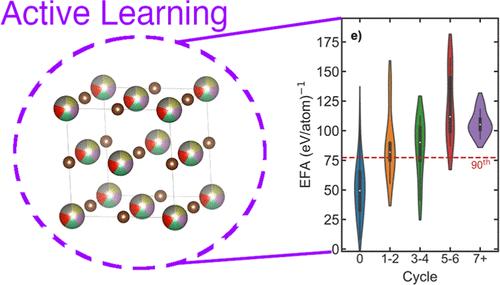
High-entropy ceramics have garnered interest due to their remarkable hardness, compressive strength, thermal stability, and fracture toughness; yet the discovery of new high-entropy ceramics (out of a tremendous number of possible elemental permutations) still largely requires costly, inefficient, trial-and-error experimental and computational approaches. The entropy forming ability (EFA) factor was recently proposed as a computational descriptor that positively correlates with the likelihood that a 5-metal high-entropy carbide (HECs) will form the desired single phase, homogeneous solid solution; however, discovery of new compositions is computationally expensive. If you consider 8 candidate metals, the HEC EFA approach uses 49 optimizations for each of the 56 unique 5-metal carbides, requiring a total of 2744 costly density functional theory calculations. Here, we describe an orders-of-magnitude more efficient active learning (AL) approach for identifying novel HECs. To begin, we compared numerous methods for generating composition-based feature vectors (e.g., magpie and mat2vec), deployed an ensemble of machine learning (ML) models to generate an average and distribution of predictions, and then utilized the distribution as an uncertainty. We then deployed an AL approach to extract new training data points where the ensemble of ML models predicted a high EFA value or was uncertain of the prediction. Our approach has the combined benefit of decreasing the amount of training data required to reach acceptable prediction qualities and biases the predictions toward identifying HECs with the desired high EFA values, which are tentatively correlated with the formation of single phase HECs. Using this approach, we increased the number of 5-metal carbides screened from 56 to 15,504, revealing 4 compositions with record-high EFA values that were previously unreported in the literature. Our AL framework is also generalizable and could be modified to rationally predict optimized candidate materials/combinations with a wide range of desired properties (e.g., mechanical stability, thermal conductivity).
期刊介绍:
The journal Chemistry of Materials focuses on publishing original research at the intersection of materials science and chemistry. The studies published in the journal involve chemistry as a prominent component and explore topics such as the design, synthesis, characterization, processing, understanding, and application of functional or potentially functional materials. The journal covers various areas of interest, including inorganic and organic solid-state chemistry, nanomaterials, biomaterials, thin films and polymers, and composite/hybrid materials. The journal particularly seeks papers that highlight the creation or development of innovative materials with novel optical, electrical, magnetic, catalytic, or mechanical properties. It is essential that manuscripts on these topics have a primary focus on the chemistry of materials and represent a significant advancement compared to prior research. Before external reviews are sought, submitted manuscripts undergo a review process by a minimum of two editors to ensure their appropriateness for the journal and the presence of sufficient evidence of a significant advance that will be of broad interest to the materials chemistry community.




 京公网安备 11010802042870号
京ICP备2023020795号-1
京公网安备 11010802042870号
京ICP备2023020795号-1

 分享
分享
 求助内容:
求助内容: 应助结果提醒方式:
 扫码关注我们
