Guining Chen, Haipeng Zhu, Guozhen Liu, Gongping Liu, Wanqin Jin
{"title":"Confinement Effects and Manipulation Strategies of Nanocomposite Membranes towards Molecular Separation","authors":"Guining Chen, Haipeng Zhu, Guozhen Liu, Gongping Liu, Wanqin Jin","doi":"10.1002/anie.202418649","DOIUrl":null,"url":null,"abstract":"<p>Materials featuring well-defined nanoscale channels offer inherent advantages in the selective transport of gases, liquids, and ions, making them pivotal in applications such as molecular separation, catalysis and energy storage. A crucial challenge lies in assembling ordered nanochannel structures and translating these microscopic architectures into macroscopic regular distributions to enhance performance. Nanocomposites provide a promising solution by incorporating nanoscale material (e.g., filler) that significantly enhances macroscale properties of matrix (e.g., polymer). In this review, we spotlight nanocomposite membranes nanocomposite membranes that utilize confinement effects between filler and matrix to precisely control nanochannel apertures, surface properties, and channel distribution for efficient separation of target systems. We discussed the underlying design principles, channel architectures, and strategies for optimizing polymer-filler interfaces and nanochannel manipulation within functional membranes. Emphasis is placed on the fundamental mechanisms of mass transport, and the structure-property-performance relationships within the nanocomposite membranes towards molecular separation. This work aims to provide a comprehensive understanding of how these nanocomposite membranes can be further developed to meet the demands of industrial and environmental applications.</p>","PeriodicalId":125,"journal":{"name":"Angewandte Chemie International Edition","volume":"64 4","pages":""},"PeriodicalIF":16.9000,"publicationDate":"2024-11-07","publicationTypes":"Journal Article","fieldsOfStudy":null,"isOpenAccess":false,"openAccessPdf":"","citationCount":"0","resultStr":null,"platform":"Semanticscholar","paperid":null,"PeriodicalName":"Angewandte Chemie International Edition","FirstCategoryId":"92","ListUrlMain":"https://onlinelibrary.wiley.com/doi/10.1002/anie.202418649","RegionNum":1,"RegionCategory":"化学","ArticlePicture":[],"TitleCN":null,"AbstractTextCN":null,"PMCID":null,"EPubDate":"","PubModel":"","JCR":"Q1","JCRName":"CHEMISTRY, MULTIDISCIPLINARY","Score":null,"Total":0}
引用次数: 0
Abstract
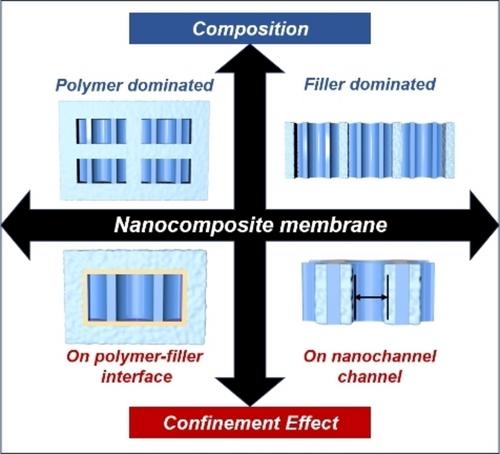
Materials featuring well-defined nanoscale channels offer inherent advantages in the selective transport of gases, liquids, and ions, making them pivotal in applications such as molecular separation, catalysis and energy storage. A crucial challenge lies in assembling ordered nanochannel structures and translating these microscopic architectures into macroscopic regular distributions to enhance performance. Nanocomposites provide a promising solution by incorporating nanoscale material (e.g., filler) that significantly enhances macroscale properties of matrix (e.g., polymer). In this review, we spotlight nanocomposite membranes nanocomposite membranes that utilize confinement effects between filler and matrix to precisely control nanochannel apertures, surface properties, and channel distribution for efficient separation of target systems. We discussed the underlying design principles, channel architectures, and strategies for optimizing polymer-filler interfaces and nanochannel manipulation within functional membranes. Emphasis is placed on the fundamental mechanisms of mass transport, and the structure-property-performance relationships within the nanocomposite membranes towards molecular separation. This work aims to provide a comprehensive understanding of how these nanocomposite membranes can be further developed to meet the demands of industrial and environmental applications.
期刊介绍:
Angewandte Chemie, a journal of the German Chemical Society (GDCh), maintains a leading position among scholarly journals in general chemistry with an impressive Impact Factor of 16.6 (2022 Journal Citation Reports, Clarivate, 2023). Published weekly in a reader-friendly format, it features new articles almost every day. Established in 1887, Angewandte Chemie is a prominent chemistry journal, offering a dynamic blend of Review-type articles, Highlights, Communications, and Research Articles on a weekly basis, making it unique in the field.



 京公网安备 11010802042870号
京ICP备2023020795号-1
京公网安备 11010802042870号
京ICP备2023020795号-1

 分享
分享
 求助内容:
求助内容: 应助结果提醒方式:
 扫码关注我们
