Xujian Mao, Jian Xu, Jingyi Jiang, Qiong Li, Ping Yao, Jinyi Jiang, Li Gong, Yin Dong, Bowen Tu, Rong Wang, Hongbing Tang, Fang Yao, Fengming Wang
{"title":"Iterative crRNA design and a PAM-free strategy enabled an ultra-specific RPA-CRISPR/Cas12a detection platform","authors":"Xujian Mao, Jian Xu, Jingyi Jiang, Qiong Li, Ping Yao, Jinyi Jiang, Li Gong, Yin Dong, Bowen Tu, Rong Wang, Hongbing Tang, Fang Yao, Fengming Wang","doi":"10.1038/s42003-024-07173-7","DOIUrl":null,"url":null,"abstract":"CRISPR/Cas12a is a highly promising detection tool. However, detecting single nucleotide variations (SNVs) remains challenging. Here, we elucidate Cas12a specificity through crRNA engineering and profiling of single- and double-base mismatch tolerance across three targets. Our findings indicate that Cas12a specificity depends on the number, type, location, and distance of mismatches within the R-loop. We also find that introducing a wobble base pair at position 14 of the R-loop does not affect the free energy change when the spacer length is truncated to 17 bp. Therefore, we develop a new universal specificity enhancement strategy via iterative crRNA design, involving truncated spacers and a wobble base pair at position 14 of the R-loop, which tremendously increases specificity without sacrificing sensitivity. Additionally, we construct a PAM-free one-pot detection platform for SARS-CoV-2 variants, which effectively distinguishes SNV targets across various GC contents. In summary, our work reveals new insights into the specificity mechanism of Cas12a and demonstrates significant potential for in vitro diagnostics. A new ultra-specific enhancement strategy for Cas12a via iterative crRNA design. A PAM-free one-pot detection platform for SARS-CoV-2 variants demonstrates significant potential for in vitro diagnostics.","PeriodicalId":10552,"journal":{"name":"Communications Biology","volume":" ","pages":"1-13"},"PeriodicalIF":5.1000,"publicationDate":"2024-11-07","publicationTypes":"Journal Article","fieldsOfStudy":null,"isOpenAccess":false,"openAccessPdf":"https://www.ncbi.nlm.nih.gov/pmc/articles/PMC11541961/pdf/","citationCount":"0","resultStr":null,"platform":"Semanticscholar","paperid":null,"PeriodicalName":"Communications Biology","FirstCategoryId":"99","ListUrlMain":"https://www.nature.com/articles/s42003-024-07173-7","RegionNum":1,"RegionCategory":"生物学","ArticlePicture":[],"TitleCN":null,"AbstractTextCN":null,"PMCID":null,"EPubDate":"","PubModel":"","JCR":"Q1","JCRName":"BIOLOGY","Score":null,"Total":0}
引用次数: 0
Abstract
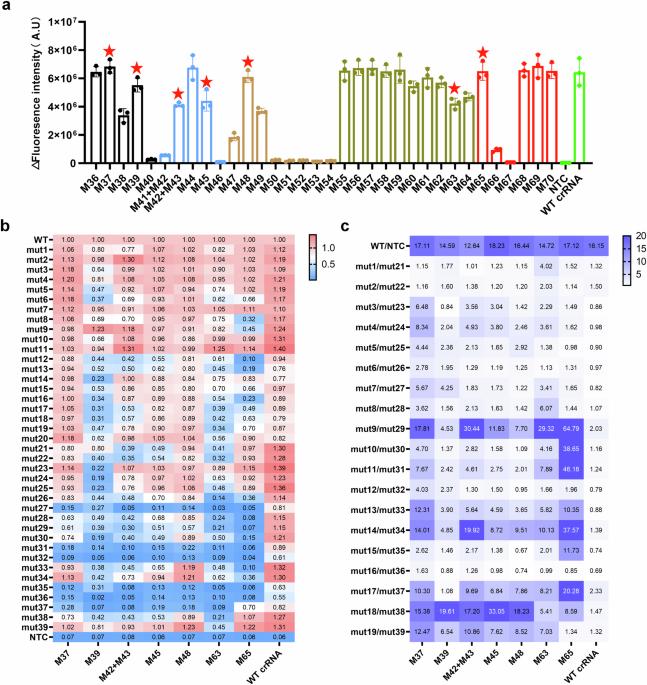
CRISPR/Cas12a is a highly promising detection tool. However, detecting single nucleotide variations (SNVs) remains challenging. Here, we elucidate Cas12a specificity through crRNA engineering and profiling of single- and double-base mismatch tolerance across three targets. Our findings indicate that Cas12a specificity depends on the number, type, location, and distance of mismatches within the R-loop. We also find that introducing a wobble base pair at position 14 of the R-loop does not affect the free energy change when the spacer length is truncated to 17 bp. Therefore, we develop a new universal specificity enhancement strategy via iterative crRNA design, involving truncated spacers and a wobble base pair at position 14 of the R-loop, which tremendously increases specificity without sacrificing sensitivity. Additionally, we construct a PAM-free one-pot detection platform for SARS-CoV-2 variants, which effectively distinguishes SNV targets across various GC contents. In summary, our work reveals new insights into the specificity mechanism of Cas12a and demonstrates significant potential for in vitro diagnostics. A new ultra-specific enhancement strategy for Cas12a via iterative crRNA design. A PAM-free one-pot detection platform for SARS-CoV-2 variants demonstrates significant potential for in vitro diagnostics.
期刊介绍:
Communications Biology is an open access journal from Nature Research publishing high-quality research, reviews and commentary in all areas of the biological sciences. Research papers published by the journal represent significant advances bringing new biological insight to a specialized area of research.



 京公网安备 11010802042870号
京ICP备2023020795号-1
京公网安备 11010802042870号
京ICP备2023020795号-1

 分享
分享
 求助内容:
求助内容: 应助结果提醒方式:
 扫码关注我们
