Dan Wang, Yuan Chu, Youzheng Wu, Mengkang Zhu, Lin Pan, Ruopeng Li, Yukai Chen, Wenchang Wang, Naotoshi Mitsuzaki and Zhidong Chen
{"title":"Synergistic coupling of a CuNi alloy with a CoFe LDH heterostructure on nickel foam toward high-efficiency overall water splitting†","authors":"Dan Wang, Yuan Chu, Youzheng Wu, Mengkang Zhu, Lin Pan, Ruopeng Li, Yukai Chen, Wenchang Wang, Naotoshi Mitsuzaki and Zhidong Chen","doi":"10.1039/D4TA05681G","DOIUrl":null,"url":null,"abstract":"<p >Accelerating the kinetics of the oxygen evolution reaction (OER) and hydrogen evolution reaction (HER) is vital for high-efficiency green hydrogen production. However, developing cost-effective and highly active bifunctional catalysts for overall water splitting electrolysis remains a huge challenge. Herein, the CuNi/CoFe LDH heterostructure is synthesized <em>in situ</em> on nickel foam (CuNi/CoFe LDH@NF) by a simple two-step electrodeposition process. The synergy of the CuNi alloy and CoFe LDH optimizes the electron distribution at the interface and improves the intrinsic activity of the HER/OER. Consequently, the optimal CuNi/CoFe LDH@NF bifunctional catalyst displays low overpotentials of 56 mV (10 mA cm<small><sup>−2</sup></small>) and 268 mV (50 mA cm<small><sup>−2</sup></small>) for the HER and OER, respectively, along with high stability in alkaline electrolyte. Remarkably, CuNi/CoFe LDH@NF as the cathode and anode requires a low voltage (1.49 V) to achieve 10 mA cm<small><sup>−2</sup></small> for overall water splitting. Meanwhile, it also displays favorable stability for operation for 17 h (50 mA cm<small><sup>−2</sup></small>) without obvious decline of the cell voltage. Density functional theory calculations indicate that constructing heterojunction interfaces promotes the redistribution of interface electrons and optimizes the free energy of adsorbed intermediates, thereby reducing the energy barrier of the rate-determining step (from *O to *OOH).</p>","PeriodicalId":82,"journal":{"name":"Journal of Materials Chemistry A","volume":" 48","pages":" 33680-33688"},"PeriodicalIF":9.5000,"publicationDate":"2024-11-07","publicationTypes":"Journal Article","fieldsOfStudy":null,"isOpenAccess":false,"openAccessPdf":"","citationCount":"0","resultStr":null,"platform":"Semanticscholar","paperid":null,"PeriodicalName":"Journal of Materials Chemistry A","FirstCategoryId":"88","ListUrlMain":"https://pubs.rsc.org/en/content/articlelanding/2024/ta/d4ta05681g","RegionNum":2,"RegionCategory":"材料科学","ArticlePicture":[],"TitleCN":null,"AbstractTextCN":null,"PMCID":null,"EPubDate":"","PubModel":"","JCR":"Q1","JCRName":"CHEMISTRY, PHYSICAL","Score":null,"Total":0}
引用次数: 0
Abstract
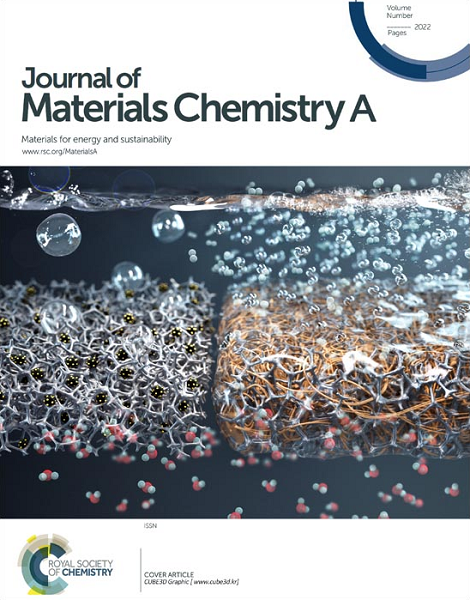
Accelerating the kinetics of the oxygen evolution reaction (OER) and hydrogen evolution reaction (HER) is vital for high-efficiency green hydrogen production. However, developing cost-effective and highly active bifunctional catalysts for overall water splitting electrolysis remains a huge challenge. Herein, the CuNi/CoFe LDH heterostructure is synthesized in situ on nickel foam (CuNi/CoFe LDH@NF) by a simple two-step electrodeposition process. The synergy of the CuNi alloy and CoFe LDH optimizes the electron distribution at the interface and improves the intrinsic activity of the HER/OER. Consequently, the optimal CuNi/CoFe LDH@NF bifunctional catalyst displays low overpotentials of 56 mV (10 mA cm−2) and 268 mV (50 mA cm−2) for the HER and OER, respectively, along with high stability in alkaline electrolyte. Remarkably, CuNi/CoFe LDH@NF as the cathode and anode requires a low voltage (1.49 V) to achieve 10 mA cm−2 for overall water splitting. Meanwhile, it also displays favorable stability for operation for 17 h (50 mA cm−2) without obvious decline of the cell voltage. Density functional theory calculations indicate that constructing heterojunction interfaces promotes the redistribution of interface electrons and optimizes the free energy of adsorbed intermediates, thereby reducing the energy barrier of the rate-determining step (from *O to *OOH).
期刊介绍:
The Journal of Materials Chemistry A, B & C covers a wide range of high-quality studies in the field of materials chemistry, with each section focusing on specific applications of the materials studied. Journal of Materials Chemistry A emphasizes applications in energy and sustainability, including topics such as artificial photosynthesis, batteries, and fuel cells. Journal of Materials Chemistry B focuses on applications in biology and medicine, while Journal of Materials Chemistry C covers applications in optical, magnetic, and electronic devices. Example topic areas within the scope of Journal of Materials Chemistry A include catalysis, green/sustainable materials, sensors, and water treatment, among others.




 京公网安备 11010802042870号
京ICP备2023020795号-1
京公网安备 11010802042870号
京ICP备2023020795号-1

 分享
分享
 求助内容:
求助内容: 应助结果提醒方式:
 扫码关注我们
