{"title":"Organoelectrocatalytic cyclopropanation of alkenyl trifluoroborates with methylene compounds","authors":"Wei Yi, Peng-Cheng Xu, Tianyu He, Shuai Shi, Shenlin Huang","doi":"10.1038/s41467-024-54082-8","DOIUrl":null,"url":null,"abstract":"<p>Cyclopropanes are not only privileged motifs in many natural products, agrochemicals, and pharmaceuticals, but also highly versatile intermediates in synthetic chemistry. As such, great effort has been devoted to the cyclopropane construction. However, novel catalytic methods for cyclopropanation with two abundant substrates, mild conditions, high functional group tolerance, and broad scope are still highly desirable. Herein, we report an intermolecular electrocatalytic cyclopropanation of alkenyl trifluoroborates with methylene compounds. The reaction uses simple diphenyl sulfide as the electrocatalyst under base-free conditions. And thus, a broad scope of various methylene compounds as well as vinyltrifluoroborates is demonstrated, including styrenyl, 1,3-dienyl, fluorosulfonyl, and base-sensitive substrates. Preliminary mechanistic studies are presented, revealing the critical role of the boryl substituent to facilitate the desired pathway and the role of water as the hydrogen atom source.</p>","PeriodicalId":19066,"journal":{"name":"Nature Communications","volume":"243 1","pages":""},"PeriodicalIF":15.7000,"publicationDate":"2024-11-07","publicationTypes":"Journal Article","fieldsOfStudy":null,"isOpenAccess":false,"openAccessPdf":"","citationCount":"0","resultStr":null,"platform":"Semanticscholar","paperid":null,"PeriodicalName":"Nature Communications","FirstCategoryId":"103","ListUrlMain":"https://doi.org/10.1038/s41467-024-54082-8","RegionNum":1,"RegionCategory":"综合性期刊","ArticlePicture":[],"TitleCN":null,"AbstractTextCN":null,"PMCID":null,"EPubDate":"","PubModel":"","JCR":"Q1","JCRName":"MULTIDISCIPLINARY SCIENCES","Score":null,"Total":0}
引用次数: 0
Abstract
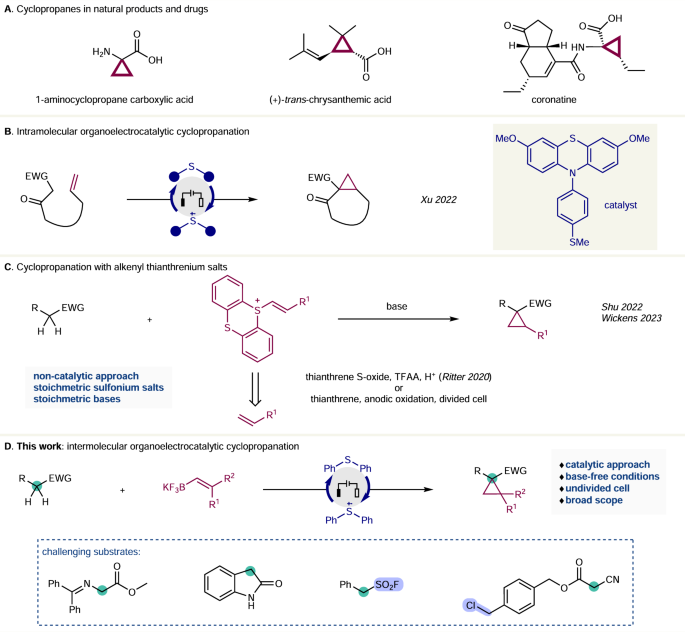
Cyclopropanes are not only privileged motifs in many natural products, agrochemicals, and pharmaceuticals, but also highly versatile intermediates in synthetic chemistry. As such, great effort has been devoted to the cyclopropane construction. However, novel catalytic methods for cyclopropanation with two abundant substrates, mild conditions, high functional group tolerance, and broad scope are still highly desirable. Herein, we report an intermolecular electrocatalytic cyclopropanation of alkenyl trifluoroborates with methylene compounds. The reaction uses simple diphenyl sulfide as the electrocatalyst under base-free conditions. And thus, a broad scope of various methylene compounds as well as vinyltrifluoroborates is demonstrated, including styrenyl, 1,3-dienyl, fluorosulfonyl, and base-sensitive substrates. Preliminary mechanistic studies are presented, revealing the critical role of the boryl substituent to facilitate the desired pathway and the role of water as the hydrogen atom source.
期刊介绍:
Nature Communications, an open-access journal, publishes high-quality research spanning all areas of the natural sciences. Papers featured in the journal showcase significant advances relevant to specialists in each respective field. With a 2-year impact factor of 16.6 (2022) and a median time of 8 days from submission to the first editorial decision, Nature Communications is committed to rapid dissemination of research findings. As a multidisciplinary journal, it welcomes contributions from biological, health, physical, chemical, Earth, social, mathematical, applied, and engineering sciences, aiming to highlight important breakthroughs within each domain.



 京公网安备 11010802042870号
京ICP备2023020795号-1
京公网安备 11010802042870号
京ICP备2023020795号-1

 分享
分享
 求助内容:
求助内容: 应助结果提醒方式:
 扫码关注我们
