{"title":"A Structurally Regularized CNN Architecture via Adaptive Subband Decomposition","authors":"Pavel Sinha;Ioannis Psaromiligkos;Zeljko Zilic","doi":"10.1109/TNNLS.2024.3486181","DOIUrl":null,"url":null,"abstract":"We propose a generalized convolutional neural network (CNN) architecture that first decomposes the input signal into subbands by an adaptive filter bank structure, and then uses convolutional layers to extract features from each subband independently. Fully connected (FC) layers finally combine the extracted features to perform classification. The proposed architecture restrains each of the subband CNNs from learning using the entire input signal spectrum, resulting in structural regularization. Our proposed CNN architecture is fully compatible with the end-to-end learning mechanism of typical CNN architectures and learns the subband decomposition from the input dataset. We show that the proposed CNN architecture has attractive properties, such as robustness to input and weight-and-bias quantization noise, compared to regular full-band CNN architectures. Importantly, the proposed architecture significantly reduces computational costs, while maintaining state-of-the-art classification accuracy. Experiments on image classification tasks using the MNIST, CIFAR-10/100, Caltech-101, and ImageNet-2012 datasets show that the proposed architecture allows accuracy surpassing state-of-the-art results. On the ImageNet-2012 dataset, we achieved top-5 and top-1 validation set accuracy of 86.91% and 69.73%, respectively. Notably, the proposed architecture offers over 90% reduction in computation cost in the inference path and approximately 75% reduction in back-propagation (per iteration) with just a single-layer subband decomposition. With a two-layer subband decomposition, the computational gains are even more significant with comparable accuracy results to the single-layer decomposition.","PeriodicalId":13303,"journal":{"name":"IEEE transactions on neural networks and learning systems","volume":"36 7","pages":"12937-12951"},"PeriodicalIF":8.9000,"publicationDate":"2024-11-08","publicationTypes":"Journal Article","fieldsOfStudy":null,"isOpenAccess":false,"openAccessPdf":"","citationCount":"0","resultStr":null,"platform":"Semanticscholar","paperid":null,"PeriodicalName":"IEEE transactions on neural networks and learning systems","FirstCategoryId":"94","ListUrlMain":"https://ieeexplore.ieee.org/document/10747274/","RegionNum":1,"RegionCategory":"计算机科学","ArticlePicture":[],"TitleCN":null,"AbstractTextCN":null,"PMCID":null,"EPubDate":"","PubModel":"","JCR":"Q1","JCRName":"COMPUTER SCIENCE, ARTIFICIAL INTELLIGENCE","Score":null,"Total":0}
引用次数: 0
Abstract
We propose a generalized convolutional neural network (CNN) architecture that first decomposes the input signal into subbands by an adaptive filter bank structure, and then uses convolutional layers to extract features from each subband independently. Fully connected (FC) layers finally combine the extracted features to perform classification. The proposed architecture restrains each of the subband CNNs from learning using the entire input signal spectrum, resulting in structural regularization. Our proposed CNN architecture is fully compatible with the end-to-end learning mechanism of typical CNN architectures and learns the subband decomposition from the input dataset. We show that the proposed CNN architecture has attractive properties, such as robustness to input and weight-and-bias quantization noise, compared to regular full-band CNN architectures. Importantly, the proposed architecture significantly reduces computational costs, while maintaining state-of-the-art classification accuracy. Experiments on image classification tasks using the MNIST, CIFAR-10/100, Caltech-101, and ImageNet-2012 datasets show that the proposed architecture allows accuracy surpassing state-of-the-art results. On the ImageNet-2012 dataset, we achieved top-5 and top-1 validation set accuracy of 86.91% and 69.73%, respectively. Notably, the proposed architecture offers over 90% reduction in computation cost in the inference path and approximately 75% reduction in back-propagation (per iteration) with just a single-layer subband decomposition. With a two-layer subband decomposition, the computational gains are even more significant with comparable accuracy results to the single-layer decomposition.
期刊介绍:
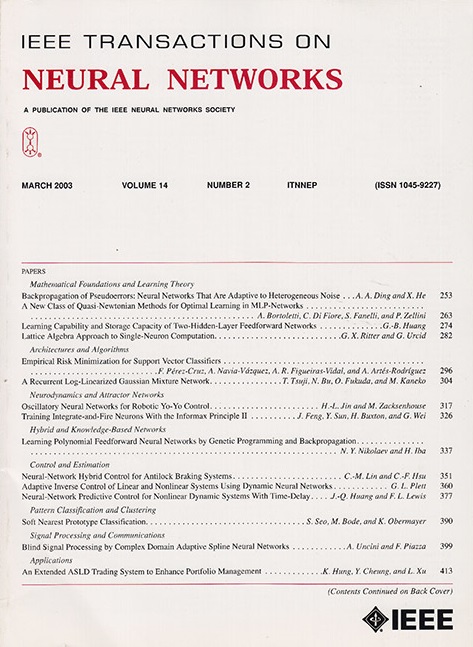
The focus of IEEE Transactions on Neural Networks and Learning Systems is to present scholarly articles discussing the theory, design, and applications of neural networks as well as other learning systems. The journal primarily highlights technical and scientific research in this domain.



 京公网安备 11010802042870号
京ICP备2023020795号-1
京公网安备 11010802042870号
京ICP备2023020795号-1

 分享
分享
 求助内容:
求助内容: 应助结果提醒方式:
 扫码关注我们
