Soumilee Chaudhuri, Desarae A. Dempsey, Yen-Ning Huang, Tamina Park, Sha Cao, Evgeny J. Chumin, Hannah Craft, Paul K. Crane, Shubhabrata Mukherjee, Seo-Eun Choi, Phoebe Scollard, Michael Lee, Connie Nakano, Jesse Mez, Emily H. Trittschuh, Brandon S. Klinedinst, Timothy J. Hohman, Jun-Young Lee, Koung Mi Kang, Chul-Ho Sohn, Yu Kyeong Kim, Dahyun Yi, Min Soo Byun, Shannon L. Risacher, Kwangsik Nho, Andrew J. Saykin, Dong Young Lee, for the KBASE Research Group
{"title":"Association of amyloid and cardiovascular risk with cognition: Findings from KBASE","authors":"Soumilee Chaudhuri, Desarae A. Dempsey, Yen-Ning Huang, Tamina Park, Sha Cao, Evgeny J. Chumin, Hannah Craft, Paul K. Crane, Shubhabrata Mukherjee, Seo-Eun Choi, Phoebe Scollard, Michael Lee, Connie Nakano, Jesse Mez, Emily H. Trittschuh, Brandon S. Klinedinst, Timothy J. Hohman, Jun-Young Lee, Koung Mi Kang, Chul-Ho Sohn, Yu Kyeong Kim, Dahyun Yi, Min Soo Byun, Shannon L. Risacher, Kwangsik Nho, Andrew J. Saykin, Dong Young Lee, for the KBASE Research Group","doi":"10.1002/alz.14290","DOIUrl":null,"url":null,"abstract":"<div>\n \n \n <section>\n \n <h3> BACKGROUND</h3>\n \n <p>Limited research has explored the effect of cardiovascular risk and amyloid interplay on cognitive decline in East Asians.</p>\n </section>\n \n <section>\n \n <h3> METHODS</h3>\n \n <p>Vascular burden was quantified using Framingham's General Cardiovascular Risk Score (FRS) in 526 Korean Brain Aging Study (KBASE) participants. Cognitive differences in groups stratified by FRS and amyloid positivity were assessed at baseline and longitudinally.</p>\n </section>\n \n <section>\n \n <h3> RESULTS</h3>\n \n <p>Baseline analyses revealed that amyloid-negative (Aβ–) cognitively normal (CN) individuals with high FRS had lower cognition compared to Aβ– CN individuals with low FRS (<i>p</i> < 0.0001). Longitudinally, amyloid pathology predominantly drove cognitive decline, while FRS alone had negligible effects on cognition in CN and mild cognitive impairment (MCI) groups.</p>\n </section>\n \n <section>\n \n <h3> CONCLUSION</h3>\n \n <p>Our findings indicate that managing vascular risk may be crucial in preserving cognition in Aβ– individuals early on and before the clinical manifestation of dementia. Within the CN and MCI groups, irrespective of FRS status, amyloid-positive individuals had worse cognitive performance than Aβ– individuals.</p>\n </section>\n \n <section>\n \n <h3> Highlights</h3>\n \n <div>\n <ul>\n \n <li>Vascular risk significantly affects cognition in amyloid-negative older Koreans.</li>\n \n <li>Amyloid-negative CN older adults with high vascular risk had lower baseline cognition.</li>\n \n <li>Amyloid pathology drives cognitive decline in CN and MCI, regardless of vascular risk.</li>\n \n <li>The study underscores the impact of vascular health on the AD disease spectrum.</li>\n </ul>\n </div>\n </section>\n </div>","PeriodicalId":7471,"journal":{"name":"Alzheimer's & Dementia","volume":"20 12","pages":"8527-8540"},"PeriodicalIF":11.1000,"publicationDate":"2024-11-07","publicationTypes":"Journal Article","fieldsOfStudy":null,"isOpenAccess":false,"openAccessPdf":"https://onlinelibrary.wiley.com/doi/epdf/10.1002/alz.14290","citationCount":"0","resultStr":null,"platform":"Semanticscholar","paperid":null,"PeriodicalName":"Alzheimer's & Dementia","FirstCategoryId":"3","ListUrlMain":"https://alz-journals.onlinelibrary.wiley.com/doi/10.1002/alz.14290","RegionNum":1,"RegionCategory":"医学","ArticlePicture":[],"TitleCN":null,"AbstractTextCN":null,"PMCID":null,"EPubDate":"","PubModel":"","JCR":"Q1","JCRName":"CLINICAL NEUROLOGY","Score":null,"Total":0}
引用次数: 0
Abstract
BACKGROUND
Limited research has explored the effect of cardiovascular risk and amyloid interplay on cognitive decline in East Asians.
METHODS
Vascular burden was quantified using Framingham's General Cardiovascular Risk Score (FRS) in 526 Korean Brain Aging Study (KBASE) participants. Cognitive differences in groups stratified by FRS and amyloid positivity were assessed at baseline and longitudinally.
RESULTS
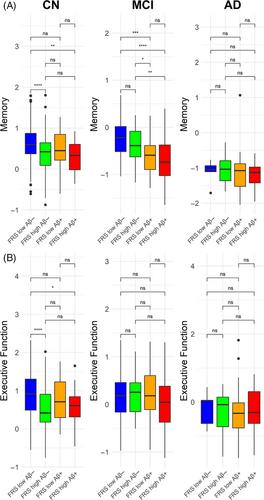
Baseline analyses revealed that amyloid-negative (Aβ–) cognitively normal (CN) individuals with high FRS had lower cognition compared to Aβ– CN individuals with low FRS (p < 0.0001). Longitudinally, amyloid pathology predominantly drove cognitive decline, while FRS alone had negligible effects on cognition in CN and mild cognitive impairment (MCI) groups.
CONCLUSION
Our findings indicate that managing vascular risk may be crucial in preserving cognition in Aβ– individuals early on and before the clinical manifestation of dementia. Within the CN and MCI groups, irrespective of FRS status, amyloid-positive individuals had worse cognitive performance than Aβ– individuals.
Highlights
Vascular risk significantly affects cognition in amyloid-negative older Koreans.
Amyloid-negative CN older adults with high vascular risk had lower baseline cognition.
Amyloid pathology drives cognitive decline in CN and MCI, regardless of vascular risk.
The study underscores the impact of vascular health on the AD disease spectrum.
期刊介绍:
Alzheimer's & Dementia is a peer-reviewed journal that aims to bridge knowledge gaps in dementia research by covering the entire spectrum, from basic science to clinical trials to social and behavioral investigations. It provides a platform for rapid communication of new findings and ideas, optimal translation of research into practical applications, increasing knowledge across diverse disciplines for early detection, diagnosis, and intervention, and identifying promising new research directions. In July 2008, Alzheimer's & Dementia was accepted for indexing by MEDLINE, recognizing its scientific merit and contribution to Alzheimer's research.




 京公网安备 11010802042870号
京ICP备2023020795号-1
京公网安备 11010802042870号
京ICP备2023020795号-1

 分享
分享
 求助内容:
求助内容: 应助结果提醒方式:
 扫码关注我们
