Sehee Lim;In Jun Jung;Gi Seok Kim;Dong Han Ko;Sumin Lee;Seong-Ook Jung
{"title":"Dual-Input Stacked Inverter-Based Single-Ended DRAM Sense Amplifier Using BL Switches for Low-Power High-Speed Sensing","authors":"Sehee Lim;In Jun Jung;Gi Seok Kim;Dong Han Ko;Sumin Lee;Seong-Ook Jung","doi":"10.1109/JSSC.2024.3487756","DOIUrl":null,"url":null,"abstract":"Dynamic random access memory (DRAM) sensing capabilities have deteriorated with the reduced supply voltage and cell capacitance as the DRAM process scales down. Previous bitline sense amplifiers (BLSAs) use offset-canceling (OC) techniques based on capacitive coupling or current mirrors. However, these OC techniques induce substantial static power during the OC phase due to the transistors operating in the saturation region. In addition, the previous offset-canceling techniques have to precede charge sharing, resulting in additional timing overhead. Furthermore, the previous BLSAs suffer from a large area due to two capacitors, high sensitivity to ambient noise, and imbalanced sensing problems, which impedes them from being utilized for the highly scaled DRAM process. This article proposes a dual-input stacked inverter-based single-ended sense amplifier (DISA) to achieve improved sensing capability with reduced energy consumption, small area, and high speed. The dual-input stacked inverter in DISA significantly reduces the static current during both OC and main sensing phases while improving inverter gain. In addition, DISA achieves the smallest area compared to the previous BLSAs because of the use of a single capacitor in the single-ended structure. The simultaneous offset canceling and charge sharing also contribute to the fast sensing operation of DISA. According to the measurement on the experimental chip fabricated in a 28-nm CMOS technology, DISA achieves the shortest sensing time of <9> <tex-math>$V_{\\text {DD}}$ </tex-math></inline-formula>.","PeriodicalId":13129,"journal":{"name":"IEEE Journal of Solid-state Circuits","volume":"60 6","pages":"2096-2105"},"PeriodicalIF":5.6000,"publicationDate":"2024-11-08","publicationTypes":"Journal Article","fieldsOfStudy":null,"isOpenAccess":false,"openAccessPdf":"","citationCount":"0","resultStr":null,"platform":"Semanticscholar","paperid":null,"PeriodicalName":"IEEE Journal of Solid-state Circuits","FirstCategoryId":"5","ListUrlMain":"https://ieeexplore.ieee.org/document/10747369/","RegionNum":1,"RegionCategory":"工程技术","ArticlePicture":[],"TitleCN":null,"AbstractTextCN":null,"PMCID":null,"EPubDate":"","PubModel":"","JCR":"Q1","JCRName":"ENGINEERING, ELECTRICAL & ELECTRONIC","Score":null,"Total":0}
引用次数: 0
Abstract
Dynamic random access memory (DRAM) sensing capabilities have deteriorated with the reduced supply voltage and cell capacitance as the DRAM process scales down. Previous bitline sense amplifiers (BLSAs) use offset-canceling (OC) techniques based on capacitive coupling or current mirrors. However, these OC techniques induce substantial static power during the OC phase due to the transistors operating in the saturation region. In addition, the previous offset-canceling techniques have to precede charge sharing, resulting in additional timing overhead. Furthermore, the previous BLSAs suffer from a large area due to two capacitors, high sensitivity to ambient noise, and imbalanced sensing problems, which impedes them from being utilized for the highly scaled DRAM process. This article proposes a dual-input stacked inverter-based single-ended sense amplifier (DISA) to achieve improved sensing capability with reduced energy consumption, small area, and high speed. The dual-input stacked inverter in DISA significantly reduces the static current during both OC and main sensing phases while improving inverter gain. In addition, DISA achieves the smallest area compared to the previous BLSAs because of the use of a single capacitor in the single-ended structure. The simultaneous offset canceling and charge sharing also contribute to the fast sensing operation of DISA. According to the measurement on the experimental chip fabricated in a 28-nm CMOS technology, DISA achieves the shortest sensing time of <9> $V_{\text {DD}}$ .
期刊介绍:
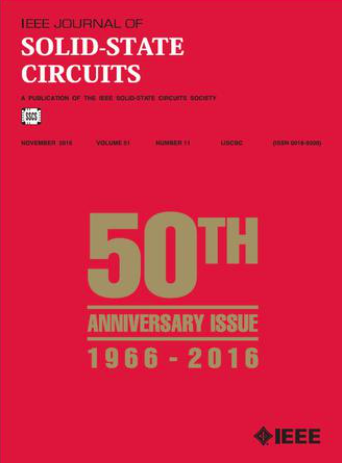
The IEEE Journal of Solid-State Circuits publishes papers each month in the broad area of solid-state circuits with particular emphasis on transistor-level design of integrated circuits. It also provides coverage of topics such as circuits modeling, technology, systems design, layout, and testing that relate directly to IC design. Integrated circuits and VLSI are of principal interest; material related to discrete circuit design is seldom published. Experimental verification is strongly encouraged.



 京公网安备 11010802042870号
京ICP备2023020795号-1
京公网安备 11010802042870号
京ICP备2023020795号-1

 分享
分享
 求助内容:
求助内容: 应助结果提醒方式:
 扫码关注我们
