José Luan da Paixão Teixeira , Ana Paula Rebellato , Raquel Fernanda Milani , Izabela Dutra Alvim , Marcelo Antonio Morgano
{"title":"Selenium micro-encapsulation: Innovative strategies for supplementing plant-based beverages","authors":"José Luan da Paixão Teixeira , Ana Paula Rebellato , Raquel Fernanda Milani , Izabela Dutra Alvim , Marcelo Antonio Morgano","doi":"10.1016/j.foodchem.2024.141993","DOIUrl":null,"url":null,"abstract":"<div><div>Selenium (Se) is an essential micronutrient for humans, and one of the new strategies to increase its intake is to fortify foodstuff with Se-bioaccessible species. This study aimed to produce Se-microparticles (selenate, selenite and Se-organic) using combined methods of microencapsulation; fortify commercial plant-based beverages (PBBs); evaluate the stability of microparticles; and estimate the bioaccessibility of Se and its contribution to the Recommended Daily Intake (RDA). Samples and bioaccessible fractions were submitted to acid digestion and Se levels (total and bioaccessible) were quantified by ICP-MS. The bioaccessibility of the Se-microparticles produced was estimated using an <em>in vitro</em> method under standardized conditions (INFOGEST). During the storage period, the microparticles maintained their stability and similar size. The PBBs fortified with Se-microparticles presented high bioaccessibility (77–94 %); being superior, in comparison, to the traditional fortification (Se-isolated salts). Thus, the results suggest promising perspectives for Se-supplementation in PBBs to meet nutritional needs effectively.</div></div>","PeriodicalId":318,"journal":{"name":"Food Chemistry","volume":"465 ","pages":"Article 141993"},"PeriodicalIF":9.8000,"publicationDate":"2024-11-10","publicationTypes":"Journal Article","fieldsOfStudy":null,"isOpenAccess":false,"openAccessPdf":"","citationCount":"0","resultStr":null,"platform":"Semanticscholar","paperid":null,"PeriodicalName":"Food Chemistry","FirstCategoryId":"97","ListUrlMain":"https://www.sciencedirect.com/science/article/pii/S0308814624036434","RegionNum":1,"RegionCategory":"农林科学","ArticlePicture":[],"TitleCN":null,"AbstractTextCN":null,"PMCID":null,"EPubDate":"","PubModel":"","JCR":"Q1","JCRName":"CHEMISTRY, APPLIED","Score":null,"Total":0}
引用次数: 0
Abstract
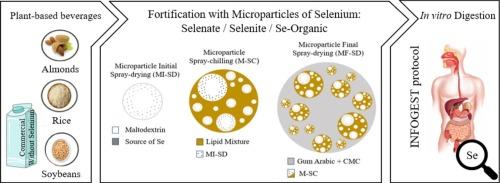
Selenium (Se) is an essential micronutrient for humans, and one of the new strategies to increase its intake is to fortify foodstuff with Se-bioaccessible species. This study aimed to produce Se-microparticles (selenate, selenite and Se-organic) using combined methods of microencapsulation; fortify commercial plant-based beverages (PBBs); evaluate the stability of microparticles; and estimate the bioaccessibility of Se and its contribution to the Recommended Daily Intake (RDA). Samples and bioaccessible fractions were submitted to acid digestion and Se levels (total and bioaccessible) were quantified by ICP-MS. The bioaccessibility of the Se-microparticles produced was estimated using an in vitro method under standardized conditions (INFOGEST). During the storage period, the microparticles maintained their stability and similar size. The PBBs fortified with Se-microparticles presented high bioaccessibility (77–94 %); being superior, in comparison, to the traditional fortification (Se-isolated salts). Thus, the results suggest promising perspectives for Se-supplementation in PBBs to meet nutritional needs effectively.
硒(Se)是人类必需的微量营养元素,而增加硒摄入量的新策略之一就是在食品中添加可被生物利用的硒元素。本研究旨在采用微胶囊化的综合方法生产硒微粒(硒酸盐、亚硒酸盐和硒有机物);强化商业植物饮料(PBBs);评估微粒的稳定性;估算硒的生物可及性及其对每日推荐摄入量(RDA)的贡献。将样品和生物可利用部分进行酸消化,并通过 ICP-MS 对 Se 含量(总含量和生物可利用含量)进行定量。采用标准化条件下的体外方法(INFOGEST)估算了所产生的硒微粒的生物可及性。在储存期间,微颗粒保持了稳定性和相似的大小。使用 Se 微颗粒强化的多溴联苯具有很高的生物可接受性(77-94%);与传统的强化方法(Se 分离盐)相比更胜一筹。因此,研究结果表明,在多溴联苯中添加硒以有效满足营养需求的前景广阔。
期刊介绍:
Food Chemistry publishes original research papers dealing with the advancement of the chemistry and biochemistry of foods or the analytical methods/ approach used. All papers should focus on the novelty of the research carried out.



 京公网安备 11010802042870号
京ICP备2023020795号-1
京公网安备 11010802042870号
京ICP备2023020795号-1

 分享
分享
 求助内容:
求助内容: 应助结果提醒方式:
 扫码关注我们
