Shengyu Zhang;Yijie Mao;Bruno Clerckx;Tony Q. S. Quek
{"title":"Interference Management in Space-Air-Ground Integrated Networks With Fully Distributed Rate-Splitting Multiple Access","authors":"Shengyu Zhang;Yijie Mao;Bruno Clerckx;Tony Q. S. Quek","doi":"10.1109/TWC.2024.3489219","DOIUrl":null,"url":null,"abstract":"Despite the allure of ubiquitous, high-speed, and low-latency connectivity offered by Space-Air-Ground Integrated Networks (SAGINs), the co-existence of Low Earth Orbit (LEO) satellites and Unmanned Aerial Vehicles (UAVs) within the same frequency band poses significant challenges in interference management. Traditional optimization approaches, requiring seconds or even minutes for beamforming design, simply cannot keep pace with this dynamic environment. This work addresses these challenges by proposing a Fully-Distributed Rate-Splitting Multiple Access (FD-RSMA), which enables efficient cross-system interference management in SAGINs with statistical Channel State Information (CSI) at the Transmitter (CSIT). Building upon FD-RSMA, we study the precoder design of LEO satellites and UAVs along with common rate allocations of RSMA to maximize Weighted Ergodic Sum Rate (WESR). To handle channel randomness, we employ a Sample Average Approximation (SAA) approach. Furthermore, a Deep Learning (DL)-based precoder design algorithm, called GruCN, which marries the advantages of Gate Recurrent Unit (GRU) and Convolutional Neural Network (CNN), is proposed to efficiently tackle the non-convex optimization problem. Numerical results demonstrate the effectiveness and efficiency of our proposed DL-assisted FD-RSMA. Compared to conventional RSMA approaches, FD-RSMA improves up to 20% of WESR performance, while the GruCN achieves around 50% higher WESR performance and up to four orders of magnitude lower processing time than the conventional optimization approaches.","PeriodicalId":13431,"journal":{"name":"IEEE Transactions on Wireless Communications","volume":"24 1","pages":"149-164"},"PeriodicalIF":10.7000,"publicationDate":"2024-11-07","publicationTypes":"Journal Article","fieldsOfStudy":null,"isOpenAccess":false,"openAccessPdf":"","citationCount":"0","resultStr":null,"platform":"Semanticscholar","paperid":null,"PeriodicalName":"IEEE Transactions on Wireless Communications","FirstCategoryId":"94","ListUrlMain":"https://ieeexplore.ieee.org/document/10747195/","RegionNum":1,"RegionCategory":"计算机科学","ArticlePicture":[],"TitleCN":null,"AbstractTextCN":null,"PMCID":null,"EPubDate":"","PubModel":"","JCR":"Q1","JCRName":"ENGINEERING, ELECTRICAL & ELECTRONIC","Score":null,"Total":0}
引用次数: 0
Abstract
Despite the allure of ubiquitous, high-speed, and low-latency connectivity offered by Space-Air-Ground Integrated Networks (SAGINs), the co-existence of Low Earth Orbit (LEO) satellites and Unmanned Aerial Vehicles (UAVs) within the same frequency band poses significant challenges in interference management. Traditional optimization approaches, requiring seconds or even minutes for beamforming design, simply cannot keep pace with this dynamic environment. This work addresses these challenges by proposing a Fully-Distributed Rate-Splitting Multiple Access (FD-RSMA), which enables efficient cross-system interference management in SAGINs with statistical Channel State Information (CSI) at the Transmitter (CSIT). Building upon FD-RSMA, we study the precoder design of LEO satellites and UAVs along with common rate allocations of RSMA to maximize Weighted Ergodic Sum Rate (WESR). To handle channel randomness, we employ a Sample Average Approximation (SAA) approach. Furthermore, a Deep Learning (DL)-based precoder design algorithm, called GruCN, which marries the advantages of Gate Recurrent Unit (GRU) and Convolutional Neural Network (CNN), is proposed to efficiently tackle the non-convex optimization problem. Numerical results demonstrate the effectiveness and efficiency of our proposed DL-assisted FD-RSMA. Compared to conventional RSMA approaches, FD-RSMA improves up to 20% of WESR performance, while the GruCN achieves around 50% higher WESR performance and up to four orders of magnitude lower processing time than the conventional optimization approaches.
期刊介绍:
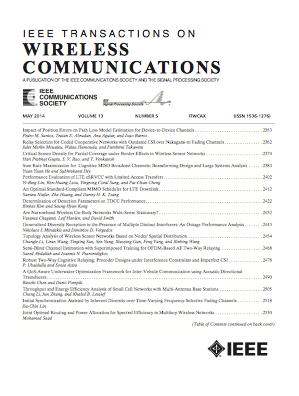
The IEEE Transactions on Wireless Communications is a prestigious publication that showcases cutting-edge advancements in wireless communications. It welcomes both theoretical and practical contributions in various areas. The scope of the Transactions encompasses a wide range of topics, including modulation and coding, detection and estimation, propagation and channel characterization, and diversity techniques. The journal also emphasizes the physical and link layer communication aspects of network architectures and protocols.
The journal is open to papers on specific topics or non-traditional topics related to specific application areas. This includes simulation tools and methodologies, orthogonal frequency division multiplexing, MIMO systems, and wireless over optical technologies.
Overall, the IEEE Transactions on Wireless Communications serves as a platform for high-quality manuscripts that push the boundaries of wireless communications and contribute to advancements in the field.



 京公网安备 11010802042870号
京ICP备2023020795号-1
京公网安备 11010802042870号
京ICP备2023020795号-1

 分享
分享
 求助内容:
求助内容: 应助结果提醒方式:
 扫码关注我们
