Yu Zhang, Yuanna Sun, Jiahang Yang, Ruobing Tian, Jiahao Liu, Xueming Tang, Junbo Wang and Qingshan Li
{"title":"A robust and adhesive anti-swelling hydrophobic ionogel with prolonged stability for strain and temperature sensors†","authors":"Yu Zhang, Yuanna Sun, Jiahang Yang, Ruobing Tian, Jiahao Liu, Xueming Tang, Junbo Wang and Qingshan Li","doi":"10.1039/D4TA06181K","DOIUrl":null,"url":null,"abstract":"<p >With the growing attention given to wearable electronic devices, flexible sensors, as a fundamental component, are emerging as the focal point. However, achieving long-term stability and precise sensing underwater remain two significant challenges that urgently need to be addressed for these sensors. By employing a fully hydrophobic structure, this work achieves a significant breakthrough in underwater applications. The hydrophobic design imparts the ionogel with exceptional water resistance, strong wet adhesion, and remarkable stability in underwater environments. These remarkable advantages make ionogels stand out as strain sensors. The ionogels exhibit extraordinary signal sensing abilities. Specifically, they can capture subtle physiological activities of the human body with precision and sensitivity, both in air or underwater. Besides, the satisfactory thermosensitivity (−2.02% °C<small><sup>−1</sup></small>), high resolution (0.1 °C) and fast response (14 s) ensure that the ionogel becomes a qualified temperature sensor. By integrating with a wireless Bluetooth transmission system, the real-time body temperature can be monitored using a smart cellphone. This work demonstrates the great potential of ionogels in marine exploitation and wearable health monitoring.</p>","PeriodicalId":82,"journal":{"name":"Journal of Materials Chemistry A","volume":" 48","pages":" 33734-33745"},"PeriodicalIF":9.5000,"publicationDate":"2024-11-11","publicationTypes":"Journal Article","fieldsOfStudy":null,"isOpenAccess":false,"openAccessPdf":"","citationCount":"0","resultStr":null,"platform":"Semanticscholar","paperid":null,"PeriodicalName":"Journal of Materials Chemistry A","FirstCategoryId":"88","ListUrlMain":"https://pubs.rsc.org/en/content/articlelanding/2024/ta/d4ta06181k","RegionNum":2,"RegionCategory":"材料科学","ArticlePicture":[],"TitleCN":null,"AbstractTextCN":null,"PMCID":null,"EPubDate":"","PubModel":"","JCR":"Q1","JCRName":"CHEMISTRY, PHYSICAL","Score":null,"Total":0}
引用次数: 0
Abstract
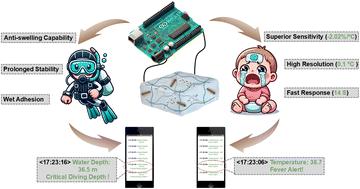
With the growing attention given to wearable electronic devices, flexible sensors, as a fundamental component, are emerging as the focal point. However, achieving long-term stability and precise sensing underwater remain two significant challenges that urgently need to be addressed for these sensors. By employing a fully hydrophobic structure, this work achieves a significant breakthrough in underwater applications. The hydrophobic design imparts the ionogel with exceptional water resistance, strong wet adhesion, and remarkable stability in underwater environments. These remarkable advantages make ionogels stand out as strain sensors. The ionogels exhibit extraordinary signal sensing abilities. Specifically, they can capture subtle physiological activities of the human body with precision and sensitivity, both in air or underwater. Besides, the satisfactory thermosensitivity (−2.02% °C−1), high resolution (0.1 °C) and fast response (14 s) ensure that the ionogel becomes a qualified temperature sensor. By integrating with a wireless Bluetooth transmission system, the real-time body temperature can be monitored using a smart cellphone. This work demonstrates the great potential of ionogels in marine exploitation and wearable health monitoring.
期刊介绍:
The Journal of Materials Chemistry A, B & C covers a wide range of high-quality studies in the field of materials chemistry, with each section focusing on specific applications of the materials studied. Journal of Materials Chemistry A emphasizes applications in energy and sustainability, including topics such as artificial photosynthesis, batteries, and fuel cells. Journal of Materials Chemistry B focuses on applications in biology and medicine, while Journal of Materials Chemistry C covers applications in optical, magnetic, and electronic devices. Example topic areas within the scope of Journal of Materials Chemistry A include catalysis, green/sustainable materials, sensors, and water treatment, among others.




 京公网安备 11010802042870号
京ICP备2023020795号-1
京公网安备 11010802042870号
京ICP备2023020795号-1

 分享
分享
 求助内容:
求助内容: 应助结果提醒方式:
 扫码关注我们
