Yu-Hui Luo , Sheng Tao , Fei Chen , Zhi-Hong Du , Hao Zhang , Min Li , Ning Liu
{"title":"Boron–pyridine nitrogen cooperative catalytic conversion of carbon dioxide and epoxides to cyclic carbonates†","authors":"Yu-Hui Luo , Sheng Tao , Fei Chen , Zhi-Hong Du , Hao Zhang , Min Li , Ning Liu","doi":"10.1039/d4cy01052c","DOIUrl":null,"url":null,"abstract":"<div><div>A type of N-heterocyclic carbene (NHC)-diboron adduct was used as a catalyst for the coupling of CO<sub>2</sub> with epoxides. A multifunctional organocatalyst, which contains both boron as a Lewis acidic site and pyridine nitrogen as a Lewis basic site, offers an efficient alternative to traditional organoboron catalysts for the conversion of CO<sub>2</sub> and epoxides into cyclic carbonates. The NHC-diboron adduct, in combination with tetrabutylammonium iodide (TBAI) as a nucleophile, catalyzes the coupling of CO<sub>2</sub> and epoxides to obtain the cyclic carbonates in high yields under relatively mild conditions (50 °C and 1 MPa of CO<sub>2</sub>). The cooperative activation of NHC-diboron adducts was elaborated by <em>in situ</em> infrared spectroscopy and electrospray ionization-high-resolution mass spectrometry (ESI-HRMS). These results suggested that the Lewis acid boron center in NHC-diboron adduct activates the epoxide by coordination with its oxygen atom to promote ring opening and that the pyridine nitrogen acts as a Lewis basic site to activate CO<sub>2</sub>.</div></div>","PeriodicalId":66,"journal":{"name":"Catalysis Science & Technology","volume":"14 22","pages":"Pages 6692-6700"},"PeriodicalIF":4.2000,"publicationDate":"2024-09-25","publicationTypes":"Journal Article","fieldsOfStudy":null,"isOpenAccess":false,"openAccessPdf":"","citationCount":"0","resultStr":null,"platform":"Semanticscholar","paperid":null,"PeriodicalName":"Catalysis Science & Technology","FirstCategoryId":"92","ListUrlMain":"https://www.sciencedirect.com/org/science/article/pii/S2044475324005689","RegionNum":3,"RegionCategory":"化学","ArticlePicture":[],"TitleCN":null,"AbstractTextCN":null,"PMCID":null,"EPubDate":"","PubModel":"","JCR":"Q2","JCRName":"CHEMISTRY, PHYSICAL","Score":null,"Total":0}
引用次数: 0
Abstract
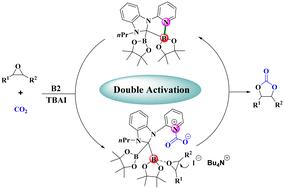
A type of N-heterocyclic carbene (NHC)-diboron adduct was used as a catalyst for the coupling of CO2 with epoxides. A multifunctional organocatalyst, which contains both boron as a Lewis acidic site and pyridine nitrogen as a Lewis basic site, offers an efficient alternative to traditional organoboron catalysts for the conversion of CO2 and epoxides into cyclic carbonates. The NHC-diboron adduct, in combination with tetrabutylammonium iodide (TBAI) as a nucleophile, catalyzes the coupling of CO2 and epoxides to obtain the cyclic carbonates in high yields under relatively mild conditions (50 °C and 1 MPa of CO2). The cooperative activation of NHC-diboron adducts was elaborated by in situ infrared spectroscopy and electrospray ionization-high-resolution mass spectrometry (ESI-HRMS). These results suggested that the Lewis acid boron center in NHC-diboron adduct activates the epoxide by coordination with its oxygen atom to promote ring opening and that the pyridine nitrogen acts as a Lewis basic site to activate CO2.
期刊介绍:
A multidisciplinary journal focusing on cutting edge research across all fundamental science and technological aspects of catalysis.
Editor-in-chief: Bert Weckhuysen
Impact factor: 5.0
Time to first decision (peer reviewed only): 31 days



 京公网安备 11010802042870号
京ICP备2023020795号-1
京公网安备 11010802042870号
京ICP备2023020795号-1

 分享
分享
 求助内容:
求助内容: 应助结果提醒方式:
 扫码关注我们
