{"title":"Scaling up clean production of biomass-derived organic acids as a step towards the realization of dual carbon goals: a review","authors":"Zulfiqar Ali , Jiliang Ma , Runcang Sun","doi":"10.1039/d4gc03829k","DOIUrl":null,"url":null,"abstract":"<div><div>The contemporary world faces issues related to energy, the environment, and food security. The use of carbon capture, storage, and utilization technologies can help reduce CO<sub>2</sub> emissions from fossil fuels, which will result in major advancements toward dual carbon targets. In addition to promoting environmentally friendly manufacturing, chemical industries may replace fossil fuel-based raw materials with renewable biomass for the synthesis of organic acids and syngas. Although several studies are being conducted on co-valorization of CO<sub>2</sub> and biomass feedstocks to produce organic acids and fine chemicals using biotechnology, thermocatalysis, electrocatalysis, and photocatalysis, there are still various obstacles in scaling up clean production, including (i) addressing environmental concerns, (ii) the intricate structure and chemical composition of biomass, (iii) conversion mechanisms and processes, (iv) designing catalyst materials with higher durability and recyclability, (v) greener solvent systems for catalysis and extraction, (vi) the deployment of modern technologies for characterization, (vii) training and guidelines for industrial operations, and (viii) governmental financing and policy. The sustainable manufacturing of biobased products from raw feedstocks produced from biomass has been made possible <em>via</em> technological breakthroughs in photo-/biorefineries, which are essential for the clean and environmentally friendly synthesis of organic acids. It is anticipated that clean production of organic acids from biomass will have a dominant market share, benefiting from both socioeconomic and environmental factors. With future technical developments, the valorization of feedstocks obtained from biomass together with CO<sub>2</sub> for manufacturing fuels and fine chemicals will be more ecologically and economically feasible.</div></div>","PeriodicalId":78,"journal":{"name":"Green Chemistry","volume":"26 22","pages":"Pages 11061-11082"},"PeriodicalIF":9.2000,"publicationDate":"2024-10-08","publicationTypes":"Journal Article","fieldsOfStudy":null,"isOpenAccess":false,"openAccessPdf":"","citationCount":"0","resultStr":null,"platform":"Semanticscholar","paperid":null,"PeriodicalName":"Green Chemistry","FirstCategoryId":"92","ListUrlMain":"https://www.sciencedirect.com/org/science/article/pii/S1463926224008409","RegionNum":1,"RegionCategory":"化学","ArticlePicture":[],"TitleCN":null,"AbstractTextCN":null,"PMCID":null,"EPubDate":"","PubModel":"","JCR":"Q1","JCRName":"CHEMISTRY, MULTIDISCIPLINARY","Score":null,"Total":0}
引用次数: 0
Abstract
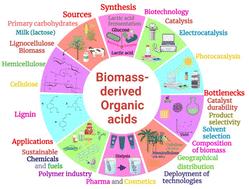
The contemporary world faces issues related to energy, the environment, and food security. The use of carbon capture, storage, and utilization technologies can help reduce CO2 emissions from fossil fuels, which will result in major advancements toward dual carbon targets. In addition to promoting environmentally friendly manufacturing, chemical industries may replace fossil fuel-based raw materials with renewable biomass for the synthesis of organic acids and syngas. Although several studies are being conducted on co-valorization of CO2 and biomass feedstocks to produce organic acids and fine chemicals using biotechnology, thermocatalysis, electrocatalysis, and photocatalysis, there are still various obstacles in scaling up clean production, including (i) addressing environmental concerns, (ii) the intricate structure and chemical composition of biomass, (iii) conversion mechanisms and processes, (iv) designing catalyst materials with higher durability and recyclability, (v) greener solvent systems for catalysis and extraction, (vi) the deployment of modern technologies for characterization, (vii) training and guidelines for industrial operations, and (viii) governmental financing and policy. The sustainable manufacturing of biobased products from raw feedstocks produced from biomass has been made possible via technological breakthroughs in photo-/biorefineries, which are essential for the clean and environmentally friendly synthesis of organic acids. It is anticipated that clean production of organic acids from biomass will have a dominant market share, benefiting from both socioeconomic and environmental factors. With future technical developments, the valorization of feedstocks obtained from biomass together with CO2 for manufacturing fuels and fine chemicals will be more ecologically and economically feasible.
期刊介绍:
Green Chemistry is a journal that provides a unique forum for the publication of innovative research on the development of alternative green and sustainable technologies. The scope of Green Chemistry is based on the definition proposed by Anastas and Warner (Green Chemistry: Theory and Practice, P T Anastas and J C Warner, Oxford University Press, Oxford, 1998), which defines green chemistry as the utilisation of a set of principles that reduces or eliminates the use or generation of hazardous substances in the design, manufacture and application of chemical products. Green Chemistry aims to reduce the environmental impact of the chemical enterprise by developing a technology base that is inherently non-toxic to living things and the environment. The journal welcomes submissions on all aspects of research relating to this endeavor and publishes original and significant cutting-edge research that is likely to be of wide general appeal. For a work to be published, it must present a significant advance in green chemistry, including a comparison with existing methods and a demonstration of advantages over those methods.



 京公网安备 11010802042870号
京ICP备2023020795号-1
京公网安备 11010802042870号
京ICP备2023020795号-1

 分享
分享
 求助内容:
求助内容: 应助结果提醒方式:
 扫码关注我们
