{"title":"Analytical Optimal Joint Resource Allocation and Continuous Trajectory Design for UAV-Assisted Covert Communications","authors":"Yuxi Huang;Yulin Hu;Xiaopeng Yuan;Anke Schmeink","doi":"10.1109/TWC.2024.3490898","DOIUrl":null,"url":null,"abstract":"In this paper, we focus on an unmanned aerial vehicle (UAV)-assisted covert communication scenario, and introduce an optimal joint resource allocation and continuous UAV trajectory design. We aim at maximizing the information throughput between UAV and a ground user, while protecting the transmission behavior from being detected by a warden. Due to the continuity of UAV trajectory in both time and space, the formulated problem has infinitely large number of variables to be optimized, i.e., being not only cutting-edge, but also very challenging to be coped with. To address this issue, we provide an artificial potential field (APF)-based approach, with which a closed-form optimal solution is for the first time obtained for considered UAV-assisted covert communication. In particular, first based on investigation on the covertness constraint, the maximal transmit power is characterized as a closed-form binary decision function with respect to UAV position. Following the characterization, we then transform the joint optimization problem to one of pure UAV trajectory design. Subsequently, via conducting an APF to covert transmission rate between the UAV and the user, the trajectory design problem is completely equivalent to a mechanical problem, i.e., a density-variable rope shape design problem in the APF, based on mechanical equivalence technique. Such mechanical problem can be optimally solved. Specifically, the force field in the conducted APF corresponding to a covert communication is actually twisted due to the presence of the warden, for which we reorganize a brand new mechanical analysis process accordingly, including reanalyzing the direction of the force field and updating the force balance expression. Then, according to the minimum total potential energy principle, the closed-form solution of the optimal rope shape is constructed following the equilibrium analysis. In addition, acknowledging that the lowest potential point of APF changes with the covert requirement, we also discuss all the three cases for optimal trajectory distinguishing in hovering behavior of the UAV.","PeriodicalId":13431,"journal":{"name":"IEEE Transactions on Wireless Communications","volume":"24 1","pages":"213-227"},"PeriodicalIF":10.7000,"publicationDate":"2024-11-11","publicationTypes":"Journal Article","fieldsOfStudy":null,"isOpenAccess":false,"openAccessPdf":"","citationCount":"0","resultStr":null,"platform":"Semanticscholar","paperid":null,"PeriodicalName":"IEEE Transactions on Wireless Communications","FirstCategoryId":"94","ListUrlMain":"https://ieeexplore.ieee.org/document/10750259/","RegionNum":1,"RegionCategory":"计算机科学","ArticlePicture":[],"TitleCN":null,"AbstractTextCN":null,"PMCID":null,"EPubDate":"","PubModel":"","JCR":"Q1","JCRName":"ENGINEERING, ELECTRICAL & ELECTRONIC","Score":null,"Total":0}
引用次数: 0
Abstract
In this paper, we focus on an unmanned aerial vehicle (UAV)-assisted covert communication scenario, and introduce an optimal joint resource allocation and continuous UAV trajectory design. We aim at maximizing the information throughput between UAV and a ground user, while protecting the transmission behavior from being detected by a warden. Due to the continuity of UAV trajectory in both time and space, the formulated problem has infinitely large number of variables to be optimized, i.e., being not only cutting-edge, but also very challenging to be coped with. To address this issue, we provide an artificial potential field (APF)-based approach, with which a closed-form optimal solution is for the first time obtained for considered UAV-assisted covert communication. In particular, first based on investigation on the covertness constraint, the maximal transmit power is characterized as a closed-form binary decision function with respect to UAV position. Following the characterization, we then transform the joint optimization problem to one of pure UAV trajectory design. Subsequently, via conducting an APF to covert transmission rate between the UAV and the user, the trajectory design problem is completely equivalent to a mechanical problem, i.e., a density-variable rope shape design problem in the APF, based on mechanical equivalence technique. Such mechanical problem can be optimally solved. Specifically, the force field in the conducted APF corresponding to a covert communication is actually twisted due to the presence of the warden, for which we reorganize a brand new mechanical analysis process accordingly, including reanalyzing the direction of the force field and updating the force balance expression. Then, according to the minimum total potential energy principle, the closed-form solution of the optimal rope shape is constructed following the equilibrium analysis. In addition, acknowledging that the lowest potential point of APF changes with the covert requirement, we also discuss all the three cases for optimal trajectory distinguishing in hovering behavior of the UAV.
期刊介绍:
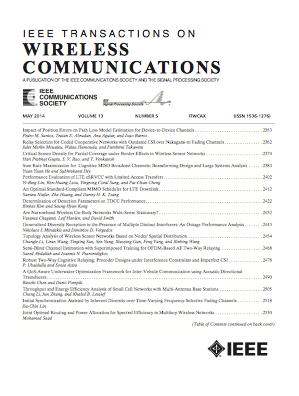
The IEEE Transactions on Wireless Communications is a prestigious publication that showcases cutting-edge advancements in wireless communications. It welcomes both theoretical and practical contributions in various areas. The scope of the Transactions encompasses a wide range of topics, including modulation and coding, detection and estimation, propagation and channel characterization, and diversity techniques. The journal also emphasizes the physical and link layer communication aspects of network architectures and protocols.
The journal is open to papers on specific topics or non-traditional topics related to specific application areas. This includes simulation tools and methodologies, orthogonal frequency division multiplexing, MIMO systems, and wireless over optical technologies.
Overall, the IEEE Transactions on Wireless Communications serves as a platform for high-quality manuscripts that push the boundaries of wireless communications and contribute to advancements in the field.



 京公网安备 11010802042870号
京ICP备2023020795号-1
京公网安备 11010802042870号
京ICP备2023020795号-1

 分享
分享
 求助内容:
求助内容: 应助结果提醒方式:
 扫码关注我们
