J Rahulkumar;R Narayanamoorthi;Harish S. Krishnamoorthy
{"title":"An Inherent CC-CV Charging Architecture for Dual Receiver Semi-Dynamic Resonant Inductive Wireless Electric Vehicle Charging System","authors":"J Rahulkumar;R Narayanamoorthi;Harish S. Krishnamoorthy","doi":"10.1109/TTE.2024.3494866","DOIUrl":null,"url":null,"abstract":"The semi-dynamic resonant inductive wireless power transfer (SD-RIWPT) technology reduces the need for large electric vehicle (EV) battery capacity, size, weight, and charging duration, thereby increasing the travel distance range or mileage. However, it faces challenges in power transfer efficiency (PTE) and optimal power delivery due to power fluctuations and power null phenomenon (PNP) effect. To address these challenges, this article proposes a novel approach integrating a dual receiver (Rx) coupling architecture with an inherent constant current–constant voltage (CC-CV) charging mechanism for the SD-RIWPT EV charging system. The combination of dual Rx with multiple transmitter (Tx) coupling SD charging Lane eliminates the PNP effect, limits the power fluctuations, and establishes the effective resonant magnetic field coupling architecture. Also, the inherent CC-CV charging hybrid compensation ensures optimal power delivery, enhancing battery charging efficiency and limiting power fluctuations. The multi-Tx coil power is consistently allocated across the couples, by introducing a proportional–integral–derivative (PID) feedback controller to achieve optimal power delivery. The unipolar square geometrical pads are embedded with optimal distance spacing in adjacent sequences to eliminate the PNP effect and optimize the cross-coupling inductance between pads to enhance PTE. The resonance magnetic field coupling (RMFC) architecture ensures coupling effectiveness along with the SD charging Lane and achieves maximum PTE. Also, the proposed system eliminates the need for a dc–dc chopper and a complicated control strategy for battery charging. This topology achieves CC-CV output automatically even with high misalignment tolerance in coupling, which enhances system reliability.","PeriodicalId":56269,"journal":{"name":"IEEE Transactions on Transportation Electrification","volume":"11 2","pages":"5961-5973"},"PeriodicalIF":8.3000,"publicationDate":"2024-11-11","publicationTypes":"Journal Article","fieldsOfStudy":null,"isOpenAccess":false,"openAccessPdf":"","citationCount":"0","resultStr":null,"platform":"Semanticscholar","paperid":null,"PeriodicalName":"IEEE Transactions on Transportation Electrification","FirstCategoryId":"5","ListUrlMain":"https://ieeexplore.ieee.org/document/10750071/","RegionNum":1,"RegionCategory":"工程技术","ArticlePicture":[],"TitleCN":null,"AbstractTextCN":null,"PMCID":null,"EPubDate":"","PubModel":"","JCR":"Q1","JCRName":"ENGINEERING, ELECTRICAL & ELECTRONIC","Score":null,"Total":0}
引用次数: 0
Abstract
The semi-dynamic resonant inductive wireless power transfer (SD-RIWPT) technology reduces the need for large electric vehicle (EV) battery capacity, size, weight, and charging duration, thereby increasing the travel distance range or mileage. However, it faces challenges in power transfer efficiency (PTE) and optimal power delivery due to power fluctuations and power null phenomenon (PNP) effect. To address these challenges, this article proposes a novel approach integrating a dual receiver (Rx) coupling architecture with an inherent constant current–constant voltage (CC-CV) charging mechanism for the SD-RIWPT EV charging system. The combination of dual Rx with multiple transmitter (Tx) coupling SD charging Lane eliminates the PNP effect, limits the power fluctuations, and establishes the effective resonant magnetic field coupling architecture. Also, the inherent CC-CV charging hybrid compensation ensures optimal power delivery, enhancing battery charging efficiency and limiting power fluctuations. The multi-Tx coil power is consistently allocated across the couples, by introducing a proportional–integral–derivative (PID) feedback controller to achieve optimal power delivery. The unipolar square geometrical pads are embedded with optimal distance spacing in adjacent sequences to eliminate the PNP effect and optimize the cross-coupling inductance between pads to enhance PTE. The resonance magnetic field coupling (RMFC) architecture ensures coupling effectiveness along with the SD charging Lane and achieves maximum PTE. Also, the proposed system eliminates the need for a dc–dc chopper and a complicated control strategy for battery charging. This topology achieves CC-CV output automatically even with high misalignment tolerance in coupling, which enhances system reliability.
期刊介绍:
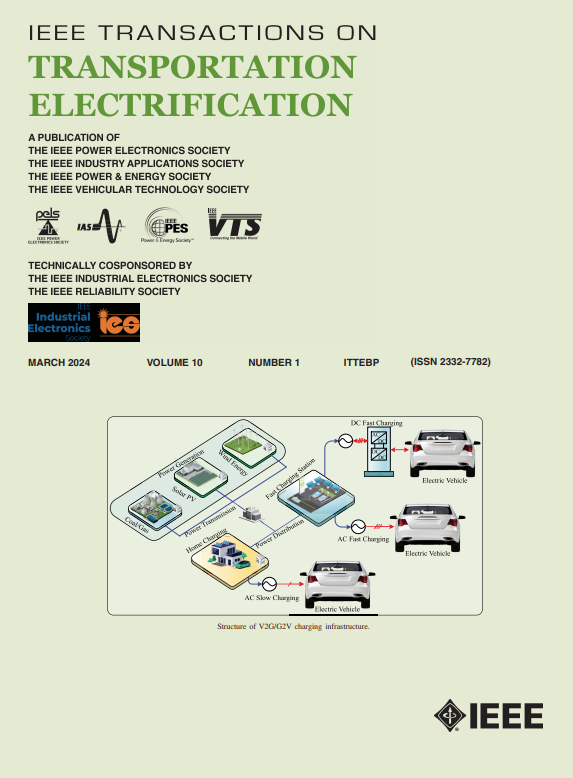
IEEE Transactions on Transportation Electrification is focused on components, sub-systems, systems, standards, and grid interface technologies related to power and energy conversion, propulsion, and actuation for all types of electrified vehicles including on-road, off-road, off-highway, and rail vehicles, airplanes, and ships.



 京公网安备 11010802042870号
京ICP备2023020795号-1
京公网安备 11010802042870号
京ICP备2023020795号-1

 分享
分享
 求助内容:
求助内容: 应助结果提醒方式:
 扫码关注我们
