Ke Gong, Abhijit Nandy, Zhexuan Song, Quan-Song Li, Ali Hassanali, Giuseppe Cassone, Shibdas Banerjee, Jing Xie
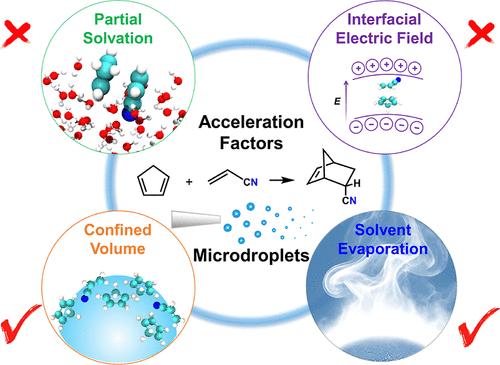
{"title":"Revisiting the Enhanced Chemical Reactivity in Water Microdroplets: The Case of a Diels–Alder Reaction","authors":"Ke Gong, Abhijit Nandy, Zhexuan Song, Quan-Song Li, Ali Hassanali, Giuseppe Cassone, Shibdas Banerjee, Jing Xie","doi":"10.1021/jacs.4c09400","DOIUrl":null,"url":null,"abstract":"Often, chemical reactions are markedly accelerated in microdroplets compared with the corresponding bulk phase. While identifying the precise causative factors remains challenging, the interfacial electric field (IEF) and partial solvation are the two widely proposed factors, accounting for the acceleration or turning on of many reactions in microdroplets. In sharp contrast, this combined computational and experimental study demonstrates that these two critical factors have a negligible effect on promoting a model Diels–Alder (DA) reaction between cyclopentadiene and acrylonitrile in water microdroplets. Instead, the acceleration of the DA reaction appears to be driven by the effect of confinement and the concentration increase caused by evaporation. Quantum chemical calculations and ab initio molecular dynamics simulations coupled with enhanced sampling techniques predict that the air–water interface exhibits a higher free-energy barrier of this reaction than the bulk, while external electric fields marginally reduce the barrier. Remarkably, the catalytic capability of the IEF at the water microdroplet surface is largely hampered by its fluctuating character. Mass spectrometric assessment of the microdroplet reaction corroborates these findings, suggesting that the DA reaction is not facilitated by the IEF as increasing the spray potential suppresses the DA products by promoting substrate oxidation. While the DA reaction exhibits a surface preference in water microdroplets, the same reaction tends to occur mainly within the core of the acetonitrile microdroplet, suggesting that the partial solvation is not necessarily a critical factor for accelerating this reaction in microdroplets. Moreover, experiments indicate that the rapid evaporation of microdroplets and subsequent reagent enrichment within the accessible confined volume of microdroplets caused the observed acceleration of the DA reaction in water microdroplets.","PeriodicalId":49,"journal":{"name":"Journal of the American Chemical Society","volume":"5 1","pages":""},"PeriodicalIF":15.6000,"publicationDate":"2024-11-12","publicationTypes":"Journal Article","fieldsOfStudy":null,"isOpenAccess":false,"openAccessPdf":"","citationCount":"0","resultStr":null,"platform":"Semanticscholar","paperid":null,"PeriodicalName":"Journal of the American Chemical Society","FirstCategoryId":"92","ListUrlMain":"https://doi.org/10.1021/jacs.4c09400","RegionNum":1,"RegionCategory":"化学","ArticlePicture":[],"TitleCN":null,"AbstractTextCN":null,"PMCID":null,"EPubDate":"","PubModel":"","JCR":"Q1","JCRName":"CHEMISTRY, MULTIDISCIPLINARY","Score":null,"Total":0}
引用次数: 0
Abstract
Often, chemical reactions are markedly accelerated in microdroplets compared with the corresponding bulk phase. While identifying the precise causative factors remains challenging, the interfacial electric field (IEF) and partial solvation are the two widely proposed factors, accounting for the acceleration or turning on of many reactions in microdroplets. In sharp contrast, this combined computational and experimental study demonstrates that these two critical factors have a negligible effect on promoting a model Diels–Alder (DA) reaction between cyclopentadiene and acrylonitrile in water microdroplets. Instead, the acceleration of the DA reaction appears to be driven by the effect of confinement and the concentration increase caused by evaporation. Quantum chemical calculations and ab initio molecular dynamics simulations coupled with enhanced sampling techniques predict that the air–water interface exhibits a higher free-energy barrier of this reaction than the bulk, while external electric fields marginally reduce the barrier. Remarkably, the catalytic capability of the IEF at the water microdroplet surface is largely hampered by its fluctuating character. Mass spectrometric assessment of the microdroplet reaction corroborates these findings, suggesting that the DA reaction is not facilitated by the IEF as increasing the spray potential suppresses the DA products by promoting substrate oxidation. While the DA reaction exhibits a surface preference in water microdroplets, the same reaction tends to occur mainly within the core of the acetonitrile microdroplet, suggesting that the partial solvation is not necessarily a critical factor for accelerating this reaction in microdroplets. Moreover, experiments indicate that the rapid evaporation of microdroplets and subsequent reagent enrichment within the accessible confined volume of microdroplets caused the observed acceleration of the DA reaction in water microdroplets.
与相应的体相相比,微滴中的化学反应通常会明显加速。虽然确定精确的致因因素仍具有挑战性,但界面电场(IEF)和部分溶解是两个广泛提出的因素,它们是微滴中许多反应加速或开启的原因。与此形成鲜明对比的是,这项计算与实验相结合的研究表明,这两个关键因素对促进环戊二烯与丙烯腈在水微滴中的 Diels-Alder (DA) 反应模型的影响微乎其微。相反,DA 反应的加速似乎是由封闭效应和蒸发引起的浓度增加所驱动的。量子化学计算和 ab initio 分子动力学模拟结合增强型取样技术预测,空气-水界面在此反应中表现出比主体更高的自由能垒,而外部电场则会稍微降低自由能垒。值得注意的是,水微滴表面的 IEF 催化能力在很大程度上受到其波动特性的阻碍。对微滴反应的质谱评估证实了这些发现,表明 IEF 并未促进 DA 反应,因为增加喷射电位会促进底物氧化,从而抑制 DA 产物。虽然 DA 反应在水微滴中表现出表面偏好,但同样的反应往往主要发生在乙腈微滴的核心部分,这表明部分溶解并不一定是加速微滴中这一反应的关键因素。此外,实验还表明,微滴的快速蒸发以及随后在微滴的可接触密闭容积内的试剂富集导致了在水微滴中观察到的 DA 反应加速。
期刊介绍:
The flagship journal of the American Chemical Society, known as the Journal of the American Chemical Society (JACS), has been a prestigious publication since its establishment in 1879. It holds a preeminent position in the field of chemistry and related interdisciplinary sciences. JACS is committed to disseminating cutting-edge research papers, covering a wide range of topics, and encompasses approximately 19,000 pages of Articles, Communications, and Perspectives annually. With a weekly publication frequency, JACS plays a vital role in advancing the field of chemistry by providing essential research.



 京公网安备 11010802042870号
京ICP备2023020795号-1
京公网安备 11010802042870号
京ICP备2023020795号-1

 分享
分享
 求助内容:
求助内容: 应助结果提醒方式:
 扫码关注我们
