Selena Wang, Yiting Wang, Frederick H. Xu, Xinyuan Tian, Carolyn A. Fredericks, Li Shen, Yize Zhao, for the Alzheimer's Disease Neuroimaging Initiative
{"title":"Sex-specific topological structure associated with dementia via latent space estimation","authors":"Selena Wang, Yiting Wang, Frederick H. Xu, Xinyuan Tian, Carolyn A. Fredericks, Li Shen, Yize Zhao, for the Alzheimer's Disease Neuroimaging Initiative","doi":"10.1002/alz.14266","DOIUrl":null,"url":null,"abstract":"<div>\n \n \n <section>\n \n <h3> INTRODUCTION</h3>\n \n <p>We investigate sex-specific topological structures associated with typical Alzheimer's disease (AD) dementia using a novel state-of-the-art latent space estimation technique.</p>\n </section>\n \n <section>\n \n <h3> METHODS</h3>\n \n <p>This study applies a probabilistic approach for latent space estimation that extends current multiplex network modeling approaches and captures the higher-order dependence in functional connectomes by preserving transitivity and modularity structures.</p>\n </section>\n \n <section>\n \n <h3> RESULTS</h3>\n \n <p>We find sex differences in network topology with females showing more default mode network (DMN)-centered hyperactivity and males showing more limbic system (LS)-centered hyperactivity, while both show DMN-centered hypoactivity. We find that centrality plays an important role in dementia-related dysfunction with stronger association between connectivity changes and regional centrality in females than in males.</p>\n </section>\n \n <section>\n \n <h3> DISCUSSION</h3>\n \n <p>The study contributes to the current literature by providing a more comprehensive picture of dementia-related neurodegeneration linking centrality, network segregation, and DMN-centered changes in functional connectomes, and how these components of neurodegeneration differ between the sexes.</p>\n </section>\n \n <section>\n \n <h3> Highlights</h3>\n \n <div>\n <ul>\n \n <li>We find evidence supporting the active role network topology plays in neurodegeneration with an imbalance between the excitatory and inhibitory mechanisms that can lead to whole-brain destabilization in dementia patients.</li>\n \n <li>We find sex-based differences in network topology with females showing more default mode network (DMN)-centered hyperactivity, males showing more limbic system (LS)-centered hyperactivity, while both show DMN-centered hypoactivity.</li>\n \n <li>We find that brain region centrality plays an important role in dementia-related dysfunction with a stronger association between connectivity changes and regional centrality in females than in males.</li>\n \n <li>Females, compared to males, tend to exhibit stronger dementia-related changes in regions that are the central actors of the brain networks.</li>\n \n <li>Taken together, this research uniquely contributes to the current literature by providing a more comprehensive picture of dementia-related neurodegeneration linking centrality, network segregation, and DMN-centered changes in functional connectomes, and how these components of neurodegeneration differ between the sexes.</li>\n </ul>\n </div>\n </section>\n </div>","PeriodicalId":7471,"journal":{"name":"Alzheimer's & Dementia","volume":"20 12","pages":"8387-8401"},"PeriodicalIF":11.1000,"publicationDate":"2024-11-12","publicationTypes":"Journal Article","fieldsOfStudy":null,"isOpenAccess":false,"openAccessPdf":"https://onlinelibrary.wiley.com/doi/epdf/10.1002/alz.14266","citationCount":"0","resultStr":null,"platform":"Semanticscholar","paperid":null,"PeriodicalName":"Alzheimer's & Dementia","FirstCategoryId":"3","ListUrlMain":"https://alz-journals.onlinelibrary.wiley.com/doi/10.1002/alz.14266","RegionNum":1,"RegionCategory":"医学","ArticlePicture":[],"TitleCN":null,"AbstractTextCN":null,"PMCID":null,"EPubDate":"","PubModel":"","JCR":"Q1","JCRName":"CLINICAL NEUROLOGY","Score":null,"Total":0}
引用次数: 0
Abstract
INTRODUCTION
We investigate sex-specific topological structures associated with typical Alzheimer's disease (AD) dementia using a novel state-of-the-art latent space estimation technique.
METHODS
This study applies a probabilistic approach for latent space estimation that extends current multiplex network modeling approaches and captures the higher-order dependence in functional connectomes by preserving transitivity and modularity structures.
RESULTS
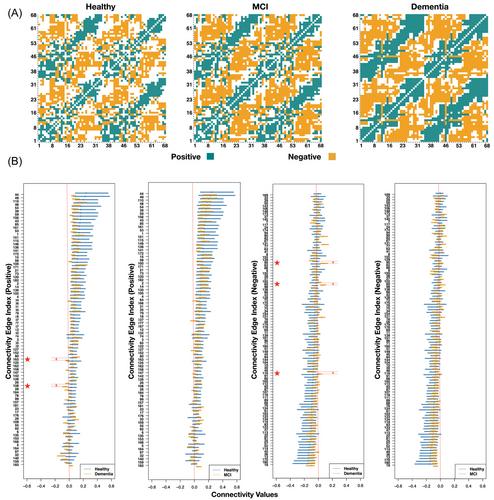
We find sex differences in network topology with females showing more default mode network (DMN)-centered hyperactivity and males showing more limbic system (LS)-centered hyperactivity, while both show DMN-centered hypoactivity. We find that centrality plays an important role in dementia-related dysfunction with stronger association between connectivity changes and regional centrality in females than in males.
DISCUSSION
The study contributes to the current literature by providing a more comprehensive picture of dementia-related neurodegeneration linking centrality, network segregation, and DMN-centered changes in functional connectomes, and how these components of neurodegeneration differ between the sexes.
Highlights
We find evidence supporting the active role network topology plays in neurodegeneration with an imbalance between the excitatory and inhibitory mechanisms that can lead to whole-brain destabilization in dementia patients.
We find sex-based differences in network topology with females showing more default mode network (DMN)-centered hyperactivity, males showing more limbic system (LS)-centered hyperactivity, while both show DMN-centered hypoactivity.
We find that brain region centrality plays an important role in dementia-related dysfunction with a stronger association between connectivity changes and regional centrality in females than in males.
Females, compared to males, tend to exhibit stronger dementia-related changes in regions that are the central actors of the brain networks.
Taken together, this research uniquely contributes to the current literature by providing a more comprehensive picture of dementia-related neurodegeneration linking centrality, network segregation, and DMN-centered changes in functional connectomes, and how these components of neurodegeneration differ between the sexes.
期刊介绍:
Alzheimer's & Dementia is a peer-reviewed journal that aims to bridge knowledge gaps in dementia research by covering the entire spectrum, from basic science to clinical trials to social and behavioral investigations. It provides a platform for rapid communication of new findings and ideas, optimal translation of research into practical applications, increasing knowledge across diverse disciplines for early detection, diagnosis, and intervention, and identifying promising new research directions. In July 2008, Alzheimer's & Dementia was accepted for indexing by MEDLINE, recognizing its scientific merit and contribution to Alzheimer's research.





 京公网安备 11010802042870号
京ICP备2023020795号-1
京公网安备 11010802042870号
京ICP备2023020795号-1

 分享
分享
 求助内容:
求助内容: 应助结果提醒方式:
 扫码关注我们
