Shanling Ren, Xiaocong Tan, Xin Huang, Zhihong Yang and Yunhui Wang
{"title":"Uniaxial tensile strain impact on 1T-NbS2 monolayers as cathode material for lithium–sulfur batteries†","authors":"Shanling Ren, Xiaocong Tan, Xin Huang, Zhihong Yang and Yunhui Wang","doi":"10.1039/D4CP03156C","DOIUrl":null,"url":null,"abstract":"<p >The application of lithium–sulfur (Li–S) batteries as efficient energy storage systems is hindered by the polysulfide shuttle and expansion effects. To overcome these obstacles, we employed density functional theory (DFT) to explore the 1T-NbS<small><sub>2</sub></small> monolayer as a cathode material for Li–S batteries, particularly focusing on the effects of uniaxial tensile strain. Our results indicate that the pristine 1T-NbS<small><sub>2</sub></small> monolayer presents a balanced adsorption affinity for LiPSs, thereby mitigating the shuttle effect. The bond formation information is investigated through comprehensive analysis of charge transfer, physical/chemical adsorption, and projected crystal orbital Hamiltonian population (pCOHP). The projected density of states (PDOS) analysis reveals the role of sulfur atoms near the Fermi surface in the lithiation process. Notably, the system keeps superior metallic characteristics, alongside a diminished decomposition energy barrier (0.45 eV), lowered lithium-ion migration energy barrier (0.16 eV), and a diminished positive Gibbs free energy change (0.41 eV) during the sulfur reduction reaction (SSR). The imposition of uniaxial tensile strain on the 1T-NbS<small><sub>2</sub></small> monolayer improves its adsorptive capacity for LiPSs and bolsters the retention of lithium–sulfur aggregates. These insights underscore the role of tensile strain in amplifying the efficiency of two-dimensional transition metal dichalcogenides as cathode materials of Li–S batteries.</p>","PeriodicalId":99,"journal":{"name":"Physical Chemistry Chemical Physics","volume":" 46","pages":" 29110-29120"},"PeriodicalIF":2.9000,"publicationDate":"2024-11-12","publicationTypes":"Journal Article","fieldsOfStudy":null,"isOpenAccess":false,"openAccessPdf":"","citationCount":"0","resultStr":null,"platform":"Semanticscholar","paperid":null,"PeriodicalName":"Physical Chemistry Chemical Physics","FirstCategoryId":"92","ListUrlMain":"https://pubs.rsc.org/en/content/articlelanding/2024/cp/d4cp03156c","RegionNum":3,"RegionCategory":"化学","ArticlePicture":[],"TitleCN":null,"AbstractTextCN":null,"PMCID":null,"EPubDate":"","PubModel":"","JCR":"Q3","JCRName":"CHEMISTRY, PHYSICAL","Score":null,"Total":0}
引用次数: 0
Abstract
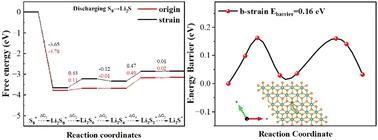
The application of lithium–sulfur (Li–S) batteries as efficient energy storage systems is hindered by the polysulfide shuttle and expansion effects. To overcome these obstacles, we employed density functional theory (DFT) to explore the 1T-NbS2 monolayer as a cathode material for Li–S batteries, particularly focusing on the effects of uniaxial tensile strain. Our results indicate that the pristine 1T-NbS2 monolayer presents a balanced adsorption affinity for LiPSs, thereby mitigating the shuttle effect. The bond formation information is investigated through comprehensive analysis of charge transfer, physical/chemical adsorption, and projected crystal orbital Hamiltonian population (pCOHP). The projected density of states (PDOS) analysis reveals the role of sulfur atoms near the Fermi surface in the lithiation process. Notably, the system keeps superior metallic characteristics, alongside a diminished decomposition energy barrier (0.45 eV), lowered lithium-ion migration energy barrier (0.16 eV), and a diminished positive Gibbs free energy change (0.41 eV) during the sulfur reduction reaction (SSR). The imposition of uniaxial tensile strain on the 1T-NbS2 monolayer improves its adsorptive capacity for LiPSs and bolsters the retention of lithium–sulfur aggregates. These insights underscore the role of tensile strain in amplifying the efficiency of two-dimensional transition metal dichalcogenides as cathode materials of Li–S batteries.
期刊介绍:
Physical Chemistry Chemical Physics (PCCP) is an international journal co-owned by 19 physical chemistry and physics societies from around the world. This journal publishes original, cutting-edge research in physical chemistry, chemical physics and biophysical chemistry. To be suitable for publication in PCCP, articles must include significant innovation and/or insight into physical chemistry; this is the most important criterion that reviewers and Editors will judge against when evaluating submissions.
The journal has a broad scope and welcomes contributions spanning experiment, theory, computation and data science. Topical coverage includes spectroscopy, dynamics, kinetics, statistical mechanics, thermodynamics, electrochemistry, catalysis, surface science, quantum mechanics, quantum computing and machine learning. Interdisciplinary research areas such as polymers and soft matter, materials, nanoscience, energy, surfaces/interfaces, and biophysical chemistry are welcomed if they demonstrate significant innovation and/or insight into physical chemistry. Joined experimental/theoretical studies are particularly appreciated when complementary and based on up-to-date approaches.




 京公网安备 11010802042870号
京ICP备2023020795号-1
京公网安备 11010802042870号
京ICP备2023020795号-1

 分享
分享
 求助内容:
求助内容: 应助结果提醒方式:
 扫码关注我们
