Thanveer Shaik;Xiaohui Tao;Haoran Xie;Lin Li;Xiaofeng Zhu;Qing Li
{"title":"Exploring the Landscape of Machine Unlearning: A Comprehensive Survey and Taxonomy","authors":"Thanveer Shaik;Xiaohui Tao;Haoran Xie;Lin Li;Xiaofeng Zhu;Qing Li","doi":"10.1109/TNNLS.2024.3486109","DOIUrl":null,"url":null,"abstract":"Machine unlearning (MU) is gaining increasing attention due to the need to remove or modify predictions made by machine learning (ML) models. While training models have become more efficient and accurate, the importance of unlearning previously learned information has become increasingly significant in fields such as privacy, security, and ethics. This article presents a comprehensive survey of MU, covering current state-of-the-art techniques and approaches, including data deletion, perturbation, and model updates. In addition, commonly used metrics and datasets are presented. This article also highlights the challenges that need to be addressed, including attack sophistication, standardization, transferability, interpretability, training data, and resource constraints. The contributions of this article include discussions about the potential benefits of MU and its future directions. Additionally, this article emphasizes the need for researchers and practitioners to continue exploring and refining unlearning techniques to ensure that ML models can adapt to changing circumstances while maintaining user trust. The importance of unlearning is further highlighted in making artificial intelligence (AI) more trustworthy and transparent, especially with the growing importance of AI across various domains that involve large amounts of personal user data.","PeriodicalId":13303,"journal":{"name":"IEEE transactions on neural networks and learning systems","volume":"36 7","pages":"11676-11696"},"PeriodicalIF":8.9000,"publicationDate":"2024-11-12","publicationTypes":"Journal Article","fieldsOfStudy":null,"isOpenAccess":false,"openAccessPdf":"","citationCount":"0","resultStr":null,"platform":"Semanticscholar","paperid":null,"PeriodicalName":"IEEE transactions on neural networks and learning systems","FirstCategoryId":"94","ListUrlMain":"https://ieeexplore.ieee.org/document/10750906/","RegionNum":1,"RegionCategory":"计算机科学","ArticlePicture":[],"TitleCN":null,"AbstractTextCN":null,"PMCID":null,"EPubDate":"","PubModel":"","JCR":"Q1","JCRName":"COMPUTER SCIENCE, ARTIFICIAL INTELLIGENCE","Score":null,"Total":0}
引用次数: 0
Abstract
Machine unlearning (MU) is gaining increasing attention due to the need to remove or modify predictions made by machine learning (ML) models. While training models have become more efficient and accurate, the importance of unlearning previously learned information has become increasingly significant in fields such as privacy, security, and ethics. This article presents a comprehensive survey of MU, covering current state-of-the-art techniques and approaches, including data deletion, perturbation, and model updates. In addition, commonly used metrics and datasets are presented. This article also highlights the challenges that need to be addressed, including attack sophistication, standardization, transferability, interpretability, training data, and resource constraints. The contributions of this article include discussions about the potential benefits of MU and its future directions. Additionally, this article emphasizes the need for researchers and practitioners to continue exploring and refining unlearning techniques to ensure that ML models can adapt to changing circumstances while maintaining user trust. The importance of unlearning is further highlighted in making artificial intelligence (AI) more trustworthy and transparent, especially with the growing importance of AI across various domains that involve large amounts of personal user data.
期刊介绍:
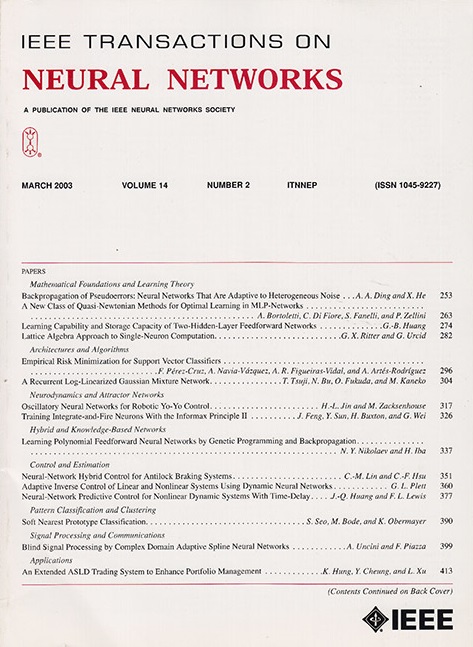
The focus of IEEE Transactions on Neural Networks and Learning Systems is to present scholarly articles discussing the theory, design, and applications of neural networks as well as other learning systems. The journal primarily highlights technical and scientific research in this domain.




 京公网安备 11010802042870号
京ICP备2023020795号-1
京公网安备 11010802042870号
京ICP备2023020795号-1

 分享
分享
 求助内容:
求助内容: 应助结果提醒方式:
 扫码关注我们
