{"title":"Distribution-Independent Domain Generalization for Multisource Remote Sensing Classification","authors":"Yunhao Gao;Mengmeng Zhang;Wei Li;Ran Tao","doi":"10.1109/TNNLS.2024.3490577","DOIUrl":null,"url":null,"abstract":"The availability of multisource remote sensing data provides the possibility for comprehensive observation. Convolutional neural networks (CNNs) naturally integrate multisource feature extractors and classifiers into an end-to-end multilayer design. However, CNN assumes data are independent and identically distributed. In practice, it is not always possible to access the labels or even data of the testing scenes. Therefore, the CNN-based methods have exposed its limitation on generalization ability. To solve the issue, a feature-distribution-independent network (FDINet) is designed for multisource remote sensing cross-domain classification without feature alignment and decoupling operations. On one hand, an elegantly designed baseline is used for extracting multisource cross-domain features. The baseline extracts the common line and texture features through shallow weight-sharing networks. More importantly, the modality prediction probability is used to measure the similarity between the source domains and the target domains, thereby improving cross-domain collaboration capabilities. On the other hand, the sharpness-aware feature discriminating (SAFD) strategy is developed for model optimization. Specifically, the generalization ability is improved by minimizing the sharpness of local optima. To avoid the decrease in feature discrimination caused by the gradient conflict between sharpness and overall loss, the discrimination constraints are designed to balance feature discrimination and generalization ability. Comprehensive experiments are conducted on two datasets, which demonstrate that the proposed FDINet outperforms other competitors in terms of quantitative and qualitative analyses.","PeriodicalId":13303,"journal":{"name":"IEEE transactions on neural networks and learning systems","volume":"36 7","pages":"13333-13344"},"PeriodicalIF":8.9000,"publicationDate":"2024-11-12","publicationTypes":"Journal Article","fieldsOfStudy":null,"isOpenAccess":false,"openAccessPdf":"","citationCount":"0","resultStr":null,"platform":"Semanticscholar","paperid":null,"PeriodicalName":"IEEE transactions on neural networks and learning systems","FirstCategoryId":"94","ListUrlMain":"https://ieeexplore.ieee.org/document/10750894/","RegionNum":1,"RegionCategory":"计算机科学","ArticlePicture":[],"TitleCN":null,"AbstractTextCN":null,"PMCID":null,"EPubDate":"","PubModel":"","JCR":"Q1","JCRName":"COMPUTER SCIENCE, ARTIFICIAL INTELLIGENCE","Score":null,"Total":0}
引用次数: 0
Abstract
The availability of multisource remote sensing data provides the possibility for comprehensive observation. Convolutional neural networks (CNNs) naturally integrate multisource feature extractors and classifiers into an end-to-end multilayer design. However, CNN assumes data are independent and identically distributed. In practice, it is not always possible to access the labels or even data of the testing scenes. Therefore, the CNN-based methods have exposed its limitation on generalization ability. To solve the issue, a feature-distribution-independent network (FDINet) is designed for multisource remote sensing cross-domain classification without feature alignment and decoupling operations. On one hand, an elegantly designed baseline is used for extracting multisource cross-domain features. The baseline extracts the common line and texture features through shallow weight-sharing networks. More importantly, the modality prediction probability is used to measure the similarity between the source domains and the target domains, thereby improving cross-domain collaboration capabilities. On the other hand, the sharpness-aware feature discriminating (SAFD) strategy is developed for model optimization. Specifically, the generalization ability is improved by minimizing the sharpness of local optima. To avoid the decrease in feature discrimination caused by the gradient conflict between sharpness and overall loss, the discrimination constraints are designed to balance feature discrimination and generalization ability. Comprehensive experiments are conducted on two datasets, which demonstrate that the proposed FDINet outperforms other competitors in terms of quantitative and qualitative analyses.
期刊介绍:
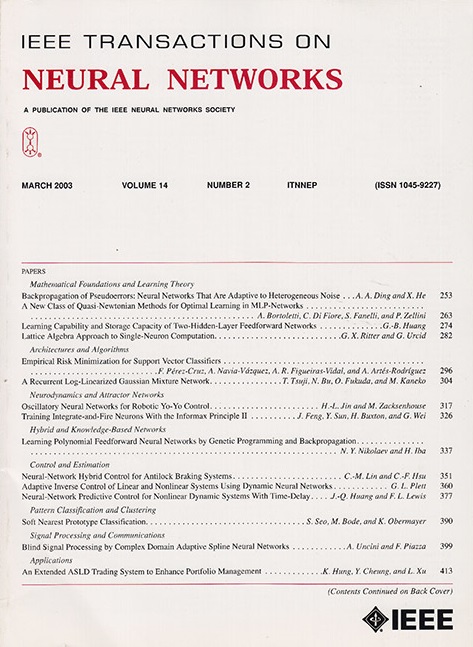
The focus of IEEE Transactions on Neural Networks and Learning Systems is to present scholarly articles discussing the theory, design, and applications of neural networks as well as other learning systems. The journal primarily highlights technical and scientific research in this domain.




 京公网安备 11010802042870号
京ICP备2023020795号-1
京公网安备 11010802042870号
京ICP备2023020795号-1

 分享
分享
 求助内容:
求助内容: 应助结果提醒方式:
 扫码关注我们
