Anna H. Boerwinkle, Julie K. Wisch, Benjamin L. Handen, Elizabeth Head, Mark Mapstone, Michael S. Rafii, Sid E. O'Bryant, Sharon J. Krinsky-McHale, Florence Lai, H. Diana Rosas, Shahid Zaman, Ira T. Lott, Dana Tudorascu, Matthew Zammit, Adam M. Brickman, Joseph H. Lee, Beau M. Ances, the Alzheimer's Biomarker Consortium-Down Syndrome
{"title":"The mediating role of plasma glial fibrillary acidic protein in amyloid and tau pathology in Down's syndrome","authors":"Anna H. Boerwinkle, Julie K. Wisch, Benjamin L. Handen, Elizabeth Head, Mark Mapstone, Michael S. Rafii, Sid E. O'Bryant, Sharon J. Krinsky-McHale, Florence Lai, H. Diana Rosas, Shahid Zaman, Ira T. Lott, Dana Tudorascu, Matthew Zammit, Adam M. Brickman, Joseph H. Lee, Beau M. Ances, the Alzheimer's Biomarker Consortium-Down Syndrome","doi":"10.1002/alz.14359","DOIUrl":null,"url":null,"abstract":"<div>\n \n \n <section>\n \n <h3> INTRODUCTION</h3>\n \n <p>Development of Alzheimer's disease (AD) pathology in Down's syndrome (DS) occurs within a compressed timeline compared to sporadic or other genetic forms of AD.</p>\n </section>\n \n <section>\n \n <h3> METHODS</h3>\n \n <p>Plasma glial fibrillary acidic protein (GFAP) and plasma pTau-217 levels were compared by AD pathophysiology (amyloid (A+) and tau (T+) positron emission tomography [PET]) in persons with DS (<i>N</i> = 348) and sibling controls (<i>N</i> = 42). Plasma GFAP, plasma pTau-217, amyloid-PET, and tau-PET levels were compared with regard to estimated years to onset of clinical symptoms (52.5 years old). We evaluated if plasma GFAP mediated the relationship between amyloid PET and plasma pTau-217 or tau PET.</p>\n </section>\n \n <section>\n \n <h3> RESULTS</h3>\n \n <p>Plasma GFAP, a measure of astrogliosis, was elevated in A+/T- and A+/T+ individuals with DS. Plasma pTau-217 was elevated in A+/T+ individuals with DS. GFAP partially mediated the relationship between amyloid-PET and tau-PET (15.3%) and amyloid-PET and plasma pTau-217 (42.1%).</p>\n </section>\n \n <section>\n \n <h3> DISCUSSION</h3>\n \n <p>Astrogliosis is a key component in the advancement of preclinical AD pathophysiology in DS.</p>\n </section>\n \n <section>\n \n <h3> Highlights</h3>\n \n <div>\n <ul>\n \n <li>\n <p>Amyloid may be a necessary precursor for stimulating astrocytes.</p>\n </li>\n \n <li>\n <p>Astrogliosis may play a key role in modifications to tau phosphorylation.</p>\n </li>\n \n <li>\n <p>Targeting neuroinflammation may only aid amyloid positive individuals.</p>\n </li>\n \n <li>\n <p>Alzheimer's disease timecourse is compressed in individuals with Down's syndrome.</p>\n </li>\n </ul>\n </div>\n </section>\n </div>","PeriodicalId":7471,"journal":{"name":"Alzheimer's & Dementia","volume":"21 1","pages":""},"PeriodicalIF":11.1000,"publicationDate":"2024-11-13","publicationTypes":"Journal Article","fieldsOfStudy":null,"isOpenAccess":false,"openAccessPdf":"https://onlinelibrary.wiley.com/doi/epdf/10.1002/alz.14359","citationCount":"0","resultStr":null,"platform":"Semanticscholar","paperid":null,"PeriodicalName":"Alzheimer's & Dementia","FirstCategoryId":"3","ListUrlMain":"https://alz-journals.onlinelibrary.wiley.com/doi/10.1002/alz.14359","RegionNum":1,"RegionCategory":"医学","ArticlePicture":[],"TitleCN":null,"AbstractTextCN":null,"PMCID":null,"EPubDate":"","PubModel":"","JCR":"Q1","JCRName":"CLINICAL NEUROLOGY","Score":null,"Total":0}
引用次数: 0
Abstract
INTRODUCTION
Development of Alzheimer's disease (AD) pathology in Down's syndrome (DS) occurs within a compressed timeline compared to sporadic or other genetic forms of AD.
METHODS
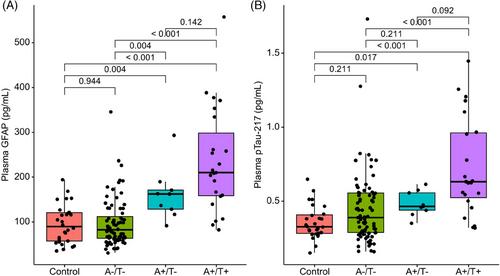
Plasma glial fibrillary acidic protein (GFAP) and plasma pTau-217 levels were compared by AD pathophysiology (amyloid (A+) and tau (T+) positron emission tomography [PET]) in persons with DS (N = 348) and sibling controls (N = 42). Plasma GFAP, plasma pTau-217, amyloid-PET, and tau-PET levels were compared with regard to estimated years to onset of clinical symptoms (52.5 years old). We evaluated if plasma GFAP mediated the relationship between amyloid PET and plasma pTau-217 or tau PET.
RESULTS
Plasma GFAP, a measure of astrogliosis, was elevated in A+/T- and A+/T+ individuals with DS. Plasma pTau-217 was elevated in A+/T+ individuals with DS. GFAP partially mediated the relationship between amyloid-PET and tau-PET (15.3%) and amyloid-PET and plasma pTau-217 (42.1%).
DISCUSSION
Astrogliosis is a key component in the advancement of preclinical AD pathophysiology in DS.
Highlights
Amyloid may be a necessary precursor for stimulating astrocytes.
Astrogliosis may play a key role in modifications to tau phosphorylation.
Targeting neuroinflammation may only aid amyloid positive individuals.
Alzheimer's disease timecourse is compressed in individuals with Down's syndrome.
期刊介绍:
Alzheimer's & Dementia is a peer-reviewed journal that aims to bridge knowledge gaps in dementia research by covering the entire spectrum, from basic science to clinical trials to social and behavioral investigations. It provides a platform for rapid communication of new findings and ideas, optimal translation of research into practical applications, increasing knowledge across diverse disciplines for early detection, diagnosis, and intervention, and identifying promising new research directions. In July 2008, Alzheimer's & Dementia was accepted for indexing by MEDLINE, recognizing its scientific merit and contribution to Alzheimer's research.





 京公网安备 11010802042870号
京ICP备2023020795号-1
京公网安备 11010802042870号
京ICP备2023020795号-1

 分享
分享
 求助内容:
求助内容: 应助结果提醒方式:
 扫码关注我们
