{"title":"Thermal Modeling of an Outer Rotor PM Assisted SynRM for the Electric Bike Applications Using a New 3-D LPTN","authors":"Reza Nasiri-Zarandi;Mohammad Farahzadi;Mohammad Sedigh Toulabi","doi":"10.1109/TTE.2024.3496787","DOIUrl":null,"url":null,"abstract":"Thermal evaluation of permanent magnet-assisted synchronous reluctance motors (PMaSynRMs) with an outer rotor has not been performed as of yet. Consequently, to fill this gap in the existing literature, this article will be conducting detailed thermal modeling by a developed 3-D lumped parameter thermal network (3-D LPTN) technique on an outer rotor PMaSynRM. For the first time in this study, the developed 3-D LPTN is directly solved in the MATLAB Simulink environment to save time and avoid computational errors, while the losses as heat sources in all parts of the motor are calculated using 3-D finite element method (3-D FEM) to improve accuracy. In order to implement this thermal modeling, it is necessary to establish a unified thermal circuit by including the circuits associated with output temperatures and heat sources, as well as some of the blocks, into the 3-D LPTN created in MATLAB Simulink. In this regard, the developed LPTN technique takes into consideration the thermal resistances of convection, conduction, and contact in the radial, axial, and circumferential directions. In this technique, it is possible to quickly and accurately calculate the temperatures of all nodes at various operating points by only updating the heat sources and thermal resistances of the unified thermal circuit. This is an advantage that this technique has over the 2-D/3-D FEM, computational fluid dynamics (CFD), and conventional 2-D/3-D LPTN methods. Finally, the developed 3-D LPTN technique is validated through experiments conducted on a 550 W outer rotor PMaSynRM for electric bike (e-bike) applications.","PeriodicalId":56269,"journal":{"name":"IEEE Transactions on Transportation Electrification","volume":"11 2","pages":"6060-6073"},"PeriodicalIF":8.3000,"publicationDate":"2024-11-12","publicationTypes":"Journal Article","fieldsOfStudy":null,"isOpenAccess":false,"openAccessPdf":"","citationCount":"0","resultStr":null,"platform":"Semanticscholar","paperid":null,"PeriodicalName":"IEEE Transactions on Transportation Electrification","FirstCategoryId":"5","ListUrlMain":"https://ieeexplore.ieee.org/document/10750876/","RegionNum":1,"RegionCategory":"工程技术","ArticlePicture":[],"TitleCN":null,"AbstractTextCN":null,"PMCID":null,"EPubDate":"","PubModel":"","JCR":"Q1","JCRName":"ENGINEERING, ELECTRICAL & ELECTRONIC","Score":null,"Total":0}
引用次数: 0
Abstract
Thermal evaluation of permanent magnet-assisted synchronous reluctance motors (PMaSynRMs) with an outer rotor has not been performed as of yet. Consequently, to fill this gap in the existing literature, this article will be conducting detailed thermal modeling by a developed 3-D lumped parameter thermal network (3-D LPTN) technique on an outer rotor PMaSynRM. For the first time in this study, the developed 3-D LPTN is directly solved in the MATLAB Simulink environment to save time and avoid computational errors, while the losses as heat sources in all parts of the motor are calculated using 3-D finite element method (3-D FEM) to improve accuracy. In order to implement this thermal modeling, it is necessary to establish a unified thermal circuit by including the circuits associated with output temperatures and heat sources, as well as some of the blocks, into the 3-D LPTN created in MATLAB Simulink. In this regard, the developed LPTN technique takes into consideration the thermal resistances of convection, conduction, and contact in the radial, axial, and circumferential directions. In this technique, it is possible to quickly and accurately calculate the temperatures of all nodes at various operating points by only updating the heat sources and thermal resistances of the unified thermal circuit. This is an advantage that this technique has over the 2-D/3-D FEM, computational fluid dynamics (CFD), and conventional 2-D/3-D LPTN methods. Finally, the developed 3-D LPTN technique is validated through experiments conducted on a 550 W outer rotor PMaSynRM for electric bike (e-bike) applications.
期刊介绍:
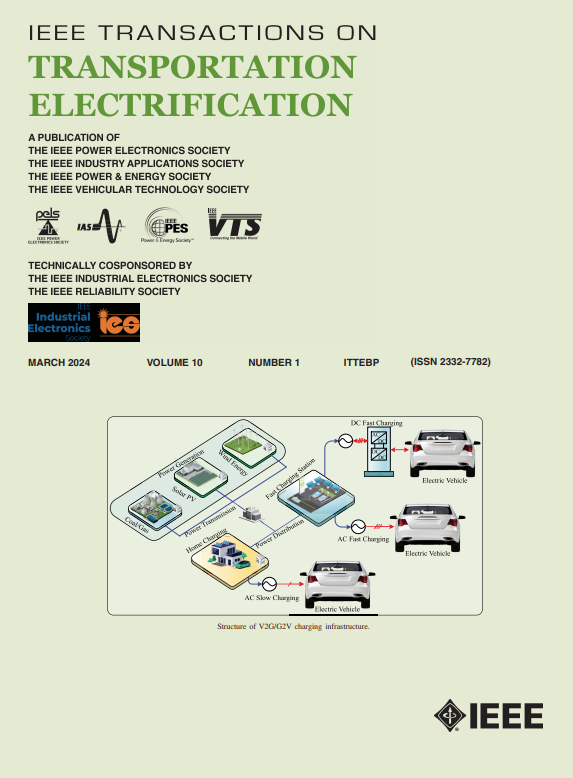
IEEE Transactions on Transportation Electrification is focused on components, sub-systems, systems, standards, and grid interface technologies related to power and energy conversion, propulsion, and actuation for all types of electrified vehicles including on-road, off-road, off-highway, and rail vehicles, airplanes, and ships.



 京公网安备 11010802042870号
京ICP备2023020795号-1
京公网安备 11010802042870号
京ICP备2023020795号-1

 分享
分享
 求助内容:
求助内容: 应助结果提醒方式:
 扫码关注我们
