Association between glucagon-like peptide-1 receptor agonist use and progression of monoclonal gammopathy of uncertain significance to multiple myeloma among patients with diabetes.
Nikhil Grandhi, Lawrence Liu, Mei Wang, Theodore Thomas, Martin Schoen, Kristen Sanfilippo, Feng Gao, Graham A Colditz, Kenneth R Carson, Murali Janakiram, Su-Hsin Chang
{"title":"Association between glucagon-like peptide-1 receptor agonist use and progression of monoclonal gammopathy of uncertain significance to multiple myeloma among patients with diabetes.","authors":"Nikhil Grandhi, Lawrence Liu, Mei Wang, Theodore Thomas, Martin Schoen, Kristen Sanfilippo, Feng Gao, Graham A Colditz, Kenneth R Carson, Murali Janakiram, Su-Hsin Chang","doi":"10.1093/jncics/pkae095","DOIUrl":null,"url":null,"abstract":"<p><strong>Background: </strong>In patients with diabetes and monoclonal gammopathy of uncertain significance (MGUS), the impact of glucagon-like peptide-1 (GLP-1) receptor agonists on the natural history of MGUS is unknown. We aimed to assess the association of GLP-1 receptor agonist use in the progression of MGUS to multiple myeloma in patients with diabetes.</p><p><strong>Methods: </strong>This is a population-based cohort study of veterans diagnosed with MGUS from 2006 to 2021 with a prior diagnosis of diabetes. A validated natural language processing algorithm was used to confirm MGUS and progression to multiple myeloma. We performed 1:2 matching for individuals with and without GLP-1 receptor agonist exposure. The Gray test was performed to detect the difference in cumulative incidence functions for progression by GLP-1 receptor agonist use status. The association between time-varying GLP-1 receptor agonist use and progression was estimated through multivariable-adjusted hazard ratio using a stratified Fine-Gray distribution hazard model, with death as a competing event and stratum for the matched patient triad.</p><p><strong>Results: </strong>Our matched cohort included 1097 individuals with MGUS who had ever used GLP-1 receptor agonists and the matched 2194 patients who had never used GLP-1 receptor agonists. Overall, 2.6% of individuals progressed in the GLP-1 receptor agonist ever use group compared with 5.0% in the GLP-1 receptor agonist never use group. Cumulative incidence functions were statistically significantly different between the exposed and unexposed groups (P = .02). GLP-1 receptor agonist use vs no use was associated with decreased progression to multiple myeloma (hazard ratio = 0.45, 95% confidence interval = 0.22 to 0.93, P = .03).</p><p><strong>Conclusions: </strong>For patients with diabetes and MGUS, GLP-1 receptor agonist use is associated with a 55% reduction in risk of progression from MGUS to multiple myeloma compared with no use.</p>","PeriodicalId":14681,"journal":{"name":"JNCI Cancer Spectrum","volume":" ","pages":""},"PeriodicalIF":4.1000,"publicationDate":"2024-11-01","publicationTypes":"Journal Article","fieldsOfStudy":null,"isOpenAccess":false,"openAccessPdf":"https://www.ncbi.nlm.nih.gov/pmc/articles/PMC11643351/pdf/","citationCount":"0","resultStr":null,"platform":"Semanticscholar","paperid":null,"PeriodicalName":"JNCI Cancer Spectrum","FirstCategoryId":"1085","ListUrlMain":"https://doi.org/10.1093/jncics/pkae095","RegionNum":0,"RegionCategory":null,"ArticlePicture":[],"TitleCN":null,"AbstractTextCN":null,"PMCID":null,"EPubDate":"","PubModel":"","JCR":"Q2","JCRName":"ONCOLOGY","Score":null,"Total":0}
引用次数: 0
Abstract
Background: In patients with diabetes and monoclonal gammopathy of uncertain significance (MGUS), the impact of glucagon-like peptide-1 (GLP-1) receptor agonists on the natural history of MGUS is unknown. We aimed to assess the association of GLP-1 receptor agonist use in the progression of MGUS to multiple myeloma in patients with diabetes.
Methods: This is a population-based cohort study of veterans diagnosed with MGUS from 2006 to 2021 with a prior diagnosis of diabetes. A validated natural language processing algorithm was used to confirm MGUS and progression to multiple myeloma. We performed 1:2 matching for individuals with and without GLP-1 receptor agonist exposure. The Gray test was performed to detect the difference in cumulative incidence functions for progression by GLP-1 receptor agonist use status. The association between time-varying GLP-1 receptor agonist use and progression was estimated through multivariable-adjusted hazard ratio using a stratified Fine-Gray distribution hazard model, with death as a competing event and stratum for the matched patient triad.
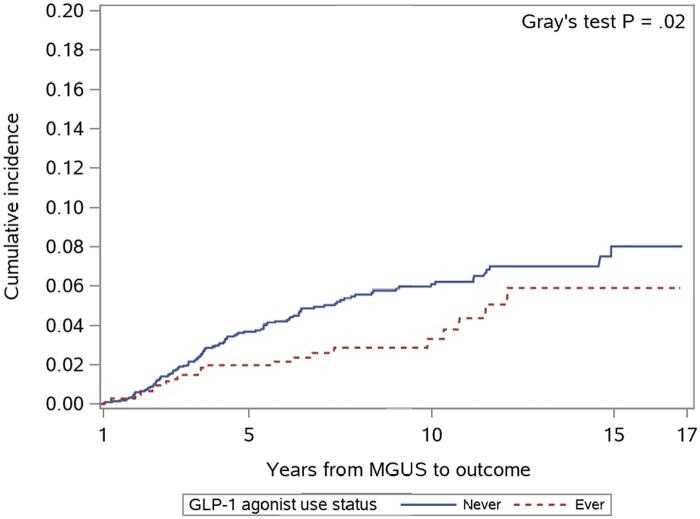
Results: Our matched cohort included 1097 individuals with MGUS who had ever used GLP-1 receptor agonists and the matched 2194 patients who had never used GLP-1 receptor agonists. Overall, 2.6% of individuals progressed in the GLP-1 receptor agonist ever use group compared with 5.0% in the GLP-1 receptor agonist never use group. Cumulative incidence functions were statistically significantly different between the exposed and unexposed groups (P = .02). GLP-1 receptor agonist use vs no use was associated with decreased progression to multiple myeloma (hazard ratio = 0.45, 95% confidence interval = 0.22 to 0.93, P = .03).
Conclusions: For patients with diabetes and MGUS, GLP-1 receptor agonist use is associated with a 55% reduction in risk of progression from MGUS to multiple myeloma compared with no use.




 京公网安备 11010802042870号
京ICP备2023020795号-1
京公网安备 11010802042870号
京ICP备2023020795号-1

 分享
分享
 求助内容:
求助内容: 应助结果提醒方式:
 扫码关注我们
