Taciano A. S. Wanderley, Roberto Buscemi, Órla Conboy, Benjamin Knight, Giacomo E. M. Crisenza
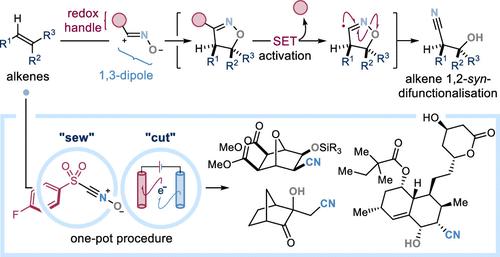
{"title":"General Alkene 1,2-syn-Cyano-Hydroxylation Procedure Via Electrochemical Activation of Isoxazoline Cycloadducts","authors":"Taciano A. S. Wanderley, Roberto Buscemi, Órla Conboy, Benjamin Knight, Giacomo E. M. Crisenza","doi":"10.1021/jacs.4c13682","DOIUrl":null,"url":null,"abstract":"Stereoselective alkene 1,2-difunctionalization is a privileged strategy to access three-dimensional C(sp<sup>3</sup>)-rich chiral molecules from readily available “flat” carbon feedstocks. State-of-the-art approaches exploit chiral transition metal-catalysts to enable high levels of regio- and stereocontrol. However, this is often achieved at the expense of a limited alkene scope and reduced generality. 1,3-Dipolar cycloadditions are routinely used to form heterocycles from alkenes with high levels of regioselectivity and stereospecificity. Nevertheless, methods for the ring-opening of cycloadducts to reveal synthetically useful functionalities require the use of hazardous reagents or forcing reaction conditions; thus limiting their synthetic applications. Herein, we describe the implementation of a practical, general and selective electrosynthetic strategy for olefin 1,2-<i>syn</i>-difunctionalization, which hinges on the design of novel reagents–consisting of a nitrile oxide 1,3-dipole precursor, equipped with a sulfonyl-handle. These can selectively difunctionalize alkenes via “click” 1,3-dipolar cycloadditions, and then facilitate the telescoped electrochemical single electron transfer activation of the ensuing isoxazoline intermediate. Cathodic reduction of the cycloadduct triggers a radical fragmentation pathway delivering sought-after stereodefined 1,2-<i>syn</i>-hydroxy nitrile derivatives. Our telescoped electrochemical procedure tolerates a wide range of functionalities, and─crucially─enables the difunctionalization of both electron-rich, electron-poor and unactivated olefins, with diverse degree of substitution; thus providing a robust, general and selective metal-free alternative to current alkene difunctionalization strategies. Capitalizing on these features, we employed our electrosynthetic method to enable the late-stage <i>syn</i>-hydroxy-cyanation of natural products and bioactive compounds, and streamline the <i>de novo</i> synthesis of pharmaceutical agents.","PeriodicalId":49,"journal":{"name":"Journal of the American Chemical Society","volume":"20 1","pages":""},"PeriodicalIF":15.6000,"publicationDate":"2024-11-13","publicationTypes":"Journal Article","fieldsOfStudy":null,"isOpenAccess":false,"openAccessPdf":"","citationCount":"0","resultStr":null,"platform":"Semanticscholar","paperid":null,"PeriodicalName":"Journal of the American Chemical Society","FirstCategoryId":"92","ListUrlMain":"https://doi.org/10.1021/jacs.4c13682","RegionNum":1,"RegionCategory":"化学","ArticlePicture":[],"TitleCN":null,"AbstractTextCN":null,"PMCID":null,"EPubDate":"","PubModel":"","JCR":"Q1","JCRName":"CHEMISTRY, MULTIDISCIPLINARY","Score":null,"Total":0}
引用次数: 0
Abstract
Stereoselective alkene 1,2-difunctionalization is a privileged strategy to access three-dimensional C(sp3)-rich chiral molecules from readily available “flat” carbon feedstocks. State-of-the-art approaches exploit chiral transition metal-catalysts to enable high levels of regio- and stereocontrol. However, this is often achieved at the expense of a limited alkene scope and reduced generality. 1,3-Dipolar cycloadditions are routinely used to form heterocycles from alkenes with high levels of regioselectivity and stereospecificity. Nevertheless, methods for the ring-opening of cycloadducts to reveal synthetically useful functionalities require the use of hazardous reagents or forcing reaction conditions; thus limiting their synthetic applications. Herein, we describe the implementation of a practical, general and selective electrosynthetic strategy for olefin 1,2-syn-difunctionalization, which hinges on the design of novel reagents–consisting of a nitrile oxide 1,3-dipole precursor, equipped with a sulfonyl-handle. These can selectively difunctionalize alkenes via “click” 1,3-dipolar cycloadditions, and then facilitate the telescoped electrochemical single electron transfer activation of the ensuing isoxazoline intermediate. Cathodic reduction of the cycloadduct triggers a radical fragmentation pathway delivering sought-after stereodefined 1,2-syn-hydroxy nitrile derivatives. Our telescoped electrochemical procedure tolerates a wide range of functionalities, and─crucially─enables the difunctionalization of both electron-rich, electron-poor and unactivated olefins, with diverse degree of substitution; thus providing a robust, general and selective metal-free alternative to current alkene difunctionalization strategies. Capitalizing on these features, we employed our electrosynthetic method to enable the late-stage syn-hydroxy-cyanation of natural products and bioactive compounds, and streamline the de novo synthesis of pharmaceutical agents.
期刊介绍:
The flagship journal of the American Chemical Society, known as the Journal of the American Chemical Society (JACS), has been a prestigious publication since its establishment in 1879. It holds a preeminent position in the field of chemistry and related interdisciplinary sciences. JACS is committed to disseminating cutting-edge research papers, covering a wide range of topics, and encompasses approximately 19,000 pages of Articles, Communications, and Perspectives annually. With a weekly publication frequency, JACS plays a vital role in advancing the field of chemistry by providing essential research.



 京公网安备 11010802042870号
京ICP备2023020795号-1
京公网安备 11010802042870号
京ICP备2023020795号-1

 分享
分享
 求助内容:
求助内容: 应助结果提醒方式:
 扫码关注我们
