Feng Qiu, Chunyan Li, Xiaodong Xuan, Senhe Huang, Chenbao Lu, Hualin Lin, Sheng Han, Xiaodong Zhuang and Wai-Yeung Wong
{"title":"Promoting CO2 electroreduction activity of porphyrinic conjugated microporous polyanilines via accelerating proton transfer dynamics†","authors":"Feng Qiu, Chunyan Li, Xiaodong Xuan, Senhe Huang, Chenbao Lu, Hualin Lin, Sheng Han, Xiaodong Zhuang and Wai-Yeung Wong","doi":"10.1039/D4TA05918B","DOIUrl":null,"url":null,"abstract":"<p >Conjugated microporous polymers (CMPs) with π-conjugated frameworks, inherent porosity and tunable structures have been considered promising platforms as electrocatalysts for the carbon dioxide reduction reaction (CO<small><sub>2</sub></small>RR). Promoting proton transfer dynamics to modulate the microenvironment of active sites in CMPs plays an important role in the improvement of their electrocatalytic activity. Herein, we developed a series of novel porphyrinic conjugated microporous polyanilines (CMPANI-<em>n</em>) constructed from tetrabromo-cobalt(<small>II</small>) porphyrin and diamino aromatics using the Buchwald–Hartwig coupling polymerization approach. Owing to the three-dimensional geometry of these polymeric skeletons, the microenvironment of catalytic CoN<small><sub>4</sub></small> sites could be readily regulated by the incorporation of nitrogen-doped diamino aromatics, leading to the enhancement of electrocatalytic activity for carbon monoxide (CO) production. Notably, pyrazine-containing CMPANI (CMPANI-3) shows high CO faradaic efficiency (FE<small><sub>CO</sub></small>) (97 % at −0.7 V <em>vs.</em> RHE), excellent turnover frequency (TOF) (2264 h<small><sup>−1</sup></small> at −0.7 V <em>vs.</em> RHE) and large current density (>200 mA cm<small><sup>−2</sup></small>). The kinetic isotope effect results indicate that the pyrazinyl-N in CMPANI-3 facilitates efficient proton absorption and transfer. Moreover, <em>in situ</em> Fourier transform infrared spectra demonstrate that the protonated pyrazinyl-N promotes the generation and stabilization of the *COOH intermediate <em>via</em> coordination interactions around the CoN<small><sub>4</sub></small> site, thus favoring the electroreduction of CO<small><sub>2</sub></small> to CO. This work provides a new insight into the design of polymeric electrocatalyst systems with superior electron and proton transport for boosting CO<small><sub>2</sub></small>RR applications.</p>","PeriodicalId":82,"journal":{"name":"Journal of Materials Chemistry A","volume":" 48","pages":" 33572-33580"},"PeriodicalIF":9.5000,"publicationDate":"2024-11-14","publicationTypes":"Journal Article","fieldsOfStudy":null,"isOpenAccess":false,"openAccessPdf":"","citationCount":"0","resultStr":null,"platform":"Semanticscholar","paperid":null,"PeriodicalName":"Journal of Materials Chemistry A","FirstCategoryId":"88","ListUrlMain":"https://pubs.rsc.org/en/content/articlelanding/2024/ta/d4ta05918b","RegionNum":2,"RegionCategory":"材料科学","ArticlePicture":[],"TitleCN":null,"AbstractTextCN":null,"PMCID":null,"EPubDate":"","PubModel":"","JCR":"Q1","JCRName":"CHEMISTRY, PHYSICAL","Score":null,"Total":0}
引用次数: 0
Abstract
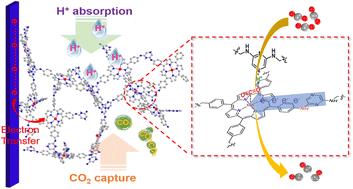
Conjugated microporous polymers (CMPs) with π-conjugated frameworks, inherent porosity and tunable structures have been considered promising platforms as electrocatalysts for the carbon dioxide reduction reaction (CO2RR). Promoting proton transfer dynamics to modulate the microenvironment of active sites in CMPs plays an important role in the improvement of their electrocatalytic activity. Herein, we developed a series of novel porphyrinic conjugated microporous polyanilines (CMPANI-n) constructed from tetrabromo-cobalt(II) porphyrin and diamino aromatics using the Buchwald–Hartwig coupling polymerization approach. Owing to the three-dimensional geometry of these polymeric skeletons, the microenvironment of catalytic CoN4 sites could be readily regulated by the incorporation of nitrogen-doped diamino aromatics, leading to the enhancement of electrocatalytic activity for carbon monoxide (CO) production. Notably, pyrazine-containing CMPANI (CMPANI-3) shows high CO faradaic efficiency (FECO) (97 % at −0.7 V vs. RHE), excellent turnover frequency (TOF) (2264 h−1 at −0.7 V vs. RHE) and large current density (>200 mA cm−2). The kinetic isotope effect results indicate that the pyrazinyl-N in CMPANI-3 facilitates efficient proton absorption and transfer. Moreover, in situ Fourier transform infrared spectra demonstrate that the protonated pyrazinyl-N promotes the generation and stabilization of the *COOH intermediate via coordination interactions around the CoN4 site, thus favoring the electroreduction of CO2 to CO. This work provides a new insight into the design of polymeric electrocatalyst systems with superior electron and proton transport for boosting CO2RR applications.
期刊介绍:
The Journal of Materials Chemistry A, B & C covers a wide range of high-quality studies in the field of materials chemistry, with each section focusing on specific applications of the materials studied. Journal of Materials Chemistry A emphasizes applications in energy and sustainability, including topics such as artificial photosynthesis, batteries, and fuel cells. Journal of Materials Chemistry B focuses on applications in biology and medicine, while Journal of Materials Chemistry C covers applications in optical, magnetic, and electronic devices. Example topic areas within the scope of Journal of Materials Chemistry A include catalysis, green/sustainable materials, sensors, and water treatment, among others.



 京公网安备 11010802042870号
京ICP备2023020795号-1
京公网安备 11010802042870号
京ICP备2023020795号-1

 分享
分享
 求助内容:
求助内容: 应助结果提醒方式:
 扫码关注我们
