Tao Liu, Lin-Jun Zhang, Cheng-Feng Xiong, Guan-Hua Jiao, Yin-Sheng Tan, Jie Hou, Hui Shi, Jun Feng, Xian-Zheng Zhang
{"title":"In Situ Construction of Bacterial Dressing for Low-Temperature Sterilization in Infected Lesions","authors":"Tao Liu, Lin-Jun Zhang, Cheng-Feng Xiong, Guan-Hua Jiao, Yin-Sheng Tan, Jie Hou, Hui Shi, Jun Feng, Xian-Zheng Zhang","doi":"10.1021/acs.chemmater.4c01603","DOIUrl":null,"url":null,"abstract":"While photothermal sterilization offers significant advantages over antibiotics for treating surgical site infections, its application is limited by side effects caused by excessive heat. To address this dilemma, this study focuses on the often-overlooked factor of temperature inhomogeneity within irradiated regions, which impacts photothermal efficacy. We propose a solution termed “bacterial photothermal dressing”. In this approach, tannic acid (TA) first attaches to bacteria or biofilm and subsequently captures surrounding Fe<sup>III</sup> ions to form a close-fitting Fe<sup>III</sup>TA dressing <i>in situ</i>. For comparison, a conventional photothermal sterilization method is established by directly administering Fe<sup>III</sup>TA nanoparticles to infected sites. The bacterial photothermal dressing approach allows for bacterial elimination at much lower temperatures, minimizing heat-related side effects. Moreover, the acidic microenvironment within the biofilm can trigger the gradual release of TA, permitting continuous antiseptic and anti-inflammatory effects. This sustained activity enhances antibacterial efficacy and helps prevent secondary infection following photothermal treatment. Consequently, this approach significantly accelerates wound healing by improving bactericidal efficiency and reducing inflammatory responses.","PeriodicalId":33,"journal":{"name":"Chemistry of Materials","volume":"11 1","pages":""},"PeriodicalIF":7.0000,"publicationDate":"2024-11-14","publicationTypes":"Journal Article","fieldsOfStudy":null,"isOpenAccess":false,"openAccessPdf":"","citationCount":"0","resultStr":null,"platform":"Semanticscholar","paperid":null,"PeriodicalName":"Chemistry of Materials","FirstCategoryId":"88","ListUrlMain":"https://doi.org/10.1021/acs.chemmater.4c01603","RegionNum":2,"RegionCategory":"材料科学","ArticlePicture":[],"TitleCN":null,"AbstractTextCN":null,"PMCID":null,"EPubDate":"","PubModel":"","JCR":"Q2","JCRName":"CHEMISTRY, PHYSICAL","Score":null,"Total":0}
引用次数: 0
Abstract
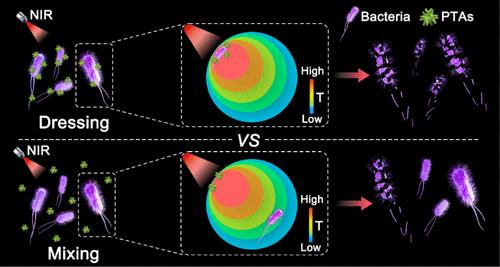
While photothermal sterilization offers significant advantages over antibiotics for treating surgical site infections, its application is limited by side effects caused by excessive heat. To address this dilemma, this study focuses on the often-overlooked factor of temperature inhomogeneity within irradiated regions, which impacts photothermal efficacy. We propose a solution termed “bacterial photothermal dressing”. In this approach, tannic acid (TA) first attaches to bacteria or biofilm and subsequently captures surrounding FeIII ions to form a close-fitting FeIIITA dressing in situ. For comparison, a conventional photothermal sterilization method is established by directly administering FeIIITA nanoparticles to infected sites. The bacterial photothermal dressing approach allows for bacterial elimination at much lower temperatures, minimizing heat-related side effects. Moreover, the acidic microenvironment within the biofilm can trigger the gradual release of TA, permitting continuous antiseptic and anti-inflammatory effects. This sustained activity enhances antibacterial efficacy and helps prevent secondary infection following photothermal treatment. Consequently, this approach significantly accelerates wound healing by improving bactericidal efficiency and reducing inflammatory responses.
期刊介绍:
The journal Chemistry of Materials focuses on publishing original research at the intersection of materials science and chemistry. The studies published in the journal involve chemistry as a prominent component and explore topics such as the design, synthesis, characterization, processing, understanding, and application of functional or potentially functional materials. The journal covers various areas of interest, including inorganic and organic solid-state chemistry, nanomaterials, biomaterials, thin films and polymers, and composite/hybrid materials. The journal particularly seeks papers that highlight the creation or development of innovative materials with novel optical, electrical, magnetic, catalytic, or mechanical properties. It is essential that manuscripts on these topics have a primary focus on the chemistry of materials and represent a significant advancement compared to prior research. Before external reviews are sought, submitted manuscripts undergo a review process by a minimum of two editors to ensure their appropriateness for the journal and the presence of sufficient evidence of a significant advance that will be of broad interest to the materials chemistry community.



 京公网安备 11010802042870号
京ICP备2023020795号-1
京公网安备 11010802042870号
京ICP备2023020795号-1

 分享
分享
 求助内容:
求助内容: 应助结果提醒方式:
 扫码关注我们
