Dayang Wang;Feng-Lei Fan;Bo-Jian Hou;Hao Zhang;Zhen Jia;Boce Zhang;Rongjie Lai;Hengyong Yu;Fei Wang
{"title":"Manifoldron: Direct Space Partition via Manifold Discovery","authors":"Dayang Wang;Feng-Lei Fan;Bo-Jian Hou;Hao Zhang;Zhen Jia;Boce Zhang;Rongjie Lai;Hengyong Yu;Fei Wang","doi":"10.1109/TNNLS.2024.3486252","DOIUrl":null,"url":null,"abstract":"A neural network (NN) with the widely-used ReLU activation has been shown to partition the sample space into many convex polytopes for prediction. However, the parametric way a NN and other machine learning models use to partition the space has imperfections, e.g., the compromised interpretability for complex models, the inflexibility in decision boundary construction due to the generic character of the model, and the risk of being trapped into shortcut solutions. In contrast, although the nonparameterized models can adorably avoid or downplay these issues, they are usually insufficiently powerful either due to over-simplification or the failure to accommodate the manifold structures of data. In this context, we first propose a new type of machine learning models referred to as Manifoldron that directly derives decision boundaries from data and partitions the space via manifold structure discovery. Then, we systematically analyze the key characteristics of the Manifoldron such as manifold characterization capability and its link to NNs. The experimental results on four synthetic examples, 20 public benchmark datasets, and one real-world application demonstrate that the proposed Manifoldron performs competitively compared to the mainstream machine learning models. We have shared our code in <uri>https://github.com/wdayang/Manifoldron</uri> for free download and evaluation.","PeriodicalId":13303,"journal":{"name":"IEEE transactions on neural networks and learning systems","volume":"36 7","pages":"12311-12325"},"PeriodicalIF":8.9000,"publicationDate":"2024-11-13","publicationTypes":"Journal Article","fieldsOfStudy":null,"isOpenAccess":false,"openAccessPdf":"","citationCount":"0","resultStr":null,"platform":"Semanticscholar","paperid":null,"PeriodicalName":"IEEE transactions on neural networks and learning systems","FirstCategoryId":"94","ListUrlMain":"https://ieeexplore.ieee.org/document/10752740/","RegionNum":1,"RegionCategory":"计算机科学","ArticlePicture":[],"TitleCN":null,"AbstractTextCN":null,"PMCID":null,"EPubDate":"","PubModel":"","JCR":"Q1","JCRName":"COMPUTER SCIENCE, ARTIFICIAL INTELLIGENCE","Score":null,"Total":0}
引用次数: 0
Abstract
A neural network (NN) with the widely-used ReLU activation has been shown to partition the sample space into many convex polytopes for prediction. However, the parametric way a NN and other machine learning models use to partition the space has imperfections, e.g., the compromised interpretability for complex models, the inflexibility in decision boundary construction due to the generic character of the model, and the risk of being trapped into shortcut solutions. In contrast, although the nonparameterized models can adorably avoid or downplay these issues, they are usually insufficiently powerful either due to over-simplification or the failure to accommodate the manifold structures of data. In this context, we first propose a new type of machine learning models referred to as Manifoldron that directly derives decision boundaries from data and partitions the space via manifold structure discovery. Then, we systematically analyze the key characteristics of the Manifoldron such as manifold characterization capability and its link to NNs. The experimental results on four synthetic examples, 20 public benchmark datasets, and one real-world application demonstrate that the proposed Manifoldron performs competitively compared to the mainstream machine learning models. We have shared our code in https://github.com/wdayang/Manifoldron for free download and evaluation.
期刊介绍:
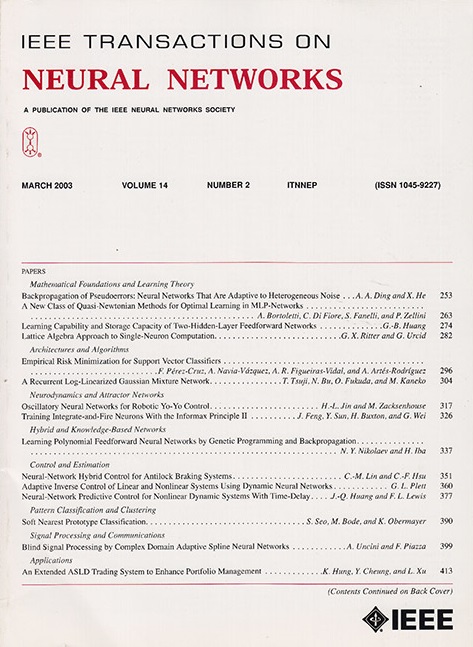
The focus of IEEE Transactions on Neural Networks and Learning Systems is to present scholarly articles discussing the theory, design, and applications of neural networks as well as other learning systems. The journal primarily highlights technical and scientific research in this domain.



 京公网安备 11010802042870号
京ICP备2023020795号-1
京公网安备 11010802042870号
京ICP备2023020795号-1

 分享
分享
 求助内容:
求助内容: 应助结果提醒方式:
 扫码关注我们
