Giuseppe Bertuglia, Sara Bringhen, Benedetto Bruno, Giorgia Andrea Impalà, Mattia D'Agostino
{"title":"M-protein-related necrobiotic granuloma in a multiple myeloma patient treated with daratumumab, lenalidomide and dexamethasone","authors":"Giuseppe Bertuglia, Sara Bringhen, Benedetto Bruno, Giorgia Andrea Impalà, Mattia D'Agostino","doi":"10.1111/bjh.19887","DOIUrl":null,"url":null,"abstract":"<p>A 75-year-old Immunoglobulin A-light chain k (IgA-k) smouldering multiple myeloma patient started complaining of pain in both soles of her feet which had progressively worsened and limited her daily living activities (DLA). On physical examination, both heels and big toes were enlarged with irregular, indurated, painful, itchy nodules, some of the ulcerated; the periungual region of the right middle finger also appeared erythematosus and de-epithelised (left upper panels, photographic images). No other skin lesions were present. Magnetic resonance imaging (MRI) of both feet showed plantar fasciitis (red arrow) with reactive oedema of the calcaneal spongy bone tissue (blue arrow), oedema of subcutaneous soft tissue (yellow arrow) and several nodules (maximum 25 mm in diameter; green arrow) on the plantar side (left middle panels, MRI). After two non-diagnostic samples, an ultrasound-guided tru-cut biopsy of the nodules was performed and histological examination (lower panels from the left to the right) led to the diagnosis of reactive necrobiotic granuloma: strands of loose connective tissue with cellular areas consisting of ill-defined CD163<sup>+</sup>, CD68<sup>+</sup> histiocyte aggregates and scattered neutrophiles with central necrosis (red arrow); absence of plasma cells (CD138 reaction negative); and very low proliferation index (Ki67 1%). In addition to the necrobiotic granuloma, possibly related to the M-protein, a thorough work-up was repeated showing one myeloma-defining event (≥60% bone marrow plasma cells). Treatment with daratumumab–lenalidomide–dexamethasone (DRd) was started. Topical 0.05% clobetasol ointment, for 1 month, and urea-based topical moisturizer were also added to DRd as suggested by dermatologists. At 1 year through treatment, the M-protein dropped from 39 to 0.7 g/L and a very good partial response, as best response, was achieved. Concurrently, the skin lesions had progressively improved (right upper panels, photographic images) with the complete resolution of the pain, the itch, the ulcers and DLA recovery as well as MRI showed the resolution of the plantar fasciitis and the subcutaneous oedema with a slight reduction of the subcutaneous nodules (right middle panels, MRI).</p><p>To our knowledge, among the wide range of granulomatous disorders, only necrobiotic xanthogranuloma has been ascribed to M-protein,<span><sup>1</sup></span> and anti-plasma cell clone drugs have been used in some cases.<span><sup>2-4</sup></span> On the one hand, we cannot exclude that foamy histiocytes, typically seen in necrobiotic xanthogranuloma,<span><sup>1</sup></span> may have been present in the residual tissue not included in the tru-cut sample, but on the other hand, the clinical presentation of necrobiotic xanthogranuloma does not match to our case.<span><sup>1</sup></span> All these elements support the theory of being an unusual and previously undescribed M-protein-related cutaneous involvement, successfully treated with anti-plasma cell clone regimen.</p><p>No funding was used for this study.</p><p>The consent form was approved by AOU Città della salute e della Scienza, University of Turin, Italy.</p><p>The patient gave her informed consent to the use of her medical charts, MRI imaging, histology imaging and photos for medical research purpose.</p>","PeriodicalId":135,"journal":{"name":"British Journal of Haematology","volume":"206 1","pages":"16-17"},"PeriodicalIF":3.8000,"publicationDate":"2024-11-14","publicationTypes":"Journal Article","fieldsOfStudy":null,"isOpenAccess":false,"openAccessPdf":"https://www.ncbi.nlm.nih.gov/pmc/articles/PMC11739761/pdf/","citationCount":"0","resultStr":null,"platform":"Semanticscholar","paperid":null,"PeriodicalName":"British Journal of Haematology","FirstCategoryId":"3","ListUrlMain":"https://onlinelibrary.wiley.com/doi/10.1111/bjh.19887","RegionNum":2,"RegionCategory":"医学","ArticlePicture":[],"TitleCN":null,"AbstractTextCN":null,"PMCID":null,"EPubDate":"","PubModel":"","JCR":"Q1","JCRName":"HEMATOLOGY","Score":null,"Total":0}
引用次数: 0
Abstract
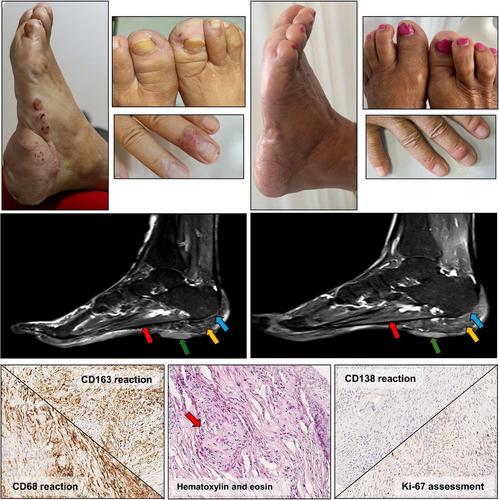
A 75-year-old Immunoglobulin A-light chain k (IgA-k) smouldering multiple myeloma patient started complaining of pain in both soles of her feet which had progressively worsened and limited her daily living activities (DLA). On physical examination, both heels and big toes were enlarged with irregular, indurated, painful, itchy nodules, some of the ulcerated; the periungual region of the right middle finger also appeared erythematosus and de-epithelised (left upper panels, photographic images). No other skin lesions were present. Magnetic resonance imaging (MRI) of both feet showed plantar fasciitis (red arrow) with reactive oedema of the calcaneal spongy bone tissue (blue arrow), oedema of subcutaneous soft tissue (yellow arrow) and several nodules (maximum 25 mm in diameter; green arrow) on the plantar side (left middle panels, MRI). After two non-diagnostic samples, an ultrasound-guided tru-cut biopsy of the nodules was performed and histological examination (lower panels from the left to the right) led to the diagnosis of reactive necrobiotic granuloma: strands of loose connective tissue with cellular areas consisting of ill-defined CD163+, CD68+ histiocyte aggregates and scattered neutrophiles with central necrosis (red arrow); absence of plasma cells (CD138 reaction negative); and very low proliferation index (Ki67 1%). In addition to the necrobiotic granuloma, possibly related to the M-protein, a thorough work-up was repeated showing one myeloma-defining event (≥60% bone marrow plasma cells). Treatment with daratumumab–lenalidomide–dexamethasone (DRd) was started. Topical 0.05% clobetasol ointment, for 1 month, and urea-based topical moisturizer were also added to DRd as suggested by dermatologists. At 1 year through treatment, the M-protein dropped from 39 to 0.7 g/L and a very good partial response, as best response, was achieved. Concurrently, the skin lesions had progressively improved (right upper panels, photographic images) with the complete resolution of the pain, the itch, the ulcers and DLA recovery as well as MRI showed the resolution of the plantar fasciitis and the subcutaneous oedema with a slight reduction of the subcutaneous nodules (right middle panels, MRI).
To our knowledge, among the wide range of granulomatous disorders, only necrobiotic xanthogranuloma has been ascribed to M-protein,1 and anti-plasma cell clone drugs have been used in some cases.2-4 On the one hand, we cannot exclude that foamy histiocytes, typically seen in necrobiotic xanthogranuloma,1 may have been present in the residual tissue not included in the tru-cut sample, but on the other hand, the clinical presentation of necrobiotic xanthogranuloma does not match to our case.1 All these elements support the theory of being an unusual and previously undescribed M-protein-related cutaneous involvement, successfully treated with anti-plasma cell clone regimen.
No funding was used for this study.
The consent form was approved by AOU Città della salute e della Scienza, University of Turin, Italy.
The patient gave her informed consent to the use of her medical charts, MRI imaging, histology imaging and photos for medical research purpose.
一名75岁的免疫球蛋白A-轻链k (IgA-k)闷燃型多发性骨髓瘤患者开始抱怨她的双脚底疼痛,并逐渐恶化,限制了她的日常生活活动(DLA)。体格检查,足跟和大脚趾肿大,有不规则、硬化、疼痛、发痒的结节,部分已溃烂;右中指趾周区也出现红斑和去上皮(左上图,摄影图像)。无其他皮肤损伤。双足MRI示足底筋膜炎(红色箭头)伴跟骨海绵状骨组织反应性水肿(蓝色箭头),皮下软组织水肿(黄色箭头)及多个结节(最大直径25mm;绿箭头)足底侧(左中面板,MRI)。在两个非诊断性样本后,对结节进行超声引导下的真切活检,组织学检查(从左到右的下图)导致诊断为反应性坏死性肉芽肿:束状松散结缔组织,细胞区域由不明确的CD163+, CD68+组织细胞聚集和分散的中性粒细胞组成,中心坏死(红箭头);浆细胞缺失(CD138反应阴性);增殖指数极低(ki671%)。除了可能与m蛋白相关的坏死性肉芽肿外,反复的彻底检查显示一个骨髓瘤定义事件(≥60%骨髓浆细胞)。开始使用达拉图单抗-来那度胺-地塞米松(DRd)治疗。根据皮肤科医生的建议,局部添加0.05%氯倍他索软膏1个月,并添加尿素基局部保湿剂。经过1年的治疗,m蛋白从39 g/L下降到0.7 g/L,达到了非常好的部分反应,即最佳反应。同时,皮肤病变逐渐改善(右上图,摄影图像),疼痛、瘙痒、溃疡和DLA恢复完全消失,MRI显示足底筋膜炎和皮下水肿消退,皮下结节轻微减少(右中图,MRI)。据我们所知,在广泛的肉芽肿疾病中,只有坏死性黄色肉芽肿被归因于m蛋白,1和抗浆细胞克隆药物已在某些情况下使用。2-4一方面,我们不能排除坏死性黄色肉芽肿中常见的泡沫组织细胞1可能存在于未包括在真切样本中的残留组织中,但另一方面,坏死性黄色肉芽肿的临床表现与我们的病例不符1所有这些因素都支持这一理论,这是一种不寻常的、以前未描述过的与m蛋白相关的皮肤病变,通过抗浆细胞克隆方案成功治疗。这项研究没有使用任何资金。本同意书经意大利都灵大学AOU citt della salute e della Scienza批准。患者知情同意将其病历、核磁共振成像、组织学成像和照片用于医学研究目的。
期刊介绍:
The British Journal of Haematology publishes original research papers in clinical, laboratory and experimental haematology. The Journal also features annotations, reviews, short reports, images in haematology and Letters to the Editor.




 京公网安备 11010802042870号
京ICP备2023020795号-1
京公网安备 11010802042870号
京ICP备2023020795号-1

 分享
分享
 求助内容:
求助内容: 应助结果提醒方式:
 扫码关注我们
