Closure of gastric mucosal defects using the reopenable-clip over-the-line method to decrease the risk of bleeding after endoscopic submucosal dissection: a multicenter propensity score–matched case-control study (with video)
{"title":"Closure of gastric mucosal defects using the reopenable-clip over-the-line method to decrease the risk of bleeding after endoscopic submucosal dissection: a multicenter propensity score–matched case-control study (with video)","authors":"Shinya Sugimoto MD , Tatsuma Nomura MD , Taishi Temma MD , Emika Sawa MD , Keita Omae MD , Nobuyuki Tsuda MD , Ayako Okuda MD , Hirofumi Okuda MD , Mayu Kawabata MD , Ryutaro Matsushima MD , Haruka Nakamura MD , Hirohisa Hisada MD , Satoshi Hayashi MD , Toji Murabayashi MD , Jun Oyamada MD , Akira Kamei MD , Hayato Nakagawa MD, PhD","doi":"10.1016/j.gie.2024.11.015","DOIUrl":null,"url":null,"abstract":"<div><h3>Background and Aims</h3><div>Endoscopic submucosal dissection (ESD) is a minimally invasive treatment for early gastric cancer. However, post-ESD bleeding presents significant risks. Closing mucosal defects after ESD may reduce the incidence of post-ESD bleeding. Currently, no optimal closure method exists. Therefore, we invented clip-line closure using the reopenable-clip over-the-line method (ROLM) and evaluated its efficacy in preventing post-ESD bleeding.</div></div><div><h3>Methods</h3><div>We retrospectively reviewed data from patients who underwent gastric ESD between January 2012 and March 2024. Patients were categorized into 2 groups: the nonclosure group (mucosal defect remained unclosed) and the ROLM group (defect was closed using ROLM). Baseline characteristics of patients, distribution of bleeding risk factors, and incidence and timing of post-ESD bleeding were compared between the groups. Propensity score matching was used to minimize potential bias.</div></div><div><h3>Results</h3><div>After propensity score matching, 162 ESDs were performed for 168 lesions in the nonclosure group, whereas 160 ESDs were performed for 168 lesions in the ROLM group. The mean long diameter of the mucosal defects, procedure time for ROLM, and number of clips required for ROLM were 45.9 mm, 35.6 minutes, and 33.2, respectively. All mucosal defects resulting from the ESD were fully closed using ROLM. The post-ESD bleeding rate in the ROLM group was significantly lower (1.8%; 3 of 168 lesions) than in the nonclosure group (7.7%; 13 of 168 lesions; <em>P</em> = .02).</div></div><div><h3>Conclusions</h3><div>ROLM is feasible for mucosal defect closure after gastric ESD and effectively prevents post-ESD bleeding in high-risk patients, addressing a significant gap in existing methods.</div></div>","PeriodicalId":12542,"journal":{"name":"Gastrointestinal endoscopy","volume":"102 1","pages":"Pages 37-46"},"PeriodicalIF":7.5000,"publicationDate":"2025-07-01","publicationTypes":"Journal Article","fieldsOfStudy":null,"isOpenAccess":false,"openAccessPdf":"","citationCount":"0","resultStr":null,"platform":"Semanticscholar","paperid":null,"PeriodicalName":"Gastrointestinal endoscopy","FirstCategoryId":"3","ListUrlMain":"https://www.sciencedirect.com/science/article/pii/S0016510724036964","RegionNum":1,"RegionCategory":"医学","ArticlePicture":[],"TitleCN":null,"AbstractTextCN":null,"PMCID":null,"EPubDate":"2024/11/12 0:00:00","PubModel":"Epub","JCR":"Q1","JCRName":"GASTROENTEROLOGY & HEPATOLOGY","Score":null,"Total":0}
引用次数: 0
Abstract
Background and Aims
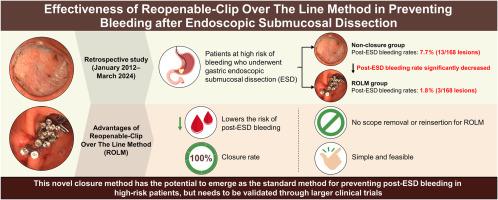
Endoscopic submucosal dissection (ESD) is a minimally invasive treatment for early gastric cancer. However, post-ESD bleeding presents significant risks. Closing mucosal defects after ESD may reduce the incidence of post-ESD bleeding. Currently, no optimal closure method exists. Therefore, we invented clip-line closure using the reopenable-clip over-the-line method (ROLM) and evaluated its efficacy in preventing post-ESD bleeding.
Methods
We retrospectively reviewed data from patients who underwent gastric ESD between January 2012 and March 2024. Patients were categorized into 2 groups: the nonclosure group (mucosal defect remained unclosed) and the ROLM group (defect was closed using ROLM). Baseline characteristics of patients, distribution of bleeding risk factors, and incidence and timing of post-ESD bleeding were compared between the groups. Propensity score matching was used to minimize potential bias.
Results
After propensity score matching, 162 ESDs were performed for 168 lesions in the nonclosure group, whereas 160 ESDs were performed for 168 lesions in the ROLM group. The mean long diameter of the mucosal defects, procedure time for ROLM, and number of clips required for ROLM were 45.9 mm, 35.6 minutes, and 33.2, respectively. All mucosal defects resulting from the ESD were fully closed using ROLM. The post-ESD bleeding rate in the ROLM group was significantly lower (1.8%; 3 of 168 lesions) than in the nonclosure group (7.7%; 13 of 168 lesions; P = .02).
Conclusions
ROLM is feasible for mucosal defect closure after gastric ESD and effectively prevents post-ESD bleeding in high-risk patients, addressing a significant gap in existing methods.
期刊介绍:
Gastrointestinal Endoscopy is a journal publishing original, peer-reviewed articles on endoscopic procedures for studying, diagnosing, and treating digestive diseases. It covers outcomes research, prospective studies, and controlled trials of new endoscopic instruments and treatment methods. The online features include full-text articles, video and audio clips, and MEDLINE links. The journal serves as an international forum for the latest developments in the specialty, offering challenging reports from authorities worldwide. It also publishes abstracts of significant articles from other clinical publications, accompanied by expert commentaries.



 京公网安备 11010802042870号
京ICP备2023020795号-1
京公网安备 11010802042870号
京ICP备2023020795号-1

 分享
分享
 求助内容:
求助内容: 应助结果提醒方式:
 扫码关注我们
