Darpan Saraswat, Isolde Gina Rojas, Rohitashw Kumar, Rui Li, Ornella Salvatori, Daniel Irimia, Mira Edgerton
{"title":"Neutrophil swarming is crucial for limiting oral mucosal infection by Candida albicans.","authors":"Darpan Saraswat, Isolde Gina Rojas, Rohitashw Kumar, Rui Li, Ornella Salvatori, Daniel Irimia, Mira Edgerton","doi":"10.1093/jleuko/qiae239","DOIUrl":null,"url":null,"abstract":"<p><p>Oral mucosal colonization by Candida albicans is benign in healthy people but progresses to deeper infection, known as oropharyngeal candidiasis, that may become disseminated when combined with immunosuppression. Cortisone use and neutropenia are risk factors for invasive mucosal fungal infections; however, the mechanisms are poorly understood. Here, we identify in vivo neutrophil functional complexes known as swarms that are crucial for preventing C. albicans epithelial invasion. Anti-Ly6G antibody treatment impaired swarm formation and increased fungal infection depth, confirming the role of neutrophil swarms in limiting C. albicans invasion. Neutrophil swarm function could be disrupted by administration of resolvins, and required BLT1 (leukotriene B4 receptor 1) expression so that administration of a leukotriene synthesis inhibitor reduced neutrophil swarm size permitting C. albicans invasion beyond the basement membrane. Cortisone treatment similarly reduced neutrophil swarming behavior and BLT1 expression and delayed expression of epithelial cytokines and chemokines. Thus, swarm structures have an important function in preventing deep invasion by C. albicans within the oral mucosa and represent a mechanism for increased disease severity under immune deficient clinical settings.</p>","PeriodicalId":16186,"journal":{"name":"Journal of Leukocyte Biology","volume":" ","pages":""},"PeriodicalIF":3.1000,"publicationDate":"2025-03-14","publicationTypes":"Journal Article","fieldsOfStudy":null,"isOpenAccess":false,"openAccessPdf":"https://www.ncbi.nlm.nih.gov/pmc/articles/PMC11953071/pdf/","citationCount":"0","resultStr":null,"platform":"Semanticscholar","paperid":null,"PeriodicalName":"Journal of Leukocyte Biology","FirstCategoryId":"3","ListUrlMain":"https://doi.org/10.1093/jleuko/qiae239","RegionNum":3,"RegionCategory":"医学","ArticlePicture":[],"TitleCN":null,"AbstractTextCN":null,"PMCID":null,"EPubDate":"","PubModel":"","JCR":"Q3","JCRName":"CELL BIOLOGY","Score":null,"Total":0}
引用次数: 0
Abstract
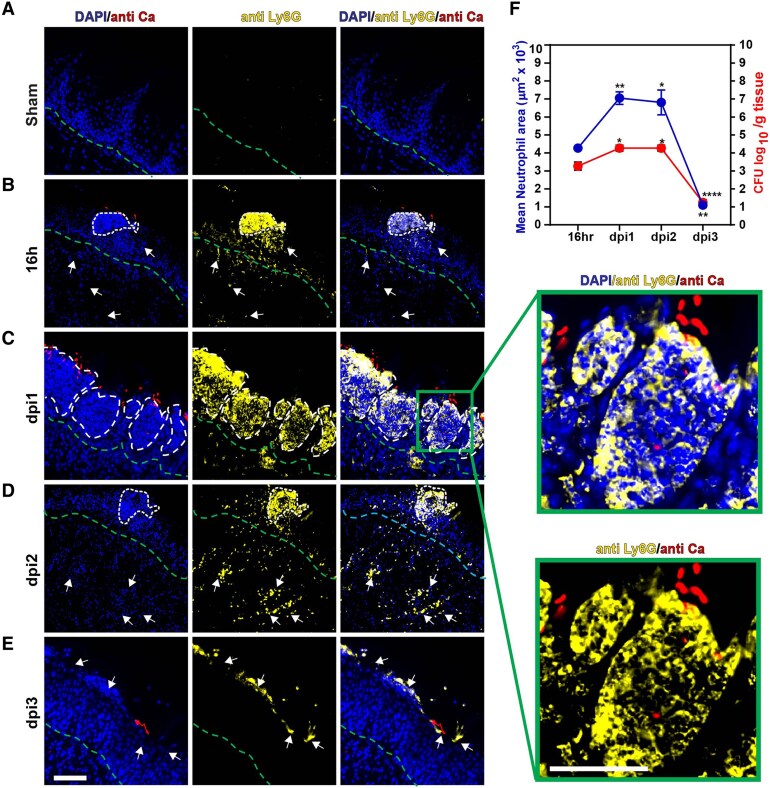
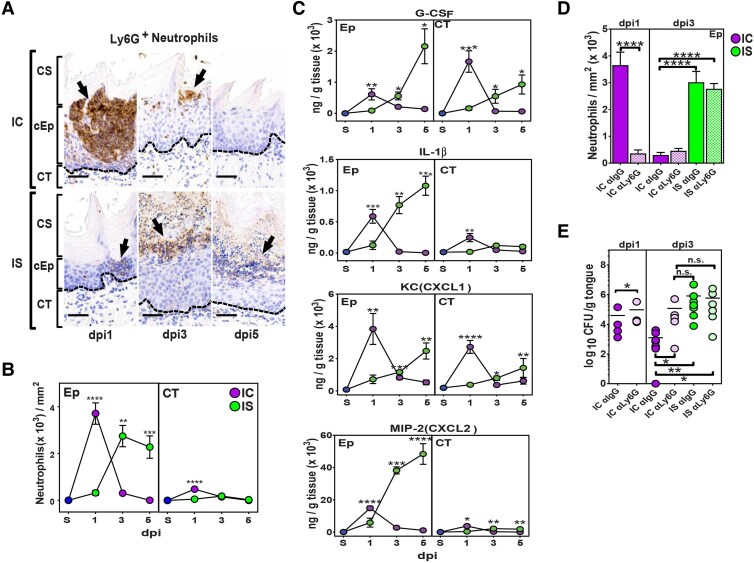
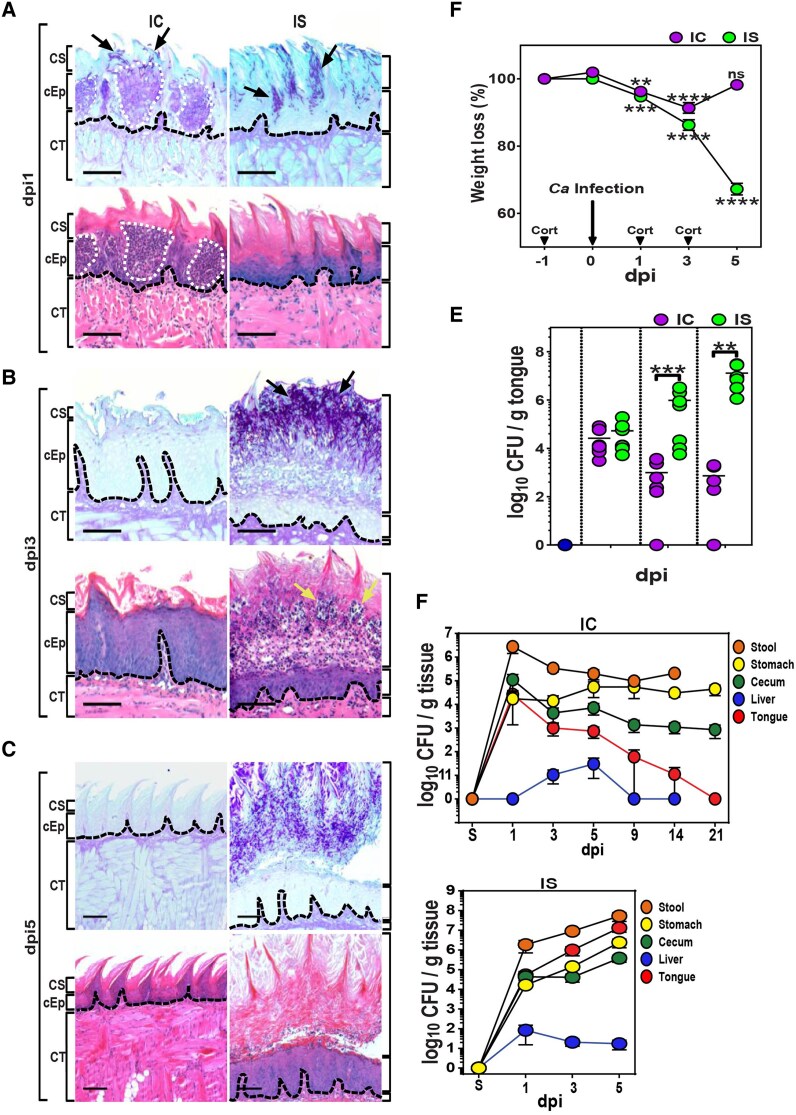
Oral mucosal colonization by Candida albicans is benign in healthy people but progresses to deeper infection, known as oropharyngeal candidiasis, that may become disseminated when combined with immunosuppression. Cortisone use and neutropenia are risk factors for invasive mucosal fungal infections; however, the mechanisms are poorly understood. Here, we identify in vivo neutrophil functional complexes known as swarms that are crucial for preventing C. albicans epithelial invasion. Anti-Ly6G antibody treatment impaired swarm formation and increased fungal infection depth, confirming the role of neutrophil swarms in limiting C. albicans invasion. Neutrophil swarm function could be disrupted by administration of resolvins, and required BLT1 (leukotriene B4 receptor 1) expression so that administration of a leukotriene synthesis inhibitor reduced neutrophil swarm size permitting C. albicans invasion beyond the basement membrane. Cortisone treatment similarly reduced neutrophil swarming behavior and BLT1 expression and delayed expression of epithelial cytokines and chemokines. Thus, swarm structures have an important function in preventing deep invasion by C. albicans within the oral mucosa and represent a mechanism for increased disease severity under immune deficient clinical settings.
白念珠菌(Ca)在健康人群中的口腔黏膜定植是良性的,但会发展成更深层的感染,即口咽念珠菌病(OPC),当合并免疫抑制时可能会扩散。使用可的松和中性粒细胞减少症是侵袭性粘膜真菌感染的危险因素,但对其机制却知之甚少。在这里,我们确定了体内中性粒细胞的功能复合体,它们被称为 "蜂群",对防止 Ca 上皮细胞入侵至关重要。抗 Ly6G 抗体处理会损害蜂群的形成并增加真菌感染深度,这证实了中性粒细胞蜂群在限制 Ca 侵袭中的作用。中性粒细胞群的功能可通过服用溶血素被破坏,并且需要白三烯 B4 受体 1(BLT1)的表达,因此服用白三烯合成抑制剂可减少中性粒细胞群的规模,从而允许 Ca 侵袭基底膜以外的区域。可的松处理也同样减少了中性粒细胞的成群行为和 BLT1 的表达,并延迟了上皮细胞因子和趋化因子的表达。因此,蜂群结构在防止白念珠菌深入口腔黏膜入侵方面具有重要功能,是免疫缺陷临床环境下疾病严重程度增加的一种机制。
期刊介绍:
JLB is a peer-reviewed, academic journal published by the Society for Leukocyte Biology for its members and the community of immunobiologists. The journal publishes papers devoted to the exploration of the cellular and molecular biology of granulocytes, mononuclear phagocytes, lymphocytes, NK cells, and other cells involved in host physiology and defense/resistance against disease. Since all cells in the body can directly or indirectly contribute to the maintenance of the integrity of the organism and restoration of homeostasis through repair, JLB also considers articles involving epithelial, endothelial, fibroblastic, neural, and other somatic cell types participating in host defense. Studies covering pathophysiology, cell development, differentiation and trafficking; fundamental, translational and clinical immunology, inflammation, extracellular mediators and effector molecules; receptors, signal transduction and genes are considered relevant. Research articles and reviews that provide a novel understanding in any of these fields are given priority as well as technical advances related to leukocyte research methods.



 京公网安备 11010802042870号
京ICP备2023020795号-1
京公网安备 11010802042870号
京ICP备2023020795号-1

 分享
分享
 求助内容:
求助内容: 应助结果提醒方式:
 扫码关注我们
