Ramesh Vidavalur, Karl F. Schettler, Carlo Dani, Sotirios Fouzas, Gabriela Mimoso, Manuel Sanchez-Luna, Vinod K. Bhutani, Daniele deLuca
{"title":"Trends of extreme hyperbilirubinemia related infant mortality in select European countries (1990–2019)","authors":"Ramesh Vidavalur, Karl F. Schettler, Carlo Dani, Sotirios Fouzas, Gabriela Mimoso, Manuel Sanchez-Luna, Vinod K. Bhutani, Daniele deLuca","doi":"10.1038/s41390-024-03695-2","DOIUrl":null,"url":null,"abstract":"Limited data exist on population-level mortality outcomes related to extreme neonatal hyperbilirubinemia (EHB) and this study examines trends in annual infant mortality rate (IMR) attributed to hemolytic and perinatal jaundice among Germany, France, Italy, Portugal, Greece and Spain from 1990 to 2019. Data on annual incident cases and disability-adjusted life years were collected from the 2019 Global Burden of Disease study. Live birth cohort data were sourced from UN World Population Prospects. We quantified temporal trends, with relative percent changes. Average annual percent changes (AAPCs) were evaluated using the Joinpoint Regression Program. EHB-related infant mortality decreased from 21.4 (95%CI: 16.1, 27.1) in 1990 to 4.2 (95%CI: 1.9, 7.6) per million live births in 2019. Germany demonstrated lowest AAPC of –3.2% (95% CI: –3.8, –2.5), while Portugal had the highest AAPC of –8.6% (95% CI –11.9, –5.1) in reducing infant mortality due to EHB. There were distinct divergences in the trajectories of declining EHB mortality among the studied countries. This study highlights a significant decline in infant mortality due to extreme hyperbilirubinemia, emphasizing the need for national surveillance and tailored guidelines to prevent bilirubin induced neurological damage.","PeriodicalId":19829,"journal":{"name":"Pediatric Research","volume":"98 1","pages":"121-126"},"PeriodicalIF":3.1000,"publicationDate":"2024-11-14","publicationTypes":"Journal Article","fieldsOfStudy":null,"isOpenAccess":false,"openAccessPdf":"https://www.nature.comhttps://www.nature.com/articles/s41390-024-03695-2.pdf","citationCount":"0","resultStr":null,"platform":"Semanticscholar","paperid":null,"PeriodicalName":"Pediatric Research","FirstCategoryId":"3","ListUrlMain":"https://www.nature.com/articles/s41390-024-03695-2","RegionNum":3,"RegionCategory":"医学","ArticlePicture":[],"TitleCN":null,"AbstractTextCN":null,"PMCID":null,"EPubDate":"","PubModel":"","JCR":"Q1","JCRName":"PEDIATRICS","Score":null,"Total":0}
引用次数: 0
Abstract
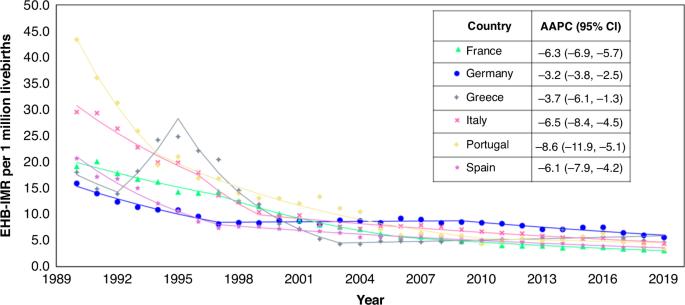
Limited data exist on population-level mortality outcomes related to extreme neonatal hyperbilirubinemia (EHB) and this study examines trends in annual infant mortality rate (IMR) attributed to hemolytic and perinatal jaundice among Germany, France, Italy, Portugal, Greece and Spain from 1990 to 2019. Data on annual incident cases and disability-adjusted life years were collected from the 2019 Global Burden of Disease study. Live birth cohort data were sourced from UN World Population Prospects. We quantified temporal trends, with relative percent changes. Average annual percent changes (AAPCs) were evaluated using the Joinpoint Regression Program. EHB-related infant mortality decreased from 21.4 (95%CI: 16.1, 27.1) in 1990 to 4.2 (95%CI: 1.9, 7.6) per million live births in 2019. Germany demonstrated lowest AAPC of –3.2% (95% CI: –3.8, –2.5), while Portugal had the highest AAPC of –8.6% (95% CI –11.9, –5.1) in reducing infant mortality due to EHB. There were distinct divergences in the trajectories of declining EHB mortality among the studied countries. This study highlights a significant decline in infant mortality due to extreme hyperbilirubinemia, emphasizing the need for national surveillance and tailored guidelines to prevent bilirubin induced neurological damage.
期刊介绍:
Pediatric Research publishes original papers, invited reviews, and commentaries on the etiologies of children''s diseases and
disorders of development, extending from molecular biology to epidemiology. Use of model organisms and in vitro techniques
relevant to developmental biology and medicine are acceptable, as are translational human studies



 京公网安备 11010802042870号
京ICP备2023020795号-1
京公网安备 11010802042870号
京ICP备2023020795号-1

 分享
分享
 求助内容:
求助内容: 应助结果提醒方式:
 扫码关注我们
