Sunghee Hong, Jihye Kim, Soo-Nam Jo, Jong-Hun Kim, Boyoung Park, Bo Youl Choi
{"title":"Characteristics of imported and domestic malaria cases in Gyeonggi Province, Korea.","authors":"Sunghee Hong, Jihye Kim, Soo-Nam Jo, Jong-Hun Kim, Boyoung Park, Bo Youl Choi","doi":"10.4178/epih.e2024087","DOIUrl":null,"url":null,"abstract":"<p><strong>Objectives: </strong>This study explored 11 years of malaria data from mandatory reporting in Gyeonggi Province, Korea, to provide information for prevention strategies by linkage to nationwide health claims data.</p><p><strong>Methods: </strong>Reported malaria cases in Gyeonggi Province from 2011 to 2021 were linked to medical usage data from the National Health Insurance Database. Data about hospitalization, antibiotic prescription and duration, malarial species, and sociodemographic information of the cases were included.</p><p><strong>Results: </strong>Between 2011 and 2021, a total of 3,011 malaria cases were reported, consisting of 2,828 domestic (93.9%) and 183 imported (6.1%) cases. Over 80% of the cases involved males, with the majority of patients being in their 20s. Both domestic and imported cases peaked between June and August over the years. Imported cases had a higher hospitalization rate (66.9%) compared to domestically-acquired cases (54.9%). There was a significant variation in treatment rates, with 80.7% of imported cases and 74.6% of domestic cases receiving treatment. For domestic cases, chloroquine combined with primaquine was the most commonly prescribed treatment (77.0%), while atovaquone-proguanil was frequently used for imported cases (25.9%). Plasmodium vivax was the predominant species in domestic cases (94.9%), whereas P. malariae was more common in imported cases (62.3%). The overall number of reported malaria cases declined following a sharp decrease in imported cases in 2020 and 2021.</p><p><strong>Conclusions: </strong>Despite a decreasing trend in malaria cases reported in Gyeonggi Province, imported cases exhibited higher hospitalization rates and different antibiotic prescription and treatment patterns, reflecting the presence of a different malarial species.</p>","PeriodicalId":48543,"journal":{"name":"Epidemiology and Health","volume":" ","pages":"e2024087"},"PeriodicalIF":2.2000,"publicationDate":"2024-01-01","publicationTypes":"Journal Article","fieldsOfStudy":null,"isOpenAccess":false,"openAccessPdf":"https://www.ncbi.nlm.nih.gov/pmc/articles/PMC11832236/pdf/","citationCount":"0","resultStr":null,"platform":"Semanticscholar","paperid":null,"PeriodicalName":"Epidemiology and Health","FirstCategoryId":"3","ListUrlMain":"https://doi.org/10.4178/epih.e2024087","RegionNum":4,"RegionCategory":"医学","ArticlePicture":[],"TitleCN":null,"AbstractTextCN":null,"PMCID":null,"EPubDate":"2024/11/8 0:00:00","PubModel":"Epub","JCR":"Q2","JCRName":"PUBLIC, ENVIRONMENTAL & OCCUPATIONAL HEALTH","Score":null,"Total":0}
引用次数: 0
Abstract
Objectives: This study explored 11 years of malaria data from mandatory reporting in Gyeonggi Province, Korea, to provide information for prevention strategies by linkage to nationwide health claims data.
Methods: Reported malaria cases in Gyeonggi Province from 2011 to 2021 were linked to medical usage data from the National Health Insurance Database. Data about hospitalization, antibiotic prescription and duration, malarial species, and sociodemographic information of the cases were included.
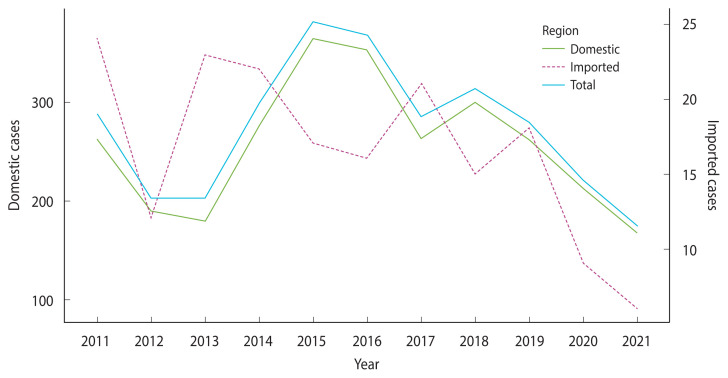
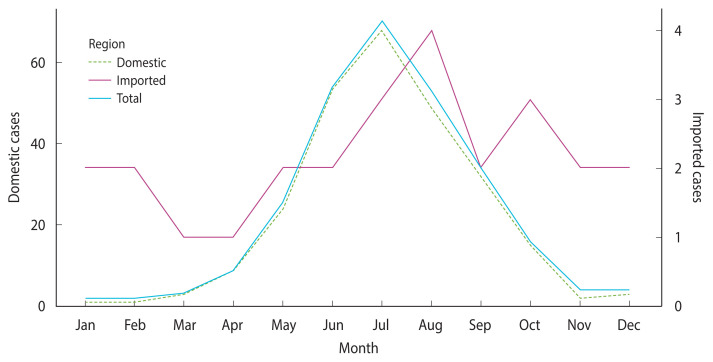
Results: Between 2011 and 2021, a total of 3,011 malaria cases were reported, consisting of 2,828 domestic (93.9%) and 183 imported (6.1%) cases. Over 80% of the cases involved males, with the majority of patients being in their 20s. Both domestic and imported cases peaked between June and August over the years. Imported cases had a higher hospitalization rate (66.9%) compared to domestically-acquired cases (54.9%). There was a significant variation in treatment rates, with 80.7% of imported cases and 74.6% of domestic cases receiving treatment. For domestic cases, chloroquine combined with primaquine was the most commonly prescribed treatment (77.0%), while atovaquone-proguanil was frequently used for imported cases (25.9%). Plasmodium vivax was the predominant species in domestic cases (94.9%), whereas P. malariae was more common in imported cases (62.3%). The overall number of reported malaria cases declined following a sharp decrease in imported cases in 2020 and 2021.
Conclusions: Despite a decreasing trend in malaria cases reported in Gyeonggi Province, imported cases exhibited higher hospitalization rates and different antibiotic prescription and treatment patterns, reflecting the presence of a different malarial species.
期刊介绍:
Epidemiology and Health (epiH) is an electronic journal publishing papers in all areas of epidemiology and public health. It is indexed on PubMed Central and the scope is wide-ranging: including descriptive, analytical and molecular epidemiology; primary preventive measures; screening approaches and secondary prevention; clinical epidemiology; and all aspects of communicable and non-communicable diseases prevention. The epiH publishes original research, and also welcomes review articles and meta-analyses, cohort profiles and data profiles, epidemic and case investigations, descriptions and applications of new methods, and discussions of research theory or public health policy. We give special consideration to papers from developing countries.



 京公网安备 11010802042870号
京ICP备2023020795号-1
京公网安备 11010802042870号
京ICP备2023020795号-1

 分享
分享
 求助内容:
求助内容: 应助结果提醒方式:
 扫码关注我们
