Menyfah Q Alanazi, Eyad K Alkhadhairi, Waleed H Alrumi, Sami A Alajlan
{"title":"Reducing Pharmaceutical and Non-Pharmaceutical Inventory Waste in Tertiary Hospital: Impact of ABC-VEN Analysis in a Zero-Waste Strategy Over 7 Years.","authors":"Menyfah Q Alanazi, Eyad K Alkhadhairi, Waleed H Alrumi, Sami A Alajlan","doi":"10.2147/RMHP.S467230","DOIUrl":null,"url":null,"abstract":"<p><strong>Aim: </strong>To evaluate the prevalence and trend of inventory waste in a tertiary hospital over the last 7 years. This included the type and average monetary value (MV) of inventory waste, as well as the outcome of using the Always-Better-Control (ABC)-Vital-Essential-Non-essential (VEN) matrix as part of a Zero-Waste Strategy.</p><p><strong>Methods: </strong>This was a retrospective observational study conducted at King Abdulaziz Medical City (KAMC) over 7 years.</p><p><strong>Results: </strong>The prevalence of waste was 0.21%, which equates to (SAR) 15 million out of SAR 7 billion. The pharmaceutical inventory had significantly higher waste in terms of MV and the number of items (89.8%, and 80.3%, respectively) (P<0.001). The expired pharmaceutical inventory had a significantly higher waste of MV than non-moving and obsolete inventory (79.8%, 14.3%, and 5.9%, respectively) (P<0.001). The ABC-VEN matrix categorized the inventory into Category I, which has the highest MV waste at 82.3%, followed by Category II with 16.8%, and then Category III with 0.9%. However, category II had a significantly higher number of wasted items at (58.2%), followed by Category I (24%) and Category III (17.8%) (P<0.01). The majority of MV waste consisted of a small number of pharmaceutical items that had a high clinical impact, representing 66% and 18%, respectively. After implementing a zero-waste strategy for landfills using the ABC-VEN matrix, the prevalence of waste declined from 0.9% to 0.21%. The waste sent to the landfill was zero from 2018 through 2020, saving 73.64% of the total money.</p><p><strong>Conclusion: </strong>The use of the ABC-VEN matrix positively impacted the reduction of MV waste. The prevalence and trend rate of inventory waste were lower than the benchmarks of global companies, saving more than two-thirds of the inventory value that would have been wasted. The majority of the wasted MV consisted of a small number of pharmaceutical items that had a significant clinical impact.</p>","PeriodicalId":56009,"journal":{"name":"Risk Management and Healthcare Policy","volume":"17 ","pages":"2659-2675"},"PeriodicalIF":2.0000,"publicationDate":"2024-11-04","publicationTypes":"Journal Article","fieldsOfStudy":null,"isOpenAccess":false,"openAccessPdf":"https://www.ncbi.nlm.nih.gov/pmc/articles/PMC11545607/pdf/","citationCount":"0","resultStr":null,"platform":"Semanticscholar","paperid":null,"PeriodicalName":"Risk Management and Healthcare Policy","FirstCategoryId":"3","ListUrlMain":"https://doi.org/10.2147/RMHP.S467230","RegionNum":4,"RegionCategory":"医学","ArticlePicture":[],"TitleCN":null,"AbstractTextCN":null,"PMCID":null,"EPubDate":"2024/1/1 0:00:00","PubModel":"eCollection","JCR":"Q2","JCRName":"HEALTH CARE SCIENCES & SERVICES","Score":null,"Total":0}
引用次数: 0
Abstract
Aim: To evaluate the prevalence and trend of inventory waste in a tertiary hospital over the last 7 years. This included the type and average monetary value (MV) of inventory waste, as well as the outcome of using the Always-Better-Control (ABC)-Vital-Essential-Non-essential (VEN) matrix as part of a Zero-Waste Strategy.
Methods: This was a retrospective observational study conducted at King Abdulaziz Medical City (KAMC) over 7 years.
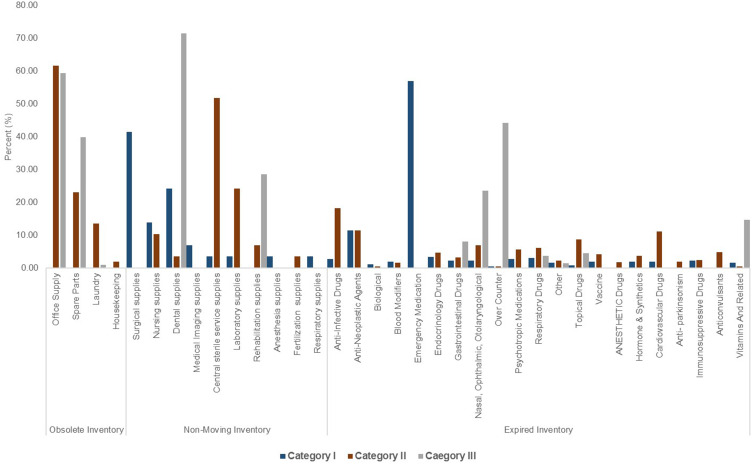
Results: The prevalence of waste was 0.21%, which equates to (SAR) 15 million out of SAR 7 billion. The pharmaceutical inventory had significantly higher waste in terms of MV and the number of items (89.8%, and 80.3%, respectively) (P<0.001). The expired pharmaceutical inventory had a significantly higher waste of MV than non-moving and obsolete inventory (79.8%, 14.3%, and 5.9%, respectively) (P<0.001). The ABC-VEN matrix categorized the inventory into Category I, which has the highest MV waste at 82.3%, followed by Category II with 16.8%, and then Category III with 0.9%. However, category II had a significantly higher number of wasted items at (58.2%), followed by Category I (24%) and Category III (17.8%) (P<0.01). The majority of MV waste consisted of a small number of pharmaceutical items that had a high clinical impact, representing 66% and 18%, respectively. After implementing a zero-waste strategy for landfills using the ABC-VEN matrix, the prevalence of waste declined from 0.9% to 0.21%. The waste sent to the landfill was zero from 2018 through 2020, saving 73.64% of the total money.
Conclusion: The use of the ABC-VEN matrix positively impacted the reduction of MV waste. The prevalence and trend rate of inventory waste were lower than the benchmarks of global companies, saving more than two-thirds of the inventory value that would have been wasted. The majority of the wasted MV consisted of a small number of pharmaceutical items that had a significant clinical impact.
期刊介绍:
Risk Management and Healthcare Policy is an international, peer-reviewed, open access journal focusing on all aspects of public health, policy and preventative measures to promote good health and improve morbidity and mortality in the population. Specific topics covered in the journal include:
Public and community health
Policy and law
Preventative and predictive healthcare
Risk and hazard management
Epidemiology, detection and screening
Lifestyle and diet modification
Vaccination and disease transmission/modification programs
Health and safety and occupational health
Healthcare services provision
Health literacy and education
Advertising and promotion of health issues
Health economic evaluations and resource management
Risk Management and Healthcare Policy focuses on human interventional and observational research. The journal welcomes submitted papers covering original research, clinical and epidemiological studies, reviews and evaluations, guidelines, expert opinion and commentary, and extended reports. Case reports will only be considered if they make a valuable and original contribution to the literature. The journal does not accept study protocols, animal-based or cell line-based studies.





 京公网安备 11010802042870号
京ICP备2023020795号-1
京公网安备 11010802042870号
京ICP备2023020795号-1

 分享
分享
 求助内容:
求助内容: 应助结果提醒方式:
 扫码关注我们
