Jessica Camacho-Ruíz, Antonio V, Mario Enrique Rendón-Macías, Mariela Bernabe-García, Emmanuel González-Bautista, Leticia Manuel-Apolinar, Lourdes Basurto-Acevedo, Oscar Orihuela-Rodríguez, Juana M Ruiz-Batalla, Braulio Rojas-Rubio, Roberto A Olivares-Santos, Carlos Paredes-Manjarrez, Rosalinda Sánchez-Arenas
{"title":"[Cognitive function groups in older people and risk factors].","authors":"Jessica Camacho-Ruíz, Antonio V, Mario Enrique Rendón-Macías, Mariela Bernabe-García, Emmanuel González-Bautista, Leticia Manuel-Apolinar, Lourdes Basurto-Acevedo, Oscar Orihuela-Rodríguez, Juana M Ruiz-Batalla, Braulio Rojas-Rubio, Roberto A Olivares-Santos, Carlos Paredes-Manjarrez, Rosalinda Sánchez-Arenas","doi":"10.5281/zenodo.10998801","DOIUrl":null,"url":null,"abstract":"<p><strong>Background: </strong>Risk stratification for cognitive impairment in communities originated from autopsies in cognitively healthy individuals. The Diagnostic and Statistical Manual of Mental Disorders, 5th edition (DSM-5) incorporates subjective and objective cognitive function (CF) measures to explore neurocognitive disorders (NCD). It can be applied in communities to explore the factors that may influence positively or negatively.</p><p><strong>Objective: </strong>To obtain the relationship between groups of CF classified using the DSM-5 categories, and sociodemographic factors, habits, comorbidities and motor function in older people living in the community.</p><p><strong>Material and methods: </strong>Cross-sectional study with a probabilistic sample (n = 347). The variables were sociodemographic, habits, comorbidities, and cognitive motor function. The participants were grouped considering subjective and objective CF, plus age, sex, and educational level, and defined according to NCD.</p><p><strong>Results: </strong>28.5% did not present cognitive disorder, 43.9% had mild disorder < 70 years (mildNCD < 70y), 19% with 70 years or more (mildNCD ≥ 70y), and with major disorder 8.6%. The associated factors for mildNCD < 70y were marital status (MS), physical activity (PA), diabetes mellitus, and frailty; for mildNCD > 70y: MS, occupation, living alone, and heart disease; for majorNCD: PA and grip strength. In the multivariate analysis it was observed greater likelihood in the mildNCD groups than in the non-NCD and majorNCD groups.</p><p><strong>Conclusions: </strong>4 important groups were identified in a community. The mildNCD was mainly explained by sociodemographic factors, lifestyle, clinical conditions, and motor functionality.</p>","PeriodicalId":94200,"journal":{"name":"Revista medica del Instituto Mexicano del Seguro Social","volume":"62 3","pages":"1-11"},"PeriodicalIF":0.0000,"publicationDate":"2024-05-06","publicationTypes":"Journal Article","fieldsOfStudy":null,"isOpenAccess":false,"openAccessPdf":"https://www.ncbi.nlm.nih.gov/pmc/articles/PMC12208709/pdf/","citationCount":"0","resultStr":null,"platform":"Semanticscholar","paperid":null,"PeriodicalName":"Revista medica del Instituto Mexicano del Seguro Social","FirstCategoryId":"1085","ListUrlMain":"https://doi.org/10.5281/zenodo.10998801","RegionNum":0,"RegionCategory":null,"ArticlePicture":[],"TitleCN":null,"AbstractTextCN":null,"PMCID":null,"EPubDate":"","PubModel":"","JCR":"","JCRName":"","Score":null,"Total":0}
引用次数: 0
Abstract
Background: Risk stratification for cognitive impairment in communities originated from autopsies in cognitively healthy individuals. The Diagnostic and Statistical Manual of Mental Disorders, 5th edition (DSM-5) incorporates subjective and objective cognitive function (CF) measures to explore neurocognitive disorders (NCD). It can be applied in communities to explore the factors that may influence positively or negatively.
Objective: To obtain the relationship between groups of CF classified using the DSM-5 categories, and sociodemographic factors, habits, comorbidities and motor function in older people living in the community.
Material and methods: Cross-sectional study with a probabilistic sample (n = 347). The variables were sociodemographic, habits, comorbidities, and cognitive motor function. The participants were grouped considering subjective and objective CF, plus age, sex, and educational level, and defined according to NCD.
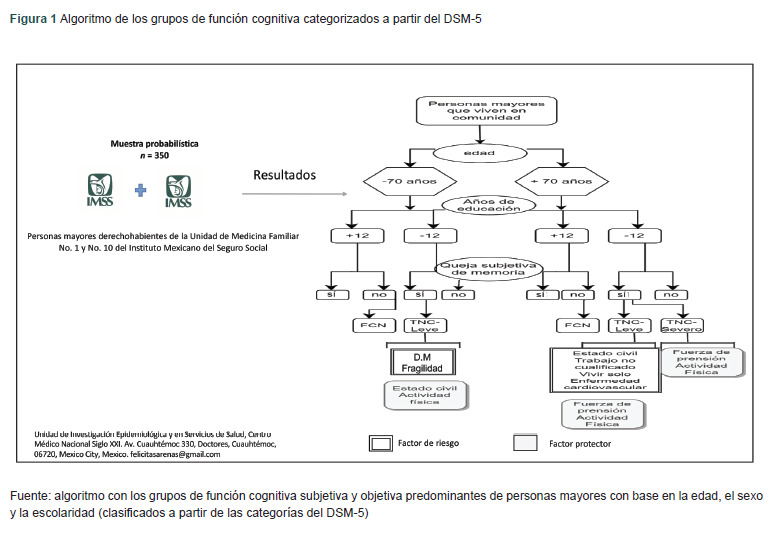
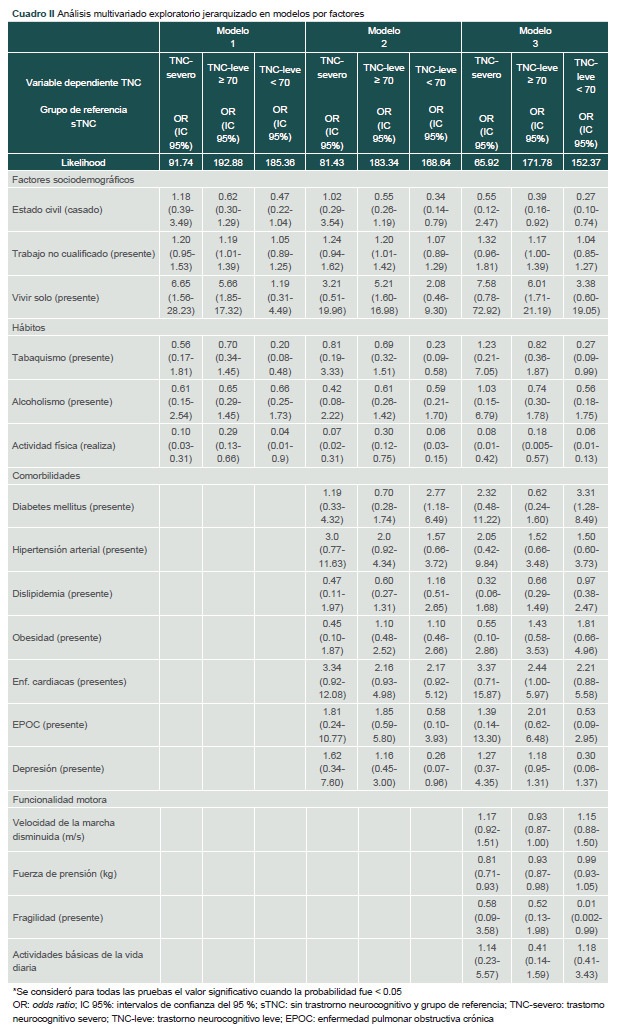
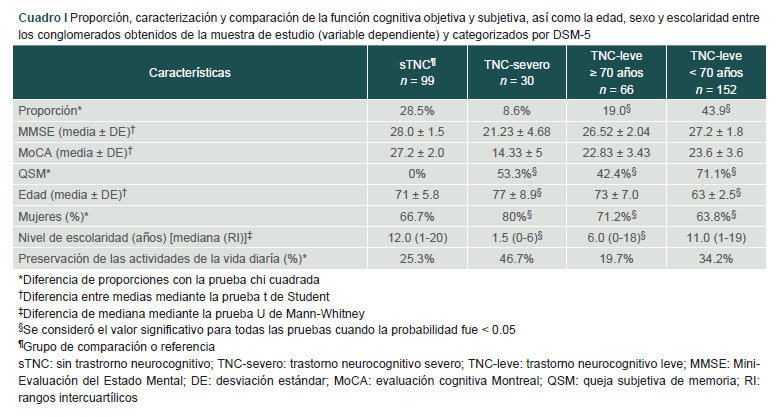
Results: 28.5% did not present cognitive disorder, 43.9% had mild disorder < 70 years (mildNCD < 70y), 19% with 70 years or more (mildNCD ≥ 70y), and with major disorder 8.6%. The associated factors for mildNCD < 70y were marital status (MS), physical activity (PA), diabetes mellitus, and frailty; for mildNCD > 70y: MS, occupation, living alone, and heart disease; for majorNCD: PA and grip strength. In the multivariate analysis it was observed greater likelihood in the mildNCD groups than in the non-NCD and majorNCD groups.
Conclusions: 4 important groups were identified in a community. The mildNCD was mainly explained by sociodemographic factors, lifestyle, clinical conditions, and motor functionality.



 京公网安备 11010802042870号
京ICP备2023020795号-1
京公网安备 11010802042870号
京ICP备2023020795号-1

 分享
分享

 求助内容:
求助内容: 应助结果提醒方式:
 扫码关注我们
