{"title":"Bias-Reduced Closed-Form Method for 3-D Moving Object Localization by AOA Using Sensors at Known and Unknown Positions","authors":"Sipu Zhou;Gang Wang;K. C. Ho","doi":"10.1109/TWC.2024.3485085","DOIUrl":null,"url":null,"abstract":"Considering all or part of the sensors are at known positions, this paper addresses the problem of locating a 3-D moving object with a linear constant velocity trajectory using angle-of-arrival (AOA) observations. We start by analyzing the minimum number of sensors and show that at least two sensors with known positions are needed for this problem. For the case of all sensors at known positions, we formulate a weighted least squares (WLS) problem with the capability of bias reduction, called the bias-reduced WLS (BR-WLS) problem, to limit the bias caused by the transformation of the measurement models. The BR-WLS problem has a closed-form solution, and thus, solving it is very computationally efficient. For the case where only part of the sensors are at known positions, we first theoretically analyze the performance gain by including the sensors at unknown positions for localization, and then extend the proposed BR-WLS method to jointly estimate the object motion parameters and the unknown sensor positions. For both cases, we show that the localization mean square error (MSE) can reach the Cramér-Rao lower bound (CRLB) when the noise is small and Gaussian distributed. Moreover, we also derive the theoretical expressions of the residual biases for the object position and velocity estimation by the proposed solutions. Simulation results confirm the good performance of the proposed solutions and also validate the theoretical results.","PeriodicalId":13431,"journal":{"name":"IEEE Transactions on Wireless Communications","volume":"23 12","pages":"19553-19569"},"PeriodicalIF":10.7000,"publicationDate":"2024-11-14","publicationTypes":"Journal Article","fieldsOfStudy":null,"isOpenAccess":false,"openAccessPdf":"","citationCount":"0","resultStr":null,"platform":"Semanticscholar","paperid":null,"PeriodicalName":"IEEE Transactions on Wireless Communications","FirstCategoryId":"94","ListUrlMain":"https://ieeexplore.ieee.org/document/10753430/","RegionNum":1,"RegionCategory":"计算机科学","ArticlePicture":[],"TitleCN":null,"AbstractTextCN":null,"PMCID":null,"EPubDate":"","PubModel":"","JCR":"Q1","JCRName":"ENGINEERING, ELECTRICAL & ELECTRONIC","Score":null,"Total":0}
引用次数: 0
Abstract
Considering all or part of the sensors are at known positions, this paper addresses the problem of locating a 3-D moving object with a linear constant velocity trajectory using angle-of-arrival (AOA) observations. We start by analyzing the minimum number of sensors and show that at least two sensors with known positions are needed for this problem. For the case of all sensors at known positions, we formulate a weighted least squares (WLS) problem with the capability of bias reduction, called the bias-reduced WLS (BR-WLS) problem, to limit the bias caused by the transformation of the measurement models. The BR-WLS problem has a closed-form solution, and thus, solving it is very computationally efficient. For the case where only part of the sensors are at known positions, we first theoretically analyze the performance gain by including the sensors at unknown positions for localization, and then extend the proposed BR-WLS method to jointly estimate the object motion parameters and the unknown sensor positions. For both cases, we show that the localization mean square error (MSE) can reach the Cramér-Rao lower bound (CRLB) when the noise is small and Gaussian distributed. Moreover, we also derive the theoretical expressions of the residual biases for the object position and velocity estimation by the proposed solutions. Simulation results confirm the good performance of the proposed solutions and also validate the theoretical results.
期刊介绍:
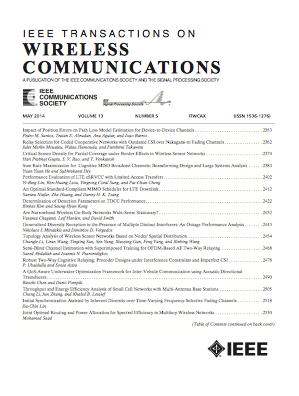
The IEEE Transactions on Wireless Communications is a prestigious publication that showcases cutting-edge advancements in wireless communications. It welcomes both theoretical and practical contributions in various areas. The scope of the Transactions encompasses a wide range of topics, including modulation and coding, detection and estimation, propagation and channel characterization, and diversity techniques. The journal also emphasizes the physical and link layer communication aspects of network architectures and protocols.
The journal is open to papers on specific topics or non-traditional topics related to specific application areas. This includes simulation tools and methodologies, orthogonal frequency division multiplexing, MIMO systems, and wireless over optical technologies.
Overall, the IEEE Transactions on Wireless Communications serves as a platform for high-quality manuscripts that push the boundaries of wireless communications and contribute to advancements in the field.



 京公网安备 11010802042870号
京ICP备2023020795号-1
京公网安备 11010802042870号
京ICP备2023020795号-1

 分享
分享
 求助内容:
求助内容: 应助结果提醒方式:
 扫码关注我们
