Mohammad Aslam , Muhammad Saeed Akhtar , Hee Nam Lim , Jeong Hyun Seo , Yong Rok Lee
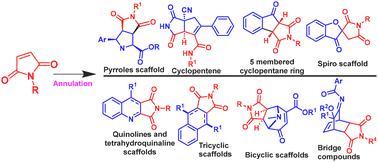
{"title":"Recent advances in the transformation of maleimides via annulation","authors":"Mohammad Aslam , Muhammad Saeed Akhtar , Hee Nam Lim , Jeong Hyun Seo , Yong Rok Lee","doi":"10.1039/d4ob01632g","DOIUrl":null,"url":null,"abstract":"<div><div>Over the past five years, maleimide scaffolds have gained considerable attention in organic synthesis for their role in forming cyclized molecules through annulation and C–H activation. As versatile and reactive coupling agents, maleimides have enabled the efficient synthesis of various cyclized products, including annulation, benzannulation, cycloaddition, and spirocyclization, with applications in medicinal chemistry, drug discovery, and materials science. Despite the extensive study of maleimide chemistry, certain reactions—such as cycloaddition-based annulation, photoannulation, and electrochemical transformations—remain underexplored despite their promising potential in the pharmaceutical and chemical industries. Recent advancements, such as photocatalysis and electrochemical methods, have expanded the utility of maleimides, providing more sustainable and selective approaches for synthesizing complex molecules. This review compiles research published between 2019 and 2024, highlighting the substrate scope, reaction diversity, and industrial relevance of maleimide-based annulation strategies. Additionally, we discuss emerging trends and future directions in maleimide chemistry, exploring opportunities for novel reaction pathways and broader applications in synthetic biology and materials science.</div></div>","PeriodicalId":96,"journal":{"name":"Organic & Biomolecular Chemistry","volume":"23 2","pages":"Pages 269-291"},"PeriodicalIF":2.7000,"publicationDate":"2024-11-06","publicationTypes":"Journal Article","fieldsOfStudy":null,"isOpenAccess":false,"openAccessPdf":"","citationCount":"0","resultStr":null,"platform":"Semanticscholar","paperid":null,"PeriodicalName":"Organic & Biomolecular Chemistry","FirstCategoryId":"92","ListUrlMain":"https://www.sciencedirect.com/org/science/article/pii/S1477052024010164","RegionNum":3,"RegionCategory":"化学","ArticlePicture":[],"TitleCN":null,"AbstractTextCN":null,"PMCID":null,"EPubDate":"2024/11/12 0:00:00","PubModel":"Epub","JCR":"Q1","JCRName":"CHEMISTRY, ORGANIC","Score":null,"Total":0}
引用次数: 0
Abstract
Over the past five years, maleimide scaffolds have gained considerable attention in organic synthesis for their role in forming cyclized molecules through annulation and C–H activation. As versatile and reactive coupling agents, maleimides have enabled the efficient synthesis of various cyclized products, including annulation, benzannulation, cycloaddition, and spirocyclization, with applications in medicinal chemistry, drug discovery, and materials science. Despite the extensive study of maleimide chemistry, certain reactions—such as cycloaddition-based annulation, photoannulation, and electrochemical transformations—remain underexplored despite their promising potential in the pharmaceutical and chemical industries. Recent advancements, such as photocatalysis and electrochemical methods, have expanded the utility of maleimides, providing more sustainable and selective approaches for synthesizing complex molecules. This review compiles research published between 2019 and 2024, highlighting the substrate scope, reaction diversity, and industrial relevance of maleimide-based annulation strategies. Additionally, we discuss emerging trends and future directions in maleimide chemistry, exploring opportunities for novel reaction pathways and broader applications in synthetic biology and materials science.
期刊介绍:
Organic & Biomolecular Chemistry is an international journal using integrated research in chemistry-organic chemistry. Founded in 2003 by the Royal Society of Chemistry, the journal is published in Semimonthly issues and has been indexed by SCIE, a leading international database. The journal focuses on the key research and cutting-edge progress in the field of chemistry-organic chemistry, publishes and reports the research results in this field in a timely manner, and is committed to becoming a window and platform for rapid academic exchanges among peers in this field. The journal's impact factor in 2023 is 2.9, and its CiteScore is 5.5.




 京公网安备 11010802042870号
京ICP备2023020795号-1
京公网安备 11010802042870号
京ICP备2023020795号-1

 分享
分享
 求助内容:
求助内容: 应助结果提醒方式:
 扫码关注我们
