Hexavalent Chromium Adsorption on Adsorbent Derived From Biomass of Fabaceae Plant in Vietnam: Effect of Preparation Conditions on Equilibrium Adsorption Capacity
Thai Phuong Vu, Lam Thi Thanh Quyen, Nguyen Trung Hiep, Ta Thi Hoai Thu, Tran Tuyet Suong
{"title":"Hexavalent Chromium Adsorption on Adsorbent Derived From Biomass of Fabaceae Plant in Vietnam: Effect of Preparation Conditions on Equilibrium Adsorption Capacity","authors":"Thai Phuong Vu, Lam Thi Thanh Quyen, Nguyen Trung Hiep, Ta Thi Hoai Thu, Tran Tuyet Suong","doi":"10.1002/tqem.22353","DOIUrl":null,"url":null,"abstract":"<div>\n \n <p>The present work is devoted to examining the potential of <i>Sesbania sesban</i> biochar produced through slow pyrolysis for 120 min at 300°C in removing hexavalent chromium from the aqueous phase. The physicochemical characteristics of biochar were analyzed utilizing a variety of analytical tools including SEM, BET, and FTIR. Results revealed that the biochar had a smooth surface, an even stacking pattern with a porous texture, a large BET surface area equal to 562 m<sup>2</sup>/g, and a pH<sub>pzc</sub> of 6.9. The biochar efficiency in eliminating Cr (VI) was investigated through several variables, including biochar dosage (0.1–0.4 g), pH (2–8), initial chromium ion concentration (10–40 mg/L), and adsorption time (15–120) min. The results identified the best conditions for adsorbing Cr (VI): an initial concentration of 10 mg/L, an absorbent dosage of 0.3 g, a pH solution of 2, and a reaction time of 90 min. The experiment achieved a Cr (VI) removal efficiency of over 90% by applying these conditions. The adsorption isotherm data were analyzed and showed a strong correlation coefficient (<i>R</i><sup>2</sup> = 0.985) for Langmuir monolayer model, in which the maximum adsorption capacity achieved was 5.3 mg/g. According to the kinetic investigation, the adsorption of Cr (VI) was adapted to a pseudo-second-order model having a high <i>R</i><sup>2</sup> value of 0.998. These results demonstrate that <i>Sesbania sesban</i> biochar has excellent potential as a cost-effective and highly efficient adsorbent for removing hexavalent chromium and improving water quality.</p>\n </div>","PeriodicalId":35327,"journal":{"name":"Environmental Quality Management","volume":"34 2","pages":""},"PeriodicalIF":1.3000,"publicationDate":"2024-11-07","publicationTypes":"Journal Article","fieldsOfStudy":null,"isOpenAccess":false,"openAccessPdf":"","citationCount":"0","resultStr":null,"platform":"Semanticscholar","paperid":null,"PeriodicalName":"Environmental Quality Management","FirstCategoryId":"1085","ListUrlMain":"https://onlinelibrary.wiley.com/doi/10.1002/tqem.22353","RegionNum":0,"RegionCategory":null,"ArticlePicture":[],"TitleCN":null,"AbstractTextCN":null,"PMCID":null,"EPubDate":"","PubModel":"","JCR":"Q4","JCRName":"ENGINEERING, ENVIRONMENTAL","Score":null,"Total":0}
引用次数: 0
Abstract
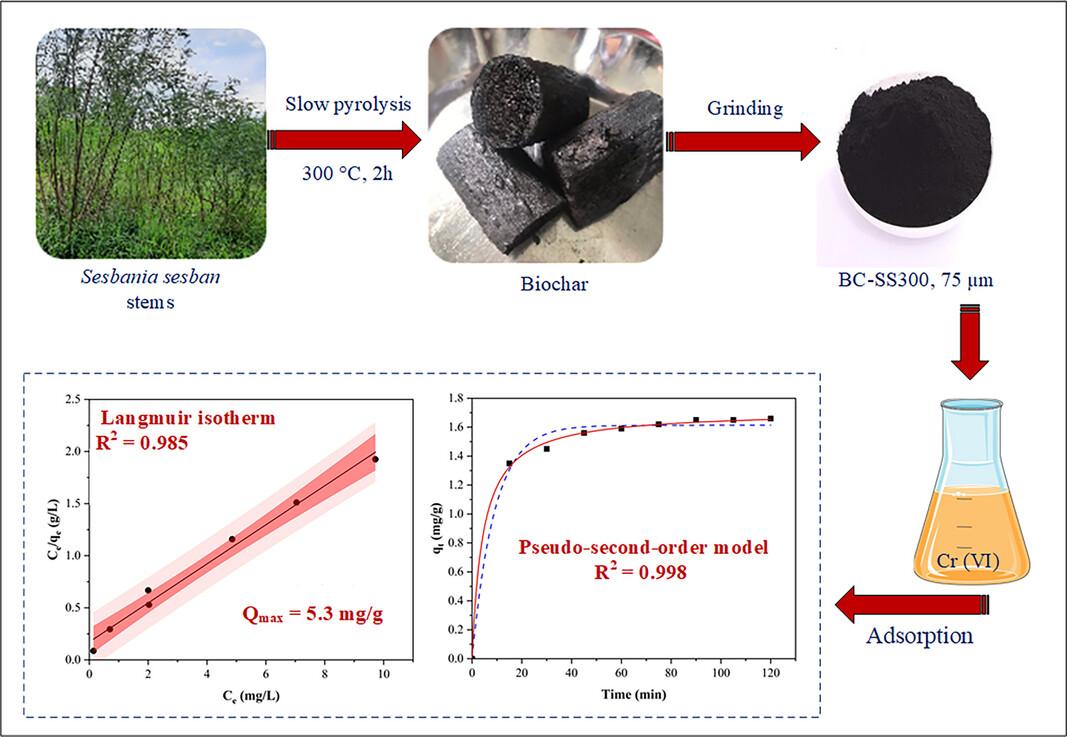
The present work is devoted to examining the potential of Sesbania sesban biochar produced through slow pyrolysis for 120 min at 300°C in removing hexavalent chromium from the aqueous phase. The physicochemical characteristics of biochar were analyzed utilizing a variety of analytical tools including SEM, BET, and FTIR. Results revealed that the biochar had a smooth surface, an even stacking pattern with a porous texture, a large BET surface area equal to 562 m2/g, and a pHpzc of 6.9. The biochar efficiency in eliminating Cr (VI) was investigated through several variables, including biochar dosage (0.1–0.4 g), pH (2–8), initial chromium ion concentration (10–40 mg/L), and adsorption time (15–120) min. The results identified the best conditions for adsorbing Cr (VI): an initial concentration of 10 mg/L, an absorbent dosage of 0.3 g, a pH solution of 2, and a reaction time of 90 min. The experiment achieved a Cr (VI) removal efficiency of over 90% by applying these conditions. The adsorption isotherm data were analyzed and showed a strong correlation coefficient (R2 = 0.985) for Langmuir monolayer model, in which the maximum adsorption capacity achieved was 5.3 mg/g. According to the kinetic investigation, the adsorption of Cr (VI) was adapted to a pseudo-second-order model having a high R2 value of 0.998. These results demonstrate that Sesbania sesban biochar has excellent potential as a cost-effective and highly efficient adsorbent for removing hexavalent chromium and improving water quality.
期刊介绍:
Four times a year, this practical journal shows you how to improve environmental performance and exceed voluntary standards such as ISO 14000. In each issue, you"ll find in-depth articles and the most current case studies of successful environmental quality improvement efforts -- and guidance on how you can apply these goals to your organization. Written by leading industry experts and practitioners, Environmental Quality Management brings you innovative practices in Performance Measurement...Life-Cycle Assessments...Safety Management... Environmental Auditing...ISO 14000 Standards and Certification..."Green Accounting"...Environmental Communication...Sustainable Development Issues...Environmental Benchmarking...Global Environmental Law and Regulation.




 京公网安备 11010802042870号
京ICP备2023020795号-1
京公网安备 11010802042870号
京ICP备2023020795号-1

 分享
分享
 求助内容:
求助内容: 应助结果提醒方式:
 扫码关注我们
