Zexun Cui, Pingping Zhang, Weixin Li, Pengyu Zhou, Yu Zhang, Bao Liu, Yuqiang Li
{"title":"Pressure Effect on Luminescence Characteristics and Energy Transfer in CsPbBr3/ZnS Nanocrystal Heterostructures","authors":"Zexun Cui, Pingping Zhang, Weixin Li, Pengyu Zhou, Yu Zhang, Bao Liu, Yuqiang Li","doi":"10.1021/acs.jpcc.4c06610","DOIUrl":null,"url":null,"abstract":"All-inorganic perovskite CsPbX<sub>3</sub> (X = Cl, Br, or I) and related materials have shown great potential for applications in solar cells, light-emitting diodes, and photodetectors. A kind of heterostructure was proposed comprising CsPbBr<sub>3</sub>/ZnS nanocrystals in order to enhance the luminescence properties of CsPbBr<sub>3</sub> nanocrystals. The incorporation of ZnS induces recombination at the interface, facilitating charge transfer and the formation of a type-II heterostructure. The luminescence characteristics of this heterostructure can be modulated by applying pressure. The photoluminescence intensity of the CsPbBr<sub>3</sub>/ZnS nanocrystals is significantly enhanced up to 0.29 GPa. With further pressure increase, these nanocrystals exhibit a red shift in emission wavelength, resulting in a high sensitivity (dλ/d<i>P</i>) of 9.59 nm GPa<sup>–1</sup> and an absolute sensitivity (dFWHM/d<i>P</i>) of 6.07 nm GPa<sup>–1</sup>. Photoluminescence quenching occurs until the completely undetectable emission at a pressure of 2.38 GPa. The observed anomalous enhancement and wavelength red shift indicate that pressure can promote the transition from free excitons to self-trapping excitons, leading to energy transfer between ZnS and CsPbBr<sub>3</sub>. This study enhances the understanding effect of high pressure on luminescent materials in heterostructures.","PeriodicalId":61,"journal":{"name":"The Journal of Physical Chemistry C","volume":"21 1","pages":""},"PeriodicalIF":3.2000,"publicationDate":"2024-11-15","publicationTypes":"Journal Article","fieldsOfStudy":null,"isOpenAccess":false,"openAccessPdf":"","citationCount":"0","resultStr":null,"platform":"Semanticscholar","paperid":null,"PeriodicalName":"The Journal of Physical Chemistry C","FirstCategoryId":"1","ListUrlMain":"https://doi.org/10.1021/acs.jpcc.4c06610","RegionNum":3,"RegionCategory":"化学","ArticlePicture":[],"TitleCN":null,"AbstractTextCN":null,"PMCID":null,"EPubDate":"","PubModel":"","JCR":"Q2","JCRName":"CHEMISTRY, PHYSICAL","Score":null,"Total":0}
引用次数: 0
Abstract
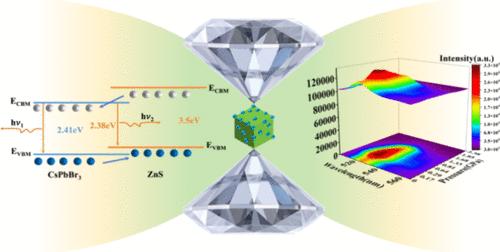
All-inorganic perovskite CsPbX3 (X = Cl, Br, or I) and related materials have shown great potential for applications in solar cells, light-emitting diodes, and photodetectors. A kind of heterostructure was proposed comprising CsPbBr3/ZnS nanocrystals in order to enhance the luminescence properties of CsPbBr3 nanocrystals. The incorporation of ZnS induces recombination at the interface, facilitating charge transfer and the formation of a type-II heterostructure. The luminescence characteristics of this heterostructure can be modulated by applying pressure. The photoluminescence intensity of the CsPbBr3/ZnS nanocrystals is significantly enhanced up to 0.29 GPa. With further pressure increase, these nanocrystals exhibit a red shift in emission wavelength, resulting in a high sensitivity (dλ/dP) of 9.59 nm GPa–1 and an absolute sensitivity (dFWHM/dP) of 6.07 nm GPa–1. Photoluminescence quenching occurs until the completely undetectable emission at a pressure of 2.38 GPa. The observed anomalous enhancement and wavelength red shift indicate that pressure can promote the transition from free excitons to self-trapping excitons, leading to energy transfer between ZnS and CsPbBr3. This study enhances the understanding effect of high pressure on luminescent materials in heterostructures.
期刊介绍:
The Journal of Physical Chemistry A/B/C is devoted to reporting new and original experimental and theoretical basic research of interest to physical chemists, biophysical chemists, and chemical physicists.



 京公网安备 11010802042870号
京ICP备2023020795号-1
京公网安备 11010802042870号
京ICP备2023020795号-1

 分享
分享
 求助内容:
求助内容: 应助结果提醒方式:
 扫码关注我们
