Factor analysis of the Gait Outcomes Assessment List's goal questions: A new method to measure goal prioritization in ambulatory individuals with cerebral palsy
{"title":"Factor analysis of the Gait Outcomes Assessment List's goal questions: A new method to measure goal prioritization in ambulatory individuals with cerebral palsy","authors":"","doi":"10.1111/dmcn.16191","DOIUrl":null,"url":null,"abstract":"<p>It is important to provide care that meets the goals of patients and their families. Physicians who treat children with special healthcare needs, such as cerebral palsy (CP), want better assessment tools to understand these goals. CP is a group of disorders that often includes difficulties in walking. This article used an existing questionnaire in a new way to better understand how individuals with CP prioritize their goals related to walking.</p><p>The study included a diverse group of 622 individuals with CP who had at least some ability to walk. Participants completed the Gait Outcomes Assessment List (GOAL), a questionnaire used to evaluate various aspects of walking in individuals with CP, including how important it is to improve each aspect (goal responses). The authors used a statistical method called factor analysis to analyze the goal responses of the GOAL questionnaire. Factor analysis helps identify patterns in data by grouping related questions together. The researchers found the goal responses could be grouped into eight distinct categories of walking-related to goals: (1) activities of daily living and independence; (2) gait, function, and mobility; (3) pain and discomfort; (4) fatigue; (5) physical activities, sports, and recreation; (6) gait pattern and appearance; (7) use of braces and mobility aids; and (8) body image and self-esteem.</p><p>The strength of goal importance varied across each category and differed across functional levels.</p>","PeriodicalId":50587,"journal":{"name":"Developmental Medicine and Child Neurology","volume":"67 2","pages":"e41"},"PeriodicalIF":4.3000,"publicationDate":"2024-11-16","publicationTypes":"Journal Article","fieldsOfStudy":null,"isOpenAccess":false,"openAccessPdf":"https://onlinelibrary.wiley.com/doi/epdf/10.1111/dmcn.16191","citationCount":"0","resultStr":null,"platform":"Semanticscholar","paperid":null,"PeriodicalName":"Developmental Medicine and Child Neurology","FirstCategoryId":"3","ListUrlMain":"https://onlinelibrary.wiley.com/doi/10.1111/dmcn.16191","RegionNum":2,"RegionCategory":"医学","ArticlePicture":[],"TitleCN":null,"AbstractTextCN":null,"PMCID":null,"EPubDate":"","PubModel":"","JCR":"Q1","JCRName":"CLINICAL NEUROLOGY","Score":null,"Total":0}
引用次数: 0
Abstract
It is important to provide care that meets the goals of patients and their families. Physicians who treat children with special healthcare needs, such as cerebral palsy (CP), want better assessment tools to understand these goals. CP is a group of disorders that often includes difficulties in walking. This article used an existing questionnaire in a new way to better understand how individuals with CP prioritize their goals related to walking.
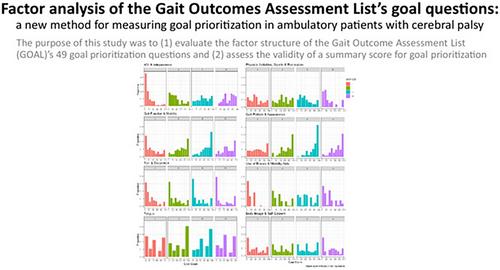
The study included a diverse group of 622 individuals with CP who had at least some ability to walk. Participants completed the Gait Outcomes Assessment List (GOAL), a questionnaire used to evaluate various aspects of walking in individuals with CP, including how important it is to improve each aspect (goal responses). The authors used a statistical method called factor analysis to analyze the goal responses of the GOAL questionnaire. Factor analysis helps identify patterns in data by grouping related questions together. The researchers found the goal responses could be grouped into eight distinct categories of walking-related to goals: (1) activities of daily living and independence; (2) gait, function, and mobility; (3) pain and discomfort; (4) fatigue; (5) physical activities, sports, and recreation; (6) gait pattern and appearance; (7) use of braces and mobility aids; and (8) body image and self-esteem.
The strength of goal importance varied across each category and differed across functional levels.
期刊介绍:
Wiley-Blackwell is pleased to publish Developmental Medicine & Child Neurology (DMCN), a Mac Keith Press publication and official journal of the American Academy for Cerebral Palsy and Developmental Medicine (AACPDM) and the British Paediatric Neurology Association (BPNA).
For over 50 years, DMCN has defined the field of paediatric neurology and neurodisability and is one of the world’s leading journals in the whole field of paediatrics. DMCN disseminates a range of information worldwide to improve the lives of disabled children and their families. The high quality of published articles is maintained by expert review, including independent statistical assessment, before acceptance.



 京公网安备 11010802042870号
京ICP备2023020795号-1
京公网安备 11010802042870号
京ICP备2023020795号-1

 分享
分享
 求助内容:
求助内容: 应助结果提醒方式:
 扫码关注我们
