Tamás László Nagy, Barbara Mikecs, Zsolt M Lohinai, János Vág
{"title":"Dose-related effect of acetylcholine on human gingival blood flow.","authors":"Tamás László Nagy, Barbara Mikecs, Zsolt M Lohinai, János Vág","doi":"10.1186/s12903-024-05169-7","DOIUrl":null,"url":null,"abstract":"<p><strong>Background: </strong>This study investigates the dose-response relationship of acetylcholine (ACh) on healthy human gingival blood flow (GBF). Understanding this dose-response relationship contributes to studying vasodilatory mechanisms in various pathological conditions.</p><p><strong>Methods: </strong>The study involved 22 young healthy men (21 - 32 years) to investigate the dose-response relationship of ACh on GBF. Semi-circular wells were created on the labial surface of the upper right second incisor (FDI #12) and upper left first incisor (FDI #21), including the gingival sulcus, for the application of drugs. ACh-chloride solutions at 0.1, 1, and 10 mg/mL were administered to the gingival sulcus of tooth FDI #12 with a Hamilton syringe. Physiological saline was applied on the contralateral side to FDI #21 as a control. The GBF was measured non-invasively by the laser speckle contrast imaging method in four 1mm high adjacent regions: coronal, midway1, midway2, and apical, and was expressed in a laser speckle perfusion unit (LSPU). After the baseline blood flow recording, ACh doses were applied sequentially, with washout periods in between. Data were statistically analyzed using a linear mixed model.</p><p><strong>Results: </strong>The GBF did not change on the saline site throughout the experiment. The GBF was significantly higher at the coronal region after all ACh doses (baseline: 218±31 LSPU, and 227±38 LSPU p < 0.05, 239±40 LSPU p < 0.001, 291±54 LSPU p < 0.001, respectively) compared to the saline. It was also elevated following 1 and 10 mg/mL at the midway1 (245±48 LSPU, p < 0.05, 293±65 LSPU p < 0.001). At midway2 and apical, only the 10 mg/mL dose was effective (285±71 LSPU, p < 0.001; 302±82 LSPU, p < 0.001).</p><p><strong>Conclusions: </strong>Our findings suggest a dose-dependent vasodilation to ACh, emphasizing its role in human gingival microcirculation. Only the 10 mg/mL ACh could evoke remote vasodilation 3 mm from the application. The described method could facilitate the investigation of endothelium-dependent vasodilation in disorders affecting microcirculation, such as periodontitis or diabetes.</p>","PeriodicalId":9072,"journal":{"name":"BMC Oral Health","volume":"24 1","pages":"1398"},"PeriodicalIF":3.1000,"publicationDate":"2024-11-17","publicationTypes":"Journal Article","fieldsOfStudy":null,"isOpenAccess":false,"openAccessPdf":"https://www.ncbi.nlm.nih.gov/pmc/articles/PMC11571918/pdf/","citationCount":"0","resultStr":null,"platform":"Semanticscholar","paperid":null,"PeriodicalName":"BMC Oral Health","FirstCategoryId":"3","ListUrlMain":"https://doi.org/10.1186/s12903-024-05169-7","RegionNum":2,"RegionCategory":"医学","ArticlePicture":[],"TitleCN":null,"AbstractTextCN":null,"PMCID":null,"EPubDate":"","PubModel":"","JCR":"Q1","JCRName":"DENTISTRY, ORAL SURGERY & MEDICINE","Score":null,"Total":0}
引用次数: 0
Abstract
Background: This study investigates the dose-response relationship of acetylcholine (ACh) on healthy human gingival blood flow (GBF). Understanding this dose-response relationship contributes to studying vasodilatory mechanisms in various pathological conditions.
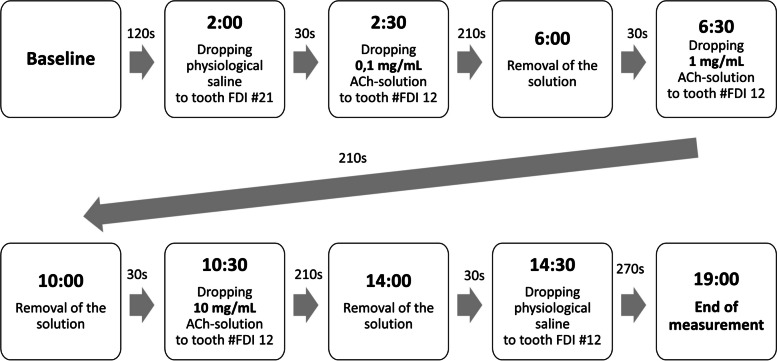
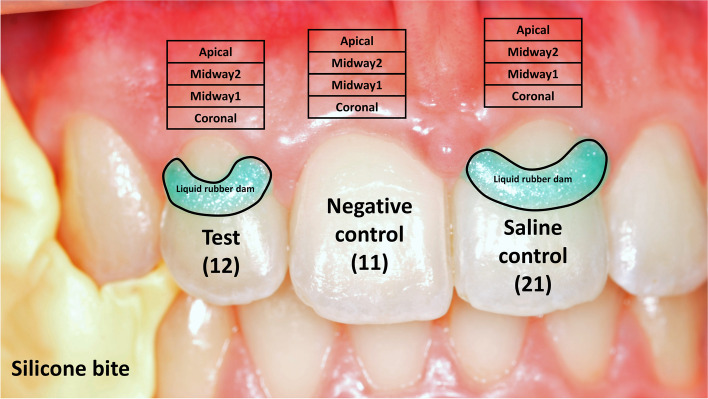
Methods: The study involved 22 young healthy men (21 - 32 years) to investigate the dose-response relationship of ACh on GBF. Semi-circular wells were created on the labial surface of the upper right second incisor (FDI #12) and upper left first incisor (FDI #21), including the gingival sulcus, for the application of drugs. ACh-chloride solutions at 0.1, 1, and 10 mg/mL were administered to the gingival sulcus of tooth FDI #12 with a Hamilton syringe. Physiological saline was applied on the contralateral side to FDI #21 as a control. The GBF was measured non-invasively by the laser speckle contrast imaging method in four 1mm high adjacent regions: coronal, midway1, midway2, and apical, and was expressed in a laser speckle perfusion unit (LSPU). After the baseline blood flow recording, ACh doses were applied sequentially, with washout periods in between. Data were statistically analyzed using a linear mixed model.
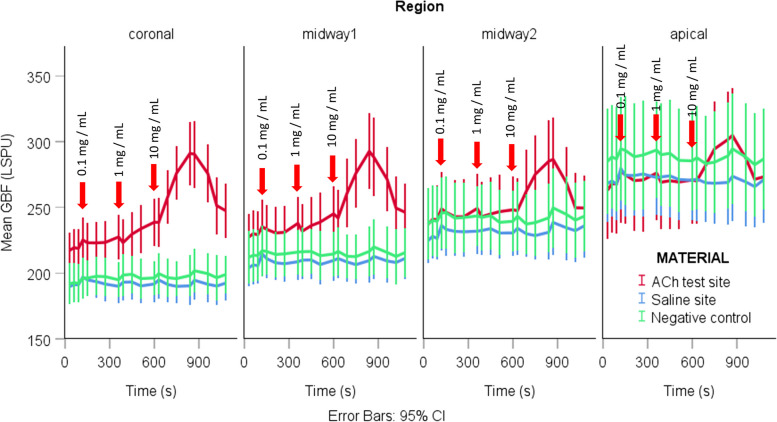
Results: The GBF did not change on the saline site throughout the experiment. The GBF was significantly higher at the coronal region after all ACh doses (baseline: 218±31 LSPU, and 227±38 LSPU p < 0.05, 239±40 LSPU p < 0.001, 291±54 LSPU p < 0.001, respectively) compared to the saline. It was also elevated following 1 and 10 mg/mL at the midway1 (245±48 LSPU, p < 0.05, 293±65 LSPU p < 0.001). At midway2 and apical, only the 10 mg/mL dose was effective (285±71 LSPU, p < 0.001; 302±82 LSPU, p < 0.001).
Conclusions: Our findings suggest a dose-dependent vasodilation to ACh, emphasizing its role in human gingival microcirculation. Only the 10 mg/mL ACh could evoke remote vasodilation 3 mm from the application. The described method could facilitate the investigation of endothelium-dependent vasodilation in disorders affecting microcirculation, such as periodontitis or diabetes.
期刊介绍:
BMC Oral Health is an open access, peer-reviewed journal that considers articles on all aspects of the prevention, diagnosis and management of disorders of the mouth, teeth and gums, as well as related molecular genetics, pathophysiology, and epidemiology.



 京公网安备 11010802042870号
京ICP备2023020795号-1
京公网安备 11010802042870号
京ICP备2023020795号-1

 分享
分享
 求助内容:
求助内容: 应助结果提醒方式:
 扫码关注我们
