Proton Relays in Molecular Catalysis for Hydrogen Evolution and Oxidation: Lessons From the Mimicry of Hydrogenases and Electrochemical Kinetic Analyses
Matthieu Haake, Dr. Bertrand Reuillard, Dr. Murielle Chavarot-Kerlidou, Prof. Cyrille Costentin, Dr. Vincent Artero
{"title":"Proton Relays in Molecular Catalysis for Hydrogen Evolution and Oxidation: Lessons From the Mimicry of Hydrogenases and Electrochemical Kinetic Analyses","authors":"Matthieu Haake, Dr. Bertrand Reuillard, Dr. Murielle Chavarot-Kerlidou, Prof. Cyrille Costentin, Dr. Vincent Artero","doi":"10.1002/anie.202413910","DOIUrl":null,"url":null,"abstract":"<p>The active sites of metalloenzymes involved in small molecules activation often contain pendant bases that act as proton relay promoting proton-coupled electron-transfer processes. Here we focus on hydrogenases and on the reactions they catalyze, i. e. the hydrogen evolution and oxidation reactions. After a short description of these enzymes, we review some of the various biomimetic and bioinspired molecular systems that contain proton relays. We then provide the formal electrochemical framework required to decipher the key role of such proton relay to enhance catalysis in a single direction and discuss the few systems active for H<sub>2</sub> evolution for which quantitative kinetic data are available. We finally highlight key parameters required to reach bidirectional catalysis (both hydrogen evolution and hydrogen oxidation catalyzed) and then transition to reversible catalysis (both reactions catalyzed in a narrow potential range) as well as illustrate these features on few systems from the literature.</p>","PeriodicalId":125,"journal":{"name":"Angewandte Chemie International Edition","volume":"63 52","pages":""},"PeriodicalIF":16.9000,"publicationDate":"2024-11-18","publicationTypes":"Journal Article","fieldsOfStudy":null,"isOpenAccess":false,"openAccessPdf":"https://onlinelibrary.wiley.com/doi/epdf/10.1002/anie.202413910","citationCount":"0","resultStr":null,"platform":"Semanticscholar","paperid":null,"PeriodicalName":"Angewandte Chemie International Edition","FirstCategoryId":"92","ListUrlMain":"https://onlinelibrary.wiley.com/doi/10.1002/anie.202413910","RegionNum":1,"RegionCategory":"化学","ArticlePicture":[],"TitleCN":null,"AbstractTextCN":null,"PMCID":null,"EPubDate":"","PubModel":"","JCR":"Q1","JCRName":"CHEMISTRY, MULTIDISCIPLINARY","Score":null,"Total":0}
引用次数: 0
Abstract
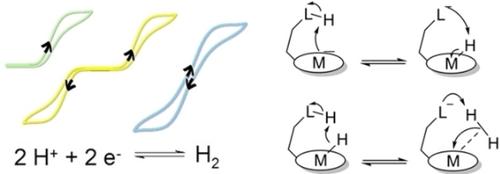
The active sites of metalloenzymes involved in small molecules activation often contain pendant bases that act as proton relay promoting proton-coupled electron-transfer processes. Here we focus on hydrogenases and on the reactions they catalyze, i. e. the hydrogen evolution and oxidation reactions. After a short description of these enzymes, we review some of the various biomimetic and bioinspired molecular systems that contain proton relays. We then provide the formal electrochemical framework required to decipher the key role of such proton relay to enhance catalysis in a single direction and discuss the few systems active for H2 evolution for which quantitative kinetic data are available. We finally highlight key parameters required to reach bidirectional catalysis (both hydrogen evolution and hydrogen oxidation catalyzed) and then transition to reversible catalysis (both reactions catalyzed in a narrow potential range) as well as illustrate these features on few systems from the literature.
期刊介绍:
Angewandte Chemie, a journal of the German Chemical Society (GDCh), maintains a leading position among scholarly journals in general chemistry with an impressive Impact Factor of 16.6 (2022 Journal Citation Reports, Clarivate, 2023). Published weekly in a reader-friendly format, it features new articles almost every day. Established in 1887, Angewandte Chemie is a prominent chemistry journal, offering a dynamic blend of Review-type articles, Highlights, Communications, and Research Articles on a weekly basis, making it unique in the field.




 京公网安备 11010802042870号
京ICP备2023020795号-1
京公网安备 11010802042870号
京ICP备2023020795号-1

 分享
分享
 求助内容:
求助内容: 应助结果提醒方式:
 扫码关注我们
