{"title":"Alterations to the Kinetic Chain Sequence After a Shoulder Injury in Throwing Athletes.","authors":"Liam P Owens, Ginny Coyles, Omid Khaiyat","doi":"10.1177/23259671241288889","DOIUrl":null,"url":null,"abstract":"<p><strong>Background: </strong>Kinetic chain (KC) sequencing is essential for efficient energy translation through the body in overhead-throwing sports. A sequencing breakdown can result in injuries to the throwing shoulder and thus the management of athlete recovery in an attempt to minimize the impact on both training and performance.</p><p><strong>Purpose: </strong>To determine kinematic differences in KC sequencing, imperative for the prevention and rehabilitation of a shoulder injury, during maximal throwing in overhead athletes with and without a shoulder injury.</p><p><strong>Study design: </strong>Controlled laboratory study.</p><p><strong>Methods: </strong>Kinematic data were collected and analyzed for 36 male overhead athletes with (symptomatic) and without (asymptomatic) a shoulder injury (18 participants per group) during maximal overhead-throwing trials using 3-dimensional motion analysis (100 Hz). Peak angular velocities and associated timing of the throwing shoulder, throwing elbow, thorax, pelvis, lead hip, and rear hip were calculated to determine the KC sequence in both groups. Kinematic data were compared using independent <i>t</i> tests, and relationships between variables were assessed using the Pearson correlation coefficient (both <i>P</i> < .05).</p><p><strong>Results: </strong>The KC sequence in overhead athletes with or without a shoulder injury was the same, except for peak elbow extension and shoulder flexion angular velocities. These angular velocities occurred simultaneously in asymptomatic throwers (both 0.17 % before ball release [BR]) but sequentially in symptomatic throwers (0.06 % before BR and 0.67 % after BR, respectively). No differences were evident in stride length (m) or resultant ball velocity (m/s) between the groups, despite differences in key joint angular velocities across KC segments (<i>P</i> range, <.001-.035). Relationships between resultant ball velocity and all key joint angular velocities were evident for symptomatic but not asymptomatic throwers (<i>P</i> range, <.001-.026).</p><p><strong>Conclusion: </strong>Our study demonstrated that overhead athletes, regardless of their shoulder injury history, had similar KC sequencing across the lower limb and lumbopelvic-hip complex segments before differences in the timing of peak elbow extension and shoulder flexion angular velocities of the throwing arm approaching BR. Further research investigating muscle activity changes and technique parameters during overhead throwing may present explanations as to how we can ensure that the KC sequence is not altered as a result of an injury.</p><p><strong>Clinical relevance: </strong>This study provides a new perspective on the KC and how an injury may not change the sequence itself in overhead-throwing performance.</p>","PeriodicalId":19646,"journal":{"name":"Orthopaedic Journal of Sports Medicine","volume":"12 11","pages":"23259671241288889"},"PeriodicalIF":2.5000,"publicationDate":"2024-11-14","publicationTypes":"Journal Article","fieldsOfStudy":null,"isOpenAccess":false,"openAccessPdf":"https://www.ncbi.nlm.nih.gov/pmc/articles/PMC11565691/pdf/","citationCount":"0","resultStr":null,"platform":"Semanticscholar","paperid":null,"PeriodicalName":"Orthopaedic Journal of Sports Medicine","FirstCategoryId":"3","ListUrlMain":"https://doi.org/10.1177/23259671241288889","RegionNum":3,"RegionCategory":"医学","ArticlePicture":[],"TitleCN":null,"AbstractTextCN":null,"PMCID":null,"EPubDate":"2024/11/1 0:00:00","PubModel":"eCollection","JCR":"Q2","JCRName":"ORTHOPEDICS","Score":null,"Total":0}
引用次数: 0
Abstract
Background: Kinetic chain (KC) sequencing is essential for efficient energy translation through the body in overhead-throwing sports. A sequencing breakdown can result in injuries to the throwing shoulder and thus the management of athlete recovery in an attempt to minimize the impact on both training and performance.
Purpose: To determine kinematic differences in KC sequencing, imperative for the prevention and rehabilitation of a shoulder injury, during maximal throwing in overhead athletes with and without a shoulder injury.
Study design: Controlled laboratory study.
Methods: Kinematic data were collected and analyzed for 36 male overhead athletes with (symptomatic) and without (asymptomatic) a shoulder injury (18 participants per group) during maximal overhead-throwing trials using 3-dimensional motion analysis (100 Hz). Peak angular velocities and associated timing of the throwing shoulder, throwing elbow, thorax, pelvis, lead hip, and rear hip were calculated to determine the KC sequence in both groups. Kinematic data were compared using independent t tests, and relationships between variables were assessed using the Pearson correlation coefficient (both P < .05).
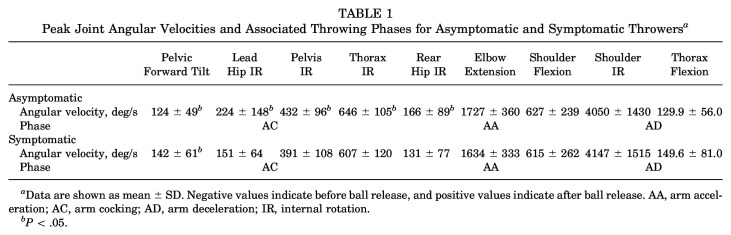
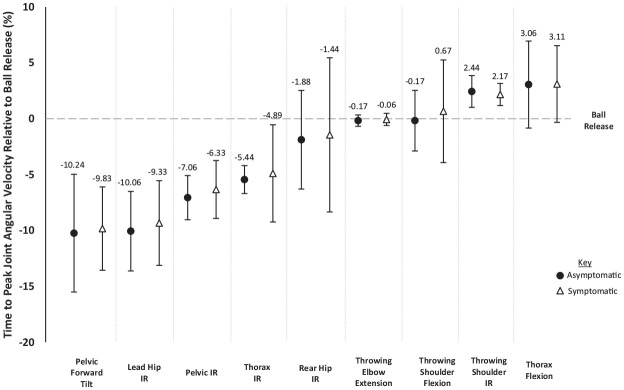
Results: The KC sequence in overhead athletes with or without a shoulder injury was the same, except for peak elbow extension and shoulder flexion angular velocities. These angular velocities occurred simultaneously in asymptomatic throwers (both 0.17 % before ball release [BR]) but sequentially in symptomatic throwers (0.06 % before BR and 0.67 % after BR, respectively). No differences were evident in stride length (m) or resultant ball velocity (m/s) between the groups, despite differences in key joint angular velocities across KC segments (P range, <.001-.035). Relationships between resultant ball velocity and all key joint angular velocities were evident for symptomatic but not asymptomatic throwers (P range, <.001-.026).
Conclusion: Our study demonstrated that overhead athletes, regardless of their shoulder injury history, had similar KC sequencing across the lower limb and lumbopelvic-hip complex segments before differences in the timing of peak elbow extension and shoulder flexion angular velocities of the throwing arm approaching BR. Further research investigating muscle activity changes and technique parameters during overhead throwing may present explanations as to how we can ensure that the KC sequence is not altered as a result of an injury.
Clinical relevance: This study provides a new perspective on the KC and how an injury may not change the sequence itself in overhead-throwing performance.
期刊介绍:
The Orthopaedic Journal of Sports Medicine (OJSM), developed by the American Orthopaedic Society for Sports Medicine (AOSSM), is a global, peer-reviewed, open access journal that combines the interests of researchers and clinical practitioners across orthopaedic sports medicine, arthroscopy, and knee arthroplasty.
Topics include original research in the areas of:
-Orthopaedic Sports Medicine, including surgical and nonsurgical treatment of orthopaedic sports injuries
-Arthroscopic Surgery (Shoulder/Elbow/Wrist/Hip/Knee/Ankle/Foot)
-Relevant translational research
-Sports traumatology/epidemiology
-Knee and shoulder arthroplasty
The OJSM also publishes relevant systematic reviews and meta-analyses.
This journal is a member of the Committee on Publication Ethics (COPE).



 京公网安备 11010802042870号
京ICP备2023020795号-1
京公网安备 11010802042870号
京ICP备2023020795号-1

 分享
分享
 求助内容:
求助内容: 应助结果提醒方式:
 扫码关注我们
