{"title":"Machine learning framework for selective and sensitive metal ion sensing with nitrogen-doped graphene quantum dots heterostructure","authors":"Ruma Das , Abhirup Paria , P.K. Giri","doi":"10.1016/j.carbon.2024.119800","DOIUrl":null,"url":null,"abstract":"<div><div>This study introduces a machine learning (ML) framework to optimize photodetector performance for sensor applications. Using the data from the fabricated photodetector with the heterostructure of nitrogen-doped graphene quantum dot and gold nanoparticles (Au@N-GQDs), various supervised ML models (more than 20 models) are trained and tested for the selection and refinement of the most effective algorithm for our work. Depending on the best-performed ML model, the optimized working wavelength of the photodetector is found for the detection of metal ions. Remarkably, the ML-based sensor shows a high level of selectivity and sensitivity in nM level towards Fe<sup>3+</sup> ions in Brahmaputra river water. A strong alignment between model predictions and experimental outcomes validates the efficacy of the proposed ML-based framework. Moreover, data visualization techniques such as heatmaps, classification algorithms, and confusion matrices are introduced to identify the trends in the database. The mechanistic insight of the sensor performance towards Fe<sup>3+</sup> ion sensing is further explained with heatmap analysis and experimental verification, which emphasizes the role of photo-induced charge transfer and Fe–O bond formation between metal ions and Au@N-GQDs due to the high electron affinity of Fe<sup>3+</sup> ions.</div></div>","PeriodicalId":262,"journal":{"name":"Carbon","volume":"232 ","pages":"Article 119800"},"PeriodicalIF":11.6000,"publicationDate":"2024-11-05","publicationTypes":"Journal Article","fieldsOfStudy":null,"isOpenAccess":false,"openAccessPdf":"","citationCount":"0","resultStr":null,"platform":"Semanticscholar","paperid":null,"PeriodicalName":"Carbon","FirstCategoryId":"88","ListUrlMain":"https://www.sciencedirect.com/science/article/pii/S0008622324010194","RegionNum":2,"RegionCategory":"材料科学","ArticlePicture":[],"TitleCN":null,"AbstractTextCN":null,"PMCID":null,"EPubDate":"","PubModel":"","JCR":"Q1","JCRName":"CHEMISTRY, PHYSICAL","Score":null,"Total":0}
引用次数: 0
Abstract
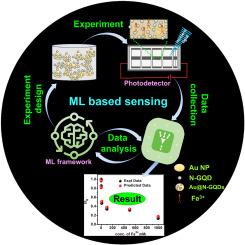
This study introduces a machine learning (ML) framework to optimize photodetector performance for sensor applications. Using the data from the fabricated photodetector with the heterostructure of nitrogen-doped graphene quantum dot and gold nanoparticles (Au@N-GQDs), various supervised ML models (more than 20 models) are trained and tested for the selection and refinement of the most effective algorithm for our work. Depending on the best-performed ML model, the optimized working wavelength of the photodetector is found for the detection of metal ions. Remarkably, the ML-based sensor shows a high level of selectivity and sensitivity in nM level towards Fe3+ ions in Brahmaputra river water. A strong alignment between model predictions and experimental outcomes validates the efficacy of the proposed ML-based framework. Moreover, data visualization techniques such as heatmaps, classification algorithms, and confusion matrices are introduced to identify the trends in the database. The mechanistic insight of the sensor performance towards Fe3+ ion sensing is further explained with heatmap analysis and experimental verification, which emphasizes the role of photo-induced charge transfer and Fe–O bond formation between metal ions and Au@N-GQDs due to the high electron affinity of Fe3+ ions.
期刊介绍:
The journal Carbon is an international multidisciplinary forum for communicating scientific advances in the field of carbon materials. It reports new findings related to the formation, structure, properties, behaviors, and technological applications of carbons. Carbons are a broad class of ordered or disordered solid phases composed primarily of elemental carbon, including but not limited to carbon black, carbon fibers and filaments, carbon nanotubes, diamond and diamond-like carbon, fullerenes, glassy carbon, graphite, graphene, graphene-oxide, porous carbons, pyrolytic carbon, and other sp2 and non-sp2 hybridized carbon systems. Carbon is the companion title to the open access journal Carbon Trends. Relevant application areas for carbon materials include biology and medicine, catalysis, electronic, optoelectronic, spintronic, high-frequency, and photonic devices, energy storage and conversion systems, environmental applications and water treatment, smart materials and systems, and structural and thermal applications.



 京公网安备 11010802042870号
京ICP备2023020795号-1
京公网安备 11010802042870号
京ICP备2023020795号-1

 分享
分享
 求助内容:
求助内容: 应助结果提醒方式:
 扫码关注我们
