Direct graphene growth on low-alloy and mild steel surfaces controlled by carbon solubility and surface microstructural transformations during chemical vapor deposition
Kaleb Hood, Nam Nguyen, Sebastian Lara, Adan Velasquez, Samuel Olson, Yi Xia, Jun Jiao
{"title":"Direct graphene growth on low-alloy and mild steel surfaces controlled by carbon solubility and surface microstructural transformations during chemical vapor deposition","authors":"Kaleb Hood, Nam Nguyen, Sebastian Lara, Adan Velasquez, Samuel Olson, Yi Xia, Jun Jiao","doi":"10.1016/j.carbon.2024.119801","DOIUrl":null,"url":null,"abstract":"<div><div>This study demonstrates for the first time, graphene grown directly on the iron-rich surfaces of bulk 8620 low-alloy and 1018 mild steel by chemical vapor deposition, a key step toward developing thin graphene coatings with strong graphene-steel bonding. Low growth temperatures of 660 °C–680 °C, were used to manipulate the steel's carbon solubility, confining carbon diffusion and microstructural transformations to the surface regions, with the bulk relatively unchanged. For 1018, a growth temperature of 680 °C resulted in a multilayer graphene coating with 80 % coverage. The alloying elements in 8620 improved graphene formation by influencing the surface microstructure transformations at these growth temperatures, with graphene coverage up to 95 %. The surface microstructure for 8620 affected graphene formation, seen in growths at 660 °C where a few-layer graphene coating formed from a cementite surface layer, and for growths at 680 °C where multi-layer graphene covered a pearlite dominant surface microstructure. Contact angle measurements confirmed the hydrophobicity of the graphene coating and electrochemical testing by potentiodynamic polarization and electrochemical impedance spectroscopy confirmed the 101 mV improvement to corrosion potential and an increase in impedance up to 18.23 kΩ. These detailed results regarding the direct growth of graphene as a coating layer on highly oxidation-sensitive steel surfaces suggest that this process is achievable through manipulating carbon solubility at the steel's surface by controlling temperature, alloy composition and surface microstructure transformations. These methods could be leveraged in developing protective graphene coatings for various iron-based alloys.</div></div>","PeriodicalId":262,"journal":{"name":"Carbon","volume":"232 ","pages":"Article 119801"},"PeriodicalIF":11.6000,"publicationDate":"2024-11-05","publicationTypes":"Journal Article","fieldsOfStudy":null,"isOpenAccess":false,"openAccessPdf":"","citationCount":"0","resultStr":null,"platform":"Semanticscholar","paperid":null,"PeriodicalName":"Carbon","FirstCategoryId":"88","ListUrlMain":"https://www.sciencedirect.com/science/article/pii/S0008622324010200","RegionNum":2,"RegionCategory":"材料科学","ArticlePicture":[],"TitleCN":null,"AbstractTextCN":null,"PMCID":null,"EPubDate":"","PubModel":"","JCR":"Q1","JCRName":"CHEMISTRY, PHYSICAL","Score":null,"Total":0}
引用次数: 0
Abstract
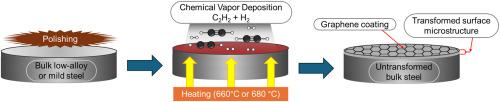
This study demonstrates for the first time, graphene grown directly on the iron-rich surfaces of bulk 8620 low-alloy and 1018 mild steel by chemical vapor deposition, a key step toward developing thin graphene coatings with strong graphene-steel bonding. Low growth temperatures of 660 °C–680 °C, were used to manipulate the steel's carbon solubility, confining carbon diffusion and microstructural transformations to the surface regions, with the bulk relatively unchanged. For 1018, a growth temperature of 680 °C resulted in a multilayer graphene coating with 80 % coverage. The alloying elements in 8620 improved graphene formation by influencing the surface microstructure transformations at these growth temperatures, with graphene coverage up to 95 %. The surface microstructure for 8620 affected graphene formation, seen in growths at 660 °C where a few-layer graphene coating formed from a cementite surface layer, and for growths at 680 °C where multi-layer graphene covered a pearlite dominant surface microstructure. Contact angle measurements confirmed the hydrophobicity of the graphene coating and electrochemical testing by potentiodynamic polarization and electrochemical impedance spectroscopy confirmed the 101 mV improvement to corrosion potential and an increase in impedance up to 18.23 kΩ. These detailed results regarding the direct growth of graphene as a coating layer on highly oxidation-sensitive steel surfaces suggest that this process is achievable through manipulating carbon solubility at the steel's surface by controlling temperature, alloy composition and surface microstructure transformations. These methods could be leveraged in developing protective graphene coatings for various iron-based alloys.
期刊介绍:
The journal Carbon is an international multidisciplinary forum for communicating scientific advances in the field of carbon materials. It reports new findings related to the formation, structure, properties, behaviors, and technological applications of carbons. Carbons are a broad class of ordered or disordered solid phases composed primarily of elemental carbon, including but not limited to carbon black, carbon fibers and filaments, carbon nanotubes, diamond and diamond-like carbon, fullerenes, glassy carbon, graphite, graphene, graphene-oxide, porous carbons, pyrolytic carbon, and other sp2 and non-sp2 hybridized carbon systems. Carbon is the companion title to the open access journal Carbon Trends. Relevant application areas for carbon materials include biology and medicine, catalysis, electronic, optoelectronic, spintronic, high-frequency, and photonic devices, energy storage and conversion systems, environmental applications and water treatment, smart materials and systems, and structural and thermal applications.



 京公网安备 11010802042870号
京ICP备2023020795号-1
京公网安备 11010802042870号
京ICP备2023020795号-1

 分享
分享
 求助内容:
求助内容: 应助结果提醒方式:
 扫码关注我们
