Leslie R. Sigmon , Jonathan Catazaro , Mohammed Abdel-Rahman , Casey Smith , Carsten Prasse , D. Howard Fairbrother
{"title":"Interrogating the photoluminescent properties of carbon dots using quantitative 13C NMR combined with systematic photobleaching","authors":"Leslie R. Sigmon , Jonathan Catazaro , Mohammed Abdel-Rahman , Casey Smith , Carsten Prasse , D. Howard Fairbrother","doi":"10.1016/j.carbon.2024.119796","DOIUrl":null,"url":null,"abstract":"<div><div>In this work, molecular-level events accompanying the photobleaching of carbon dots (CDs) synthesized from ethylenediamine and citric acid (CACDs) were identified using solution-phase NMR. By combining quantitative <sup>13</sup>C NMR data with fluorescence measurements we show that this new approach is capable of identifying not only molecular fluorophores in CACDs, but also their contribution to the overall CACD fluorescence and their relative photostability. Specifically, imidazo[1,2-a]pyridine-7-carboxylic acid (IPCA) is found to be the dominant (84 %) species responsible for fluorescence in CACDs along with a second undetermined source, most likely associated with the aromatic core which is significantly (approximately 20 times) more photostable than IPCA. The presence of these two fluorescent species with different photostabilities rationalizes not only the photobleaching kinetics but also the evolution of the fluorescence spectrum during photobleaching Diffusion-ordered spectroscopy (DOSY) also reveals that all of the IPCA molecules are trapped within or covalently bound to the CACD, but are not present as isolated molecules freely rotating in solution. Singlet oxygen is confirmed as a key ROS responsible for photobleaching, with prototypical photoproducts identified from mass spectrometry studies of citrazinic acid. Quantitative <sup>13</sup>C NMR of CACDs is possible because their extremely high colloidal stability enables high concentrations (667 mg/mL) to remain stable in solution. The approach described in this study could be extended to identify the structure of chromophores in other CDs and interrogate molecular level processes that accompany CD sensing.</div></div>","PeriodicalId":262,"journal":{"name":"Carbon","volume":"232 ","pages":"Article 119796"},"PeriodicalIF":11.6000,"publicationDate":"2024-11-02","publicationTypes":"Journal Article","fieldsOfStudy":null,"isOpenAccess":false,"openAccessPdf":"","citationCount":"0","resultStr":null,"platform":"Semanticscholar","paperid":null,"PeriodicalName":"Carbon","FirstCategoryId":"88","ListUrlMain":"https://www.sciencedirect.com/science/article/pii/S0008622324010157","RegionNum":2,"RegionCategory":"材料科学","ArticlePicture":[],"TitleCN":null,"AbstractTextCN":null,"PMCID":null,"EPubDate":"","PubModel":"","JCR":"Q1","JCRName":"CHEMISTRY, PHYSICAL","Score":null,"Total":0}
引用次数: 0
Abstract
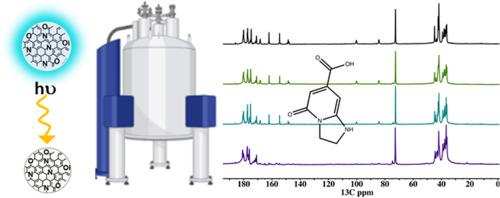
In this work, molecular-level events accompanying the photobleaching of carbon dots (CDs) synthesized from ethylenediamine and citric acid (CACDs) were identified using solution-phase NMR. By combining quantitative 13C NMR data with fluorescence measurements we show that this new approach is capable of identifying not only molecular fluorophores in CACDs, but also their contribution to the overall CACD fluorescence and their relative photostability. Specifically, imidazo[1,2-a]pyridine-7-carboxylic acid (IPCA) is found to be the dominant (84 %) species responsible for fluorescence in CACDs along with a second undetermined source, most likely associated with the aromatic core which is significantly (approximately 20 times) more photostable than IPCA. The presence of these two fluorescent species with different photostabilities rationalizes not only the photobleaching kinetics but also the evolution of the fluorescence spectrum during photobleaching Diffusion-ordered spectroscopy (DOSY) also reveals that all of the IPCA molecules are trapped within or covalently bound to the CACD, but are not present as isolated molecules freely rotating in solution. Singlet oxygen is confirmed as a key ROS responsible for photobleaching, with prototypical photoproducts identified from mass spectrometry studies of citrazinic acid. Quantitative 13C NMR of CACDs is possible because their extremely high colloidal stability enables high concentrations (667 mg/mL) to remain stable in solution. The approach described in this study could be extended to identify the structure of chromophores in other CDs and interrogate molecular level processes that accompany CD sensing.
期刊介绍:
The journal Carbon is an international multidisciplinary forum for communicating scientific advances in the field of carbon materials. It reports new findings related to the formation, structure, properties, behaviors, and technological applications of carbons. Carbons are a broad class of ordered or disordered solid phases composed primarily of elemental carbon, including but not limited to carbon black, carbon fibers and filaments, carbon nanotubes, diamond and diamond-like carbon, fullerenes, glassy carbon, graphite, graphene, graphene-oxide, porous carbons, pyrolytic carbon, and other sp2 and non-sp2 hybridized carbon systems. Carbon is the companion title to the open access journal Carbon Trends. Relevant application areas for carbon materials include biology and medicine, catalysis, electronic, optoelectronic, spintronic, high-frequency, and photonic devices, energy storage and conversion systems, environmental applications and water treatment, smart materials and systems, and structural and thermal applications.




 京公网安备 11010802042870号
京ICP备2023020795号-1
京公网安备 11010802042870号
京ICP备2023020795号-1

 分享
分享
 求助内容:
求助内容: 应助结果提醒方式:
 扫码关注我们
